


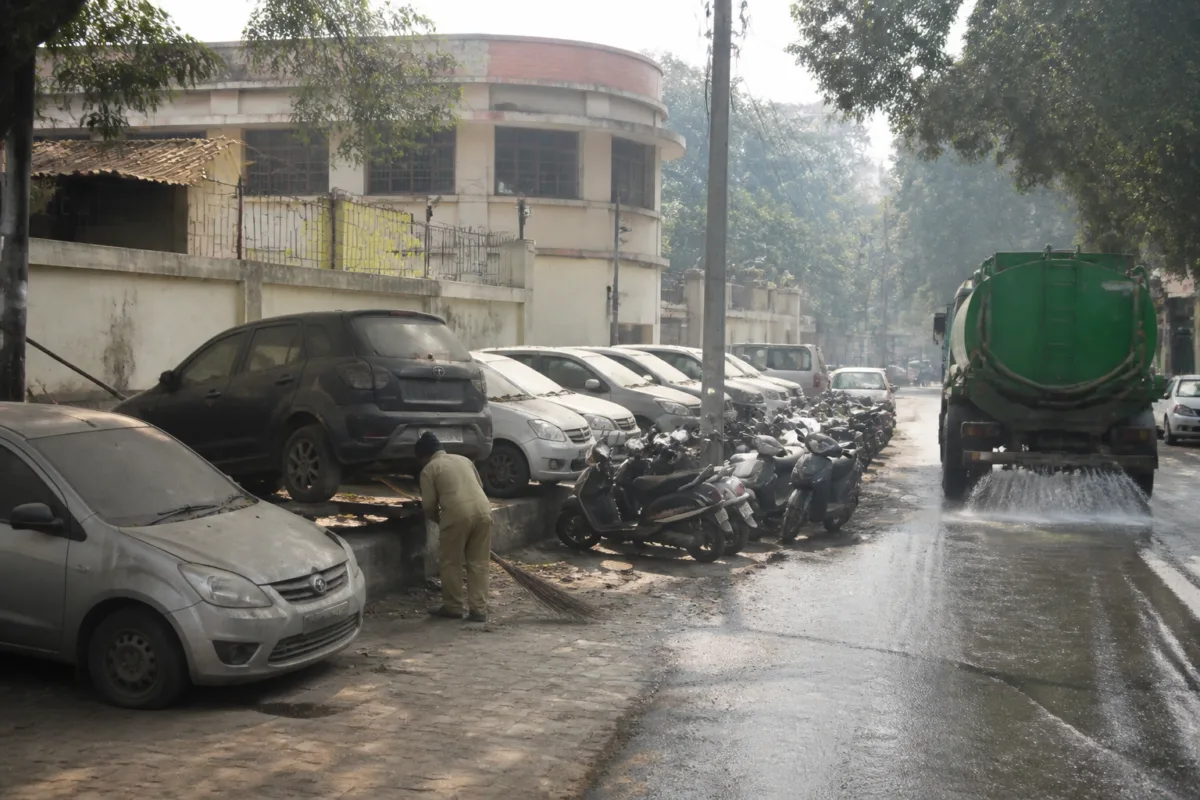
Delhi Chief Minister Rekha Gupta has directed the police commissioner to review vehicles seized or held as case property outside police stations, and to speed up disposal where legal procedures have been completed, according to an official statement reported by Navbharat Times.
The direction followed concerns that vehicles parked for long periods near police stations accumulate dust and waste, while the areas beneath them are difficult to clean. The chief minister also asked departments to prepare a policy for shifting vehicles that still need to be retained as case property to designated locations away from police-station premises.
The issue was discussed at a meeting chaired by Gupta on traffic congestion and pollution-control measures in Delhi. The official statement said improvement work had been completed at 43 of 62 identified traffic-jam locations, reducing congestion at those sites by 54% compared with the previous year. The work covered 42 corridors, 250 points and 353 interventions.
The government has also set a target of making 18 corridors signal-free. Work on eight of them has been completed, the statement said. The report did not provide details of the remaining corridors or their completion schedules.
The meeting also reviewed road maintenance and dust control. Gupta expressed concern about roads being left damaged for extended periods after utility excavation and directed the department or agency carrying out the excavation to restore the road after completing its work. The Municipal Corporation of Delhi and the Public Works Department were instructed to accelerate cleaning of major roads, footpaths and central verges, using mechanised sweeping, water sprinkling and road washing.
The statement said Delhi currently has 108 large and medium mechanised road-sweeping machines against a requirement of 171. The municipal corporation is deploying 70 additional machines, while 1,000-litre-capacity picker machines are being procured. Of these, 600 are expected to be available by December 2026 and the remainder by January 2027.
The number of anti-smog guns increased from 376 last year to 437, while water sprinklers rose from 271 to 296, according to the statement. These measures are part of the city’s wider response to road dust and construction-related pollution, but the figures also indicate a continuing gap between available and stated equipment requirements.
Construction and demolition sites were another focus of the review. Between 1 and 17 November, authorities inspected 8,874 sites and found violations at 554, the statement said. Officials directed the closure of 112 sites, issued 462 show-cause notices and imposed environmental compensation exceeding Rs 2.65 crore. The inspections covered 2,118 sites measuring 500 square metres or more and 6,756 smaller sites.
The statement also reported that 68,137 complaints concerning roads, unpaved sections and potholes within three kilometres of pollution hotspots had been received across agencies, of which 61,507 had been resolved. Thirteen district nodal officers carried out 41 inspections between 2 and 17 November, while municipal zonal deputy commissioners conducted 134 inspections covering 301 locations between 2 and 16 November.
Vehicle-emissions enforcement formed another part of the meeting. Between 1 and 17 November, challans were issued to 25,610 vehicles without valid pollution-under-control certificates. Officials inspected 181,548 non-CNG vehicles registered outside Delhi that were below Bharat Stage VI standards. Of these, 30,742 were turned back at the capital’s boundary, 2,817 were fined and 189 were seized. The action generated fines exceeding Rs 5.42 crore, according to the official statement.
From January to 16 November, authorities seized 41,659 older polluting vehicles and sent 64,800 vehicles for scrapping, the statement said. Automatic number-plate recognition cameras identified 7,055 Bharat Stage III and older vehicles over the preceding 12 months.
The review links several sources of urban pollution—road dust, construction activity, vehicle emissions and poorly managed seized vehicles—to separate administrative responses. Its effectiveness will depend on whether departments can maintain cleaned roads, complete restoration after excavation, provide designated storage for case-property vehicles and dispose of eligible vehicles within the legal process. The statement did not specify a common implementation deadline or identify the designated storage locations.

