


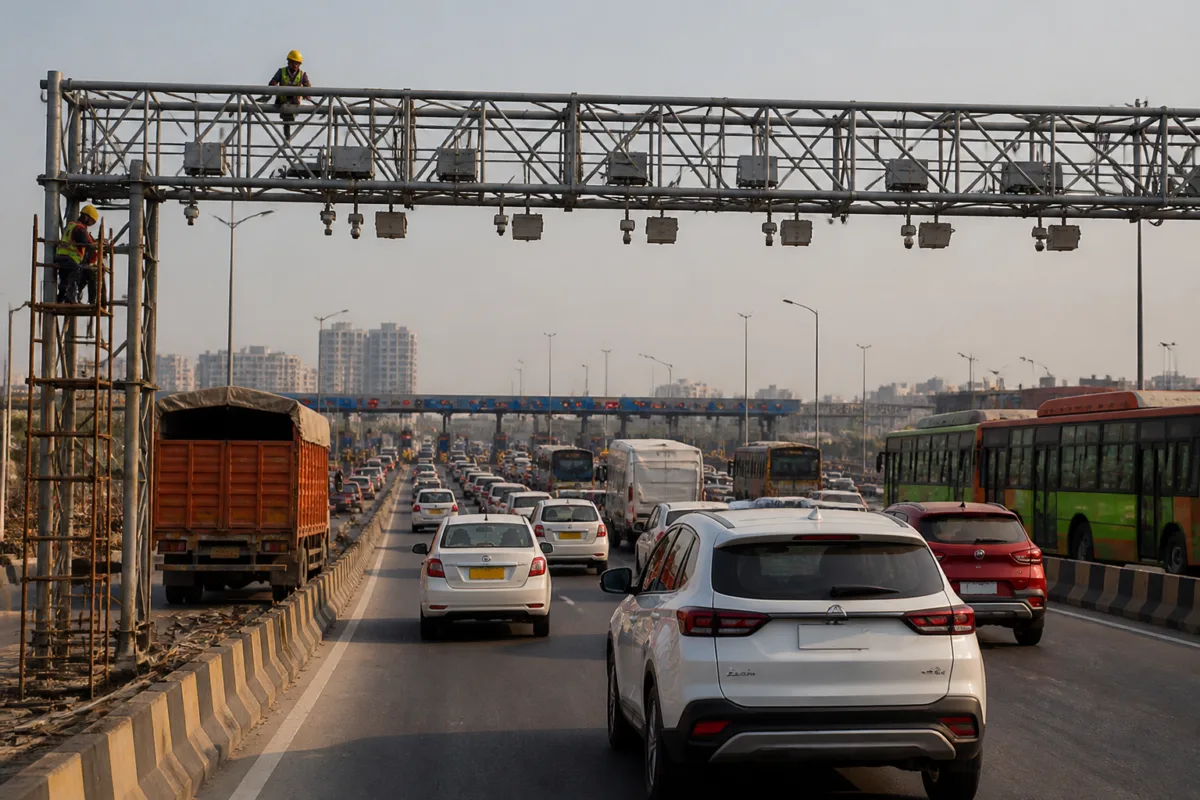
Delhi’s municipal corporation is racing to make a multi-lane free-flow tolling system operational at 20 major entry points by October 31, a move intended to reduce queues, vehicle idling and pollution at the city’s border toll plazas. The system will use RFID readers and automatic number plate recognition cameras to collect tolls and environment compensation charges without stopping vehicles at barriers.
The Municipal Corporation of Delhi has already installed overhead gantries at the selected locations, while control systems and other equipment are expected to be installed within days, according to a report by The Times of India. The MCD is planning a trial run at all 20 locations next week.
The rollout follows a Supreme Court directive concerning congestion around Delhi’s border toll plazas. In December 2025, the court had raised concerns over severe traffic snarls and questioned whether toll collection could be temporarily suspended or shifted to ease congestion. The National Highways Authority of India told the court that long queues and idling vehicles at nine MCD border toll booths were contributing significantly to winter air pollution.
The first phase covers 20 of Delhi’s 154 toll points. These locations account for nearly 85% of the traffic entering the city and include Ghazipur, Rajokri, Badarpur, Dwarka, Aya Nagar and the Delhi-Gurgaon corridor. MCD plans to cover the remaining toll plazas by the end of December.
The urgency of the project is visible at some of the busiest entry points. The Times of India reported witnessing traffic jams at the Ghazipur toll plaza on both the Delhi-Meerut Expressway and its side carriageway over three consecutive days, including during afternoon hours. Gantries had been installed at the two Ghazipur locations, but the full tolling system was not yet operational.
Under the system, vehicles fitted with RFID tags will be charged as they pass under overhead gantries. High-definition ANPR cameras will record registration numbers and verify vehicles that do not complete payment through the RFID system. Digital notices will be generated when a vehicle’s passage is recorded but the applicable toll or environment compensation charge remains unpaid.
Each entry point will have RFID readers and antennas, ANPR cameras, surveillance cameras and infrared illumination units, the MCD said. Two gantries—one primary and one backup—are being installed in each direction about 200 metres before the existing toll plazas to support continuous operations.
The project’s work order was issued in June after anticipatory approval, but permission from the NHAI to implement the system on major roads was received only on September 15, a senior MCD official told The Times of India. The MCD standing committee formally approved the project on Friday.
The agency selected through the MCD tender will design, develop, commission, operate and maintain the multi-lane free-flow infrastructure for six years. Its responsibilities include field surveys, engineering design, installation of gantry-mounted equipment, integration with the existing RFID ecosystem and long-term operation and maintenance. The immediate milestone is the planned trial next week, followed by the October 31 target for operationalising the first 20 entry points.

