


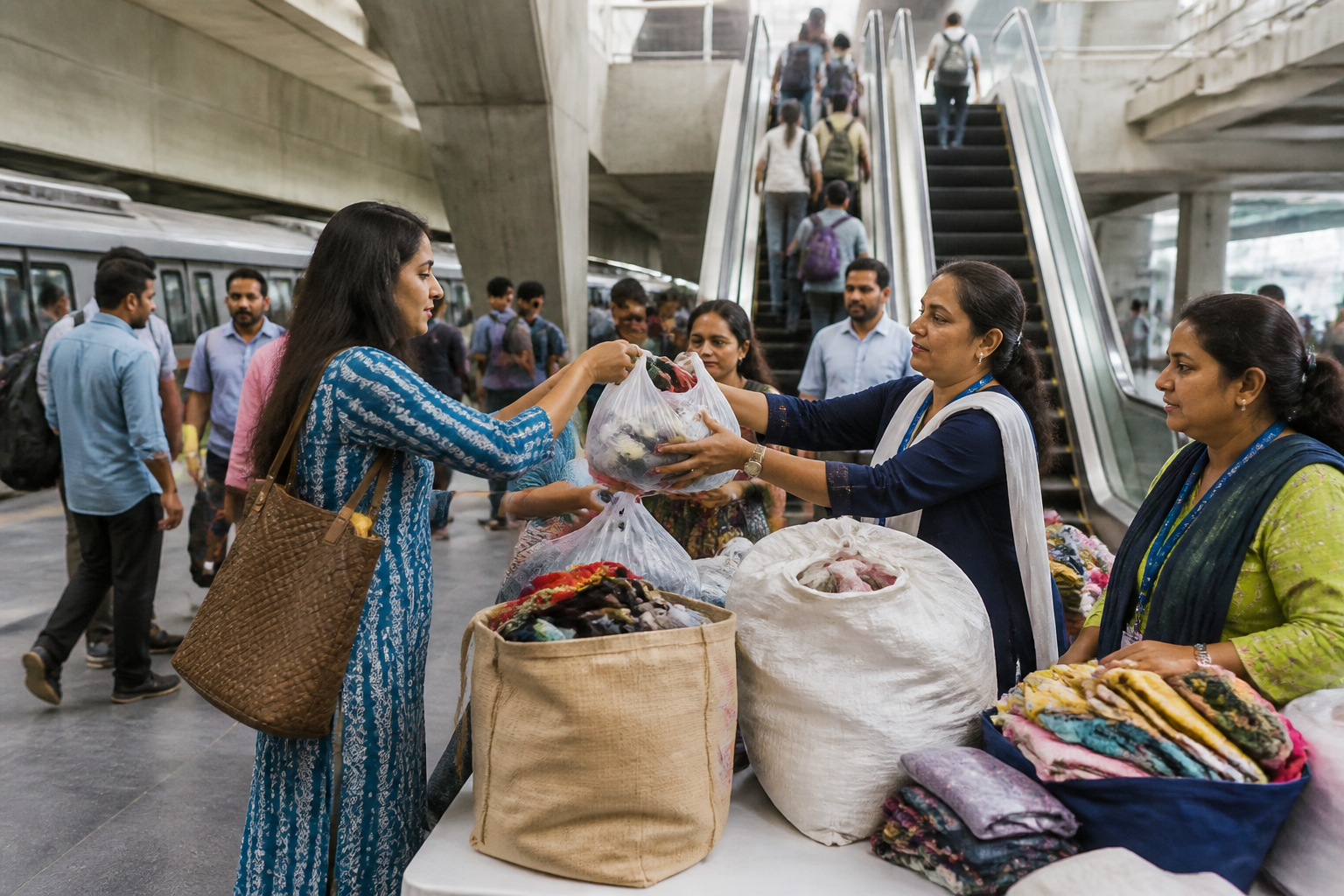
Delhi Metro’s Arpan Kendras have collected 41,181.59 kg of old clothing in less than a month, revealing how a convenient disposal point inside a high-footfall public transport network can turn an everyday waste problem into a recycling and livelihood programme. The initiative, launched across 10 stations, is now set to expand to 10 more locations by January.
The collection figures were reported after 3,940 people deposited clothing at the centres by August 31. The programme is being presented as a response to the difficulty residents face in disposing of old clothes responsibly. Instead of leaving garments beside roads or placing them in ordinary bins, people can take them to designated collection points at Metro stations.
That arrangement connects two systems that are usually planned separately: public transport and waste management. Delhi Metro stations already function as places where large numbers of residents pass through each day. Using some of that public access for material collection reduces the need for residents to make a separate trip to a recycling facility or specialised disposal point. The reported response suggests that location and convenience may be central to whether households participate in textile recovery.
The programme also moves beyond collection. The clothing deposited at the centres is being divided between material that can be reused and material that can be recycled. By August 31, around 4,266 kg of old clothing had been reused through upcycling, while 29,424 kg had been sent for recycling. The report does not specify the treatment of the remaining material, the final products made from the recycled portion, or the destination of material that could not be processed.
Those gaps matter because collection alone does not establish a circular system. A collection centre becomes part of a functioning recovery chain only when materials are sorted, processed and directed towards clearly defined end uses. In the Arpan Kendras model, the available figures show that at least part of the collected clothing is already moving into reuse and recycling streams, while self-help groups are involved in converting some of the material into saleable products.
The reported products include folders, key rings, pouches and bags. These are being sold at the Arpan Kendras, creating a visible link between waste collection and local production. Sales during August totalled Rs 27,036. The figure is modest compared with the quantity collected, but it establishes a model in which discarded clothing is not treated only as a disposal burden. It is also being used as an input for products made by self-help groups.
This is the institutional feature that distinguishes the initiative from a conventional donation box. The programme combines a public-facing collection network, processing through reuse and recycling, and production by community-based groups. The reported involvement of self-help groups also means that the initiative has a livelihood dimension, although the available information does not state how many groups or workers are participating, how they are paid, or what share of sales returns to them.
## The station as a civic collection point
The first five Arpan Kendras were launched on August 3, followed by five more between August 12 and 17. Their placement at Metro stations gives the programme a distributed footprint rather than concentrating collection at one facility. Residents can encounter the centres as part of regular travel, which may lower the practical barrier to handing over old clothes.
The collection numbers varied significantly between stations. The Dr Baba Saheb Ambedkar Hospital Metro station centre recorded the highest collection at 9,861.40 kg. The Shalimar Bagh centre followed with 9,761.03 kg. Together, those two locations accounted for nearly half of the total reported collection. The difference between stations indicates that access alone may not determine participation. The surrounding population, station footfall, nearby institutions, awareness of the centre and the availability of storage or transport for collected material may all influence the results, although the report does not provide comparative data on these factors.
The 3,940 depositors and 41,181.59 kg collected also show that the programme has received material from a substantial number of individual contributors during its initial period. On a simple average, the reported quantity works out to about 10.45 kg per depositor. That average should not be treated as a typical household contribution because the source does not explain whether deposits were made by individuals, institutions or groups, nor whether a small number of large donations influenced the total.
The same caution applies to the station-level figures. High collection at a centre may reflect residential demand, institutional drives or other local conditions. Without information on footfall, catchment population and the number of operating days at each location, the figures cannot establish which stations are most efficient or whether the model will perform similarly after expansion.
The planned second phase will add centres at Model Town, INA, IP Extension, Paschim Vihar, Rajendra Place, Janakpuri West, Rajouri Garden, Greater Kailash, Dwarka Sector 10 and Chhatarpur. These locations extend the programme across different parts of Delhi and include stations serving residential areas, commercial districts and major interchange or activity zones. The source states that the additional centres are expected to open by January, but it does not provide exact opening dates, operating hours or collection targets.
## From old clothing to measurable recovery
The programme’s early data offers a partial picture of material recovery. Of the 41,181.59 kg collected, 4,266 kg was reported as reused through upcycling and 29,424 kg as recycled. Combined, those two categories account for 33,690 kg, or nearly 82 per cent of the total collected quantity. The remaining 7,491.59 kg is not explained in the report. It may include material awaiting sorting or processing, but that cannot be established from the available information.
This distinction is important for assessing future performance. Collection is an input measure. Reuse, recycling and the production of usable goods are output measures. If the initiative expands to 20 centres, reporting both sets of figures will be necessary to determine whether the additional locations increase actual recovery or simply increase the volume temporarily stored in the system.
The product sales provide one further indicator of activity. Self-help groups made folders, key rings, pouches and bags from the collected clothing, and goods worth Rs 27,036 were sold in August. The available report does not identify the number of products sold, their prices or the proportion made from upcycled clothing rather than other inputs. It also does not state whether sales are limited to the Metro centres or whether products are distributed through other channels.
These details would help establish whether the model is primarily a waste diversion programme, a livelihood initiative, a public-awareness effort or a combination of all three. At present, the reported evidence supports all three elements, but does not measure their relative importance.
The initiative also places responsibility for textile disposal partly in the hands of residents. That can improve recovery when people know where to take unwanted clothing and what will happen next. It can also create expectations about transparency. Residents may reasonably want to know how clothing is sorted, what happens to damaged or contaminated material, which organisations undertake recycling, and how the proceeds from products are distributed.
## The governance question behind the collection drive
The reported statement by Chief Minister Rekha Gupta describes the Arpan Kendras as a practical solution for the proper disposal of old clothing and as a way to convert garments into useful products through reuse and recycling. The programme therefore operates at the intersection of public communication, waste management and social enterprise.
However, the available information does not identify the full administrative structure. It does not specify which department manages the centres, whether Delhi Metro provides space or operational support, which agency handles sorting and recycling, or how the self-help groups are contracted. Those institutional details will determine whether the initiative can operate consistently as it grows.
The expansion to 10 additional stations is the next test. A larger network will require reliable collection schedules, storage capacity, sorting arrangements and downstream processing. It will also require consistent public information so that residents know what types of clothing can be deposited and whether the centres accept all textiles or only selected items. None of those operating rules are included in the reported announcement.
The geographical spread of the planned locations could make the programme more accessible, but expansion also creates a need for comparable reporting. If each centre publishes collection, reuse, recycling and sales figures using the same definitions, the government and residents will be able to compare performance. If only aggregate collection numbers are released, it will be harder to assess whether the programme is reducing disposal or merely shifting material between collection points.
The Arpan Kendras also raise a broader question about how public infrastructure can support environmental services. Metro stations are primarily designed for mobility, but their public reach gives them potential roles in other civic programmes. Clothing collection is one example. The same principle could apply to other recoverable materials, provided that additional uses do not obstruct passenger movement, compromise safety or create operational burdens for the transport system.
For now, the available evidence confirms a strong initial response: 3,940 people deposited more than 41 tonnes of old clothing across 10 centres in less than a month. It also confirms that at least 33,690 kg had been assigned to reuse or recycling streams by August 31 and that self-help groups were making and selling products from part of the material. What remains unclear is the fate of the unaccounted quantity, the full economics of the programme, the operating responsibilities and the results that will follow the planned expansion.
The next meaningful milestone will be the opening of the 10 additional centres by January and the publication of comparable data showing collection, processing, reuse, recycling and sales at each location. Those details will determine whether the Arpan Kendras remain a successful pilot or develop into a durable part of Delhi’s urban waste-management network.
