


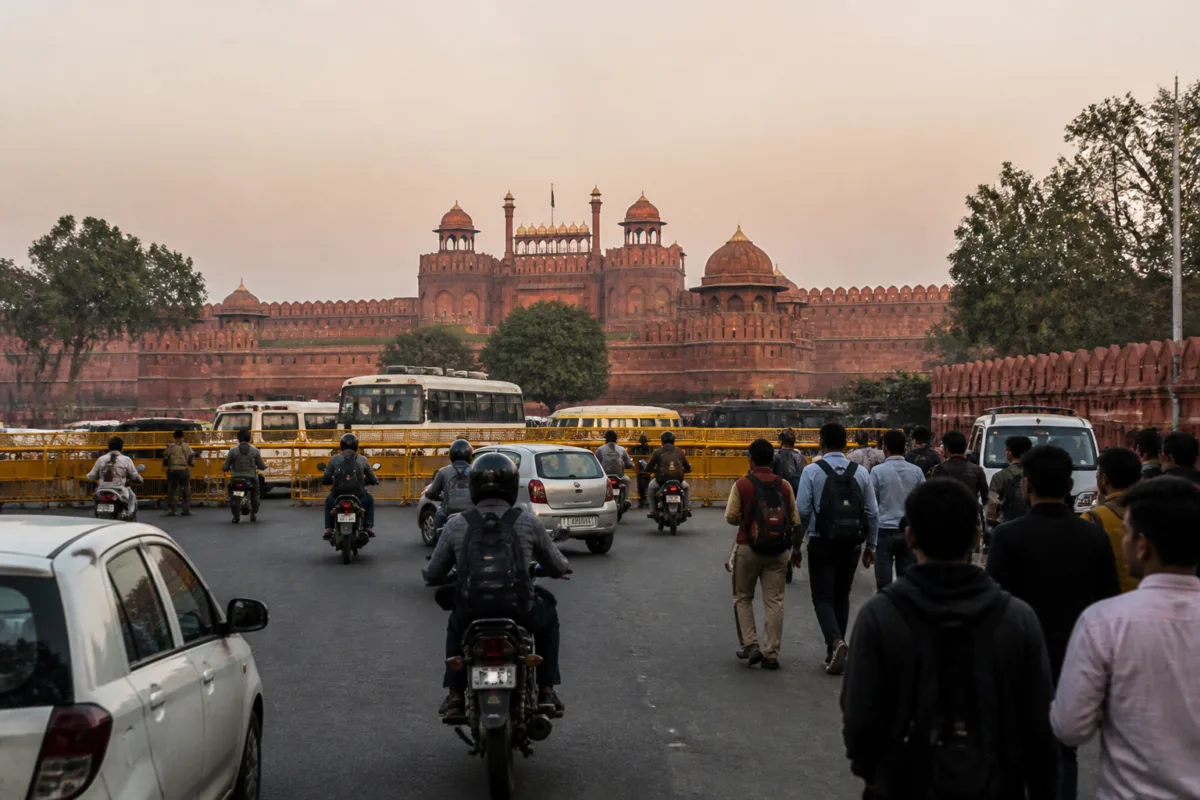
The Delhi Lal Qila blast investigation, as described in the latest report, has shifted attention from the immediate destruction of the attack to the longer chain of radicalisation, failed travel plans and target selection that allegedly preceded it. The National Investigation Agency has filed a chargesheet against nine people, while investigators say the blast killed 12 people and was connected to an alleged plan to overthrow the government and impose Sharia law.
The case matters to the city not only because the attack took place near one of Delhi’s most recognisable public landmarks, but also because the reported targets included locations embedded in everyday urban life: a traffic signal, a police post and religious sites. The investigation therefore raises questions about how crowded public spaces are assessed, monitored and protected without disrupting the ordinary movement that makes them valuable.
According to the report, the alleged plot was called “Heavenly Hind” and was first conceived in Srinagar in 2022. Investigators believe the group decided to carry out a suicide attack after attempts to travel to Afghanistan through Turkey failed. The report says the accused wanted to go to Afghanistan to work for what they described as the promotion of Islam globally, but later turned to an attack in Delhi.
The central figures identified in the report are Dr Umar-un-Nabi, a Kashmiri doctor and former assistant professor at Haryana’s Al-Falah University, and doctors Muzammil Shakeel and Adil Ahmad Rather. Investigators reportedly believe that the three and their associates became radicalised on their own. At the same time, the report says the group was ideologically linked to Al-Qaeda in the Indian Subcontinent and to the Kashmir-based organisation Ansar Ghazwat-ul-Hind.
This distinction is important. The investigation, as presented, does not describe a straightforward case of a locally operating cell directed by a Pakistan-based terrorist organisation. Officials cited in the report reportedly do not believe that the group had contact with Pakistan-based terrorist organisations. The same account, however, says investigators suspect that members may have been in contact with someone in Afghanistan through an Al-Qaeda channel. The available report does not establish the nature, duration or operational significance of that suspected contact.
The investigation’s account also leaves a significant question unresolved: whether the blast site was selected through a fixed plan or whether the attack unfolded after an operational error. The report says Nabi had identified several possible targets, including a police post, the Gauri Shankar temple and a Jain temple. It also says the explosive device was carried in his car and detonated at a traffic signal near the Lal Qila.
Because the vehicle was completely destroyed, investigators reportedly found no forensic evidence at the scene showing how the explosive was manufactured or what kind of timer may have been used. That missing evidence limits what can be conclusively reconstructed about the preparation and timing of the attack. The report consequently says investigators have not been able to determine whether the crowded-area explosion was fixed in advance or occurred because of a lapse or mistake.
The use of a traffic signal as the reported site is significant for understanding the urban dimension of the case. Traffic intersections are designed for movement, not controlled access. They bring together pedestrians, motorists, public transport users, vendors, enforcement personnel and nearby commercial activity. A vehicle positioned at such a location can blend into the normal visual and operational background of a large city, while the surrounding crowd increases the potential consequences of an attack.
The Lal Qila area adds another layer. It is a heritage and visitor destination, a major public landmark and part of a dense central-city environment. Such places combine tourism, local commerce, religious activity, policing and transport. Security planning in these areas therefore cannot be separated from the management of roads, pedestrian flows, surveillance, emergency response and access points. The supplied report does not provide details of the security arrangements in place at the time, any subsequent changes or the responsibilities assigned to individual agencies.
The NIA’s chargesheet is the clearest institutional milestone identified in the report. It was filed on May 14 and names nine accused, including Nabi. The chargesheet indicates that investigators have moved beyond the initial incident response and formally presented their account of the alleged conspiracy. It does not, by itself, resolve every factual dispute or answer the operational questions that remain open in the reported investigation.
The chronology described in the report begins with a decision allegedly taken in Srinagar in 2022, followed by failed attempts to reach Afghanistan through Turkey and the later decision to conduct an attack in Delhi. That sequence points to the importance of examining the pathways between online or ideological radicalisation, travel aspirations, local networks and physical target selection. However, the supplied material does not identify the specific platforms, communications, funding routes or recruitment mechanisms involved.
The report also does not provide a broader dataset on attacks or attempted attacks around Delhi’s public landmarks. It gives no comparative figures for security incidents at traffic signals, heritage sites or religious places, and no information on changes in visitor numbers, policing resources or emergency response capacity. These omissions matter because one case, however serious, cannot by itself establish a citywide trend.
What the available evidence does establish is narrower but still important. A group allegedly operating without a clearly established Pakistan-based command structure was able to develop an extremist objective, consider international travel, identify possible targets and carry out a lethal attack in a crowded central Delhi location. The investigation also indicates that authorities are still working to distinguish between independent radicalisation, ideological influence and possible overseas contact.
For urban governance, the case highlights the difficulty of protecting open public environments. Delhi’s landmarks and streets are not closed compounds. Their public value depends on access and movement, while their exposure comes from precisely those characteristics. Effective security therefore involves more than barriers or visible policing; it requires coordination among investigating agencies, local police, traffic authorities, emergency services, heritage managers and institutions located around high-footfall sites. The supplied report does not establish how that coordination operated in this case.
The chargesheet and the continuing investigation leave two levels of accountability to be tested. The first is legal: whether the prosecution can prove the alleged conspiracy, ideological links, communications and roles of the nine accused. The second is operational: whether the sequence of target identification, vehicle movement and detonation reveals failures that can be addressed in the management of crowded urban spaces. The report provides no final judicial finding on either question.
The Delhi Lal Qila blast case therefore offers a limited but significant lesson about urban vulnerability. The attack was not confined to a remote conflict zone or an isolated facility; according to the investigation account, it entered the everyday infrastructure of a major city through a vehicle, a traffic signal and a crowded landmark setting. The NIA chargesheet establishes the next formal stage of the case, while the unresolved questions around target selection, forensic reconstruction and overseas contact remain matters for the court and investigators to clarify.

