


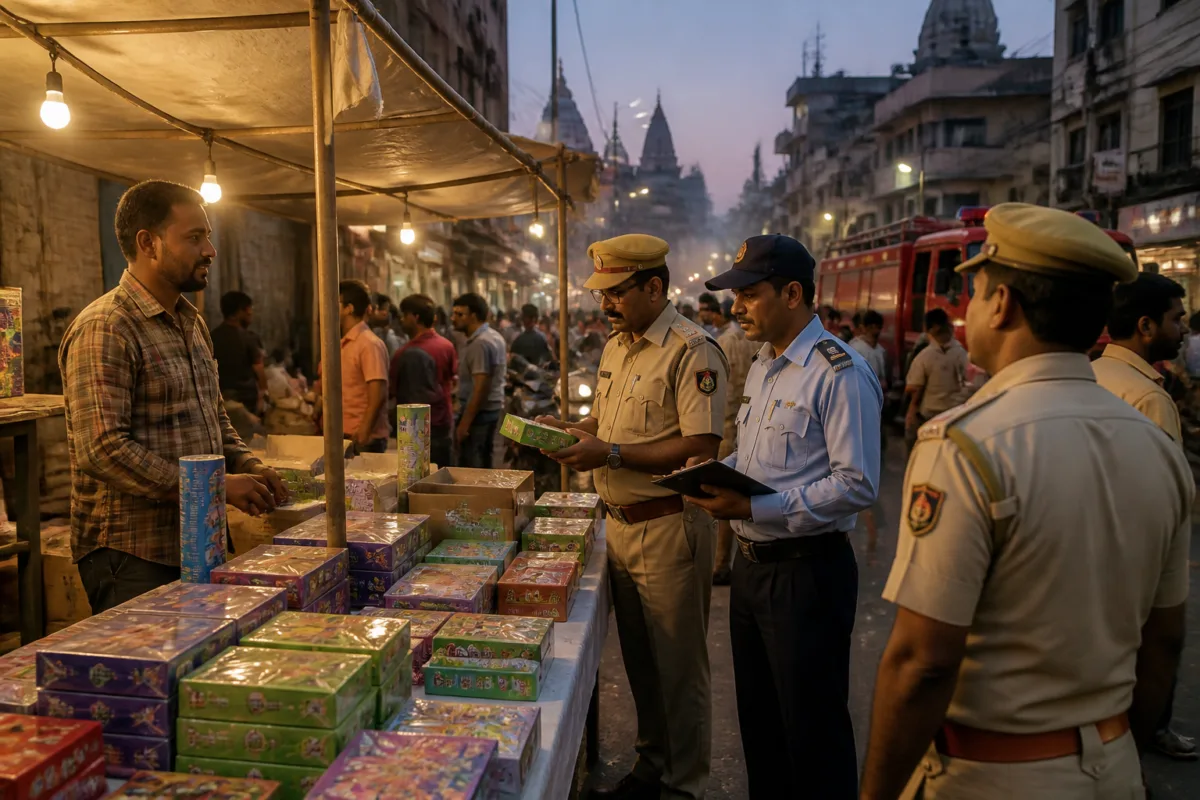
The Supreme Court’s conditional permission for Delhi green crackers during Diwali has created a regulatory window that is legally clear but administratively compressed. The court has allowed sales for three days, from 4 to 6 November, while traders say the permissions, licensing and supply-chain approvals required to use that window cannot be completed in time. The resulting gap is not merely a dispute between sellers and regulators; it shows how an urban pollution-control order can become difficult to implement when legal permission, municipal licensing, fire safety and market enforcement do not move together.
According to the report by Jagran, the court’s order permits the sale of green crackers for the specified three-day period, with the restriction returning from midnight on 6 November. The permitted period covers the days when demand is expected to be strongest, but traders say the effective selling window is shorter because the market typically begins building up around Dhanteras and continues through Chhoti Diwali and Diwali. The reported order therefore places a narrow legal limit around a market whose commercial activity is concentrated across a few high-demand days.
The difference between a legal window and an operational window is central to the dispute. Rajiv Jain, president of the Delhi Fire Works Traders Association, told Jagran that traders had effectively been given only one day to complete the approval process. Permanent sellers are waiting for the Petroleum and Explosives Safety Organisation, or PESO, to lift the suspension of their licences. Temporary sellers, the report said, need approvals from the Municipal Corporation of Delhi, the Delhi Fire Service and PESO, along with clearance from the licensing department of Delhi Police.
That sequence turns the court’s three-day permission into a multi-agency implementation problem. Each approval addresses a different risk: municipal authorities regulate the location and local operation of temporary sales, the fire service assesses fire-safety conditions, PESO deals with explosives-related licensing, and the police licensing department provides another layer of authorisation. The system may be designed to prevent unsafe sales, but when all approvals are required within a compressed period, lawful traders can be left without enough time to activate their businesses.
The supply chain adds another constraint. The report says permanent traders cannot bring stock into Delhi from fireworks warehouses in Meerut, Hapur, Rohtak, Panipat, Kurukshetra and Ambala until their suspended licences are restored. This means that even a trader who receives approval at the point of sale may still face a logistical delay in obtaining legally permitted stock. Licensing, transportation and retail operations are therefore linked: a delay in any one part can reduce or eliminate the usable period for the others.
The numbers cited in the report indicate the scale of the regulatory change. Delhi has more than 125 regular firecracker shops that are permitted to sell fireworks throughout the year, but their licences have reportedly remained suspended since 2016 amid the air-pollution dispute. At an earlier point, nearly 10,000 temporary firecracker sale licences were issued in Delhi, whereas the number is now described as limited. These figures show that the city has moved from a broad seasonal licensing model to a much narrower and more restrictive one.
The 2016 starting point is important because it places the current order within a decade-long conflict between festival commerce, public health and air-quality regulation. The reported suspension of regular licences has not eliminated demand for fireworks. Instead, it has separated demand from the formal retail system. Traders say that restricted sellers face extensive compliance requirements while prohibited or unapproved products continue to be sold in parts of the city. That claim is reported by Jagran and should be understood as a trader allegation about enforcement conditions, not as an independently established measure of the illegal market.
The locations mentioned in the report include Sadar Bazaar, Chandni Chowk and Bhagirath Palace, where sales on carts and temporary roadside points are said to continue even before the permitted period. If accurate, this points to a familiar urban governance problem: formal controls are easiest to apply to identifiable, licensed premises, while dispersed street-level commerce can be harder to monitor. The issue is not only whether a rule exists, but whether enforcement capacity reaches the places where transactions actually occur.
Green crackers are intended to address the pollution concerns associated with conventional fireworks, but the supplied report does not provide measurements showing how much pollution the permitted products reduce, nor does it set out the technical criteria used to identify compliant stock. It also does not provide the number of licences approved, the number of applications received, or the enforcement resources available to the agencies involved. Those absences matter because a court-directed market cannot be assessed only by the text of the permission. Its practical effect depends on product verification, licensing coverage, supply-chain traceability and enforcement after the sale.
The arrangement also creates two different administrative clocks. The court has fixed the dates for lawful sales, while agencies and traders must complete approvals before those dates. The order may provide a legal boundary, but the municipal and licensing apparatus must convert that boundary into permits, inspections and controlled retail locations. When this conversion begins too late, compliant sellers may be unable to participate even though the court has permitted the activity. At the same time, consumers may still find products through informal channels, weakening the purpose of a regulated green-cracker market.
This is why the dispute cannot be reduced to whether traders are dissatisfied with a shorter festive season. The deeper question is whether Delhi’s pollution and fire-safety controls are being administered as a coordinated urban system. The reported requirements involve at least four authorities and a supply network extending beyond Delhi. The success of the policy therefore depends on coordination between agencies within the capital and on the movement of stock from warehouses in neighbouring states.
The court’s conditional permission also places pressure on public communication. Residents need to know which products qualify as green crackers, where licensed sales are allowed, during which hours sales and use are permitted, and how violations can be reported. The report establishes the three-day sales period and the return of the restriction after midnight on 6 November, but it does not provide the full operational guidance issued by each authority. Without clear public information, consumers may find it difficult to distinguish authorised sellers and compliant products from illegal stock.
The citizen response described in the report is mixed. Praveen Shankar Kapoor of the Chandni Chowk Citizens Forum welcomed the time-bound permission, arguing that people already buy and use expensive fireworks despite restrictions. This view treats regulated permission as a practical response to behaviour that may continue regardless of a total ban. Traders, however, argue that regulation is meaningful only if formal sellers can obtain approvals and compete with unauthorised vendors on equal terms.
Both positions highlight the same implementation tension. A prohibition may be difficult to enforce if demand persists, while a conditional market requires credible licensing and monitoring. The available report does not establish whether the court’s arrangement will reduce total cracker use, shift purchases into the formal market or simply compress activity into a few days. It does establish that the time available to traders is short and that multiple permissions remain necessary.
For Delhi’s urban administration, the immediate milestones are the restoration or continuation of relevant licences, the processing of temporary permissions, the movement of authorised stock into the city and enforcement against sales outside the permitted framework. The supplied material does not state how many approvals have been issued or whether the agencies have created a joint process. Those details will determine whether the order functions as a controlled environmental compromise or as a rule that is formally available but practically inaccessible to compliant traders.
The evidence currently confirms a narrow legal permission, a multi-agency approval process, a historically reduced licensing system and continuing allegations of informal sales. It does not yet establish the environmental outcome of the three-day window or the scale of enforcement. The most important developments to monitor are the number of licences granted, the availability of certified green crackers, the operation of authorised sales points and the action taken against unauthorised sellers after the permitted period ends.

