


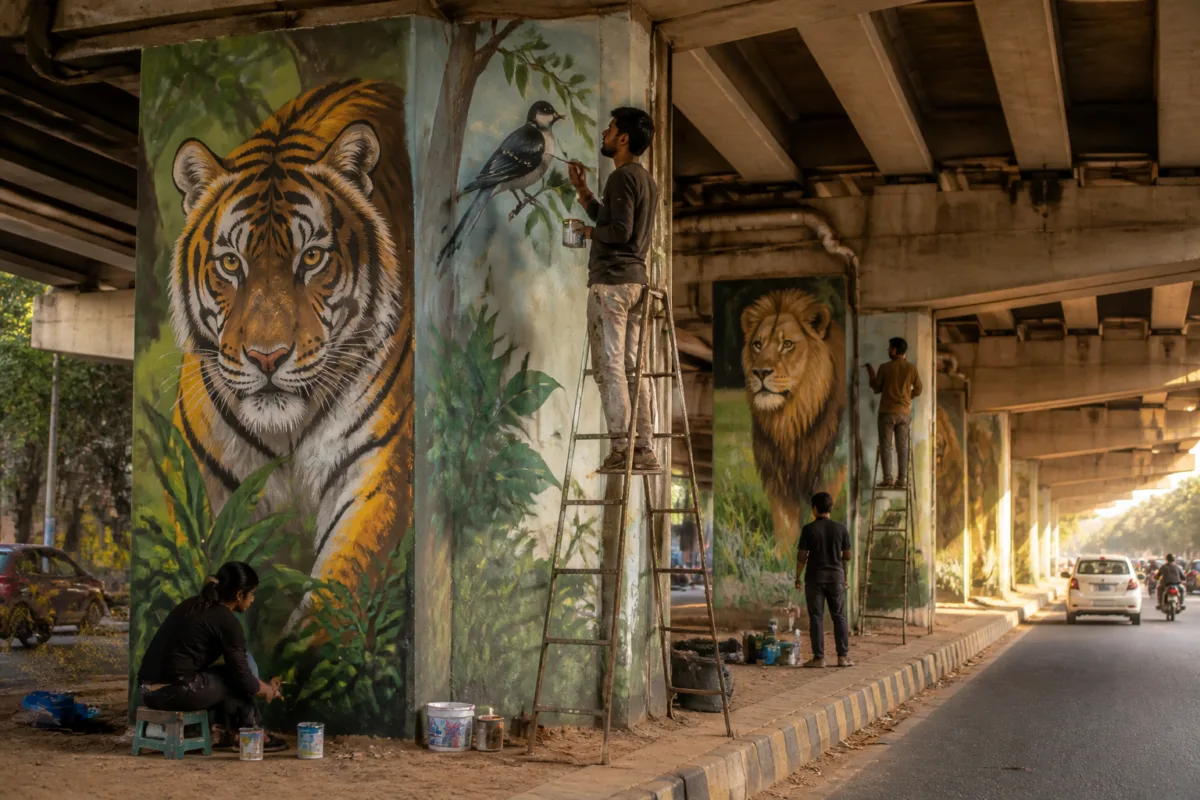
Wildlife murals now being painted beneath Delhi’s Chirag Dilli flyover have turned a neglected public surface into a test of what urban beautification can and cannot achieve. The project replaces torn posters, accumulated rubbish and stained concrete with paintings of tigers, lions and birds, while also drawing attention to the larger question of who maintains the city’s everyday infrastructure after a makeover is complete.
The murals are being created by a team of 12 to 15 painters led by Sandeep Nayak of Jharkhand for Indian Oil Corporation Limited (IOCL). Nayak told The Times of India that the work was expected to be completed by Monday. He said the intention was to promote animal and environmental conservation through the paintings.
At street level, the intervention is straightforward: a large, grime-covered concrete surface is being given a visual identity. Beneath a flyover, where traffic infrastructure often creates leftover spaces that are difficult to use and easy to neglect, the paintings offer a more deliberate public-facing treatment. The immediate change is therefore not only aesthetic. It alters what motorists, pedestrians and nearby residents encounter as they move through the corridor.
But the project’s significance lies less in the murals themselves than in the institutional arrangement behind them. The work is part of a wider partnership between the Delhi government and IOCL. According to a Times of India report published last year, the two had signed a memorandum of understanding covering improvements to city infrastructure, health facilities and public services.
That agreement included flyover beautification, hospital upgrades, water ATMs and modern energy hubs at Delhi Transport Corporation depots. It also placed five major flyovers and a stretch of road under IOCL’s adoption programme. The locations identified in the report were the flyovers at IIT Delhi, Panchsheel, Punjabi Bagh, Chirag Dilli and Mukarba Chowk, along with a 500-metre stretch of Aurobindo Marg.
The arrangement was intended to cover maintenance for three years. The beautification work was estimated at Rs 20 crore and was to be carried out through an external agency. The Chirag Dilli murals are therefore one visible component of a programme that combines corporate participation, government coordination and outsourced implementation across several urban sites.
This model matters because city infrastructure does not end when a flyover is opened or a road is laid. Concrete structures require cleaning, repair, lighting, surface treatment and monitoring. Areas underneath elevated roads also sit at the intersection of transport infrastructure and public space. They can become circulation areas, informal activity zones or simply highly visible parts of the city that residents experience every day without being destinations in themselves.
The Chirag Dilli project shows how a maintenance programme can begin with visual repair. The original condition described in the report—torn posters, rubbish and stained concrete—suggests that the problem was not a lack of infrastructure in the narrow engineering sense. The flyover was present, but the space around and beneath it had accumulated signs of weak upkeep. The murals address that visible deterioration by making the surface more legible and intentional.
Their conservation theme also gives the project a public message beyond decoration. Tigers, lions and birds are being used to communicate animal and environmental conservation, according to the painter leading the work. The supplied material does not establish whether the murals form part of a wider education programme, whether interpretive information will be installed, or how their condition will be assessed after completion. What it does establish is that the artwork has been conceived as a message as well as a visual treatment.
The limits of beautification are equally important. A painted surface can cover stains and remove the visual space available for posters, but it does not by itself resolve the causes of rubbish accumulation, unauthorised pasting or surface damage. Nor does the available information say whether cleaning, waste collection, repairs and repainting will continue at the site once the artwork is finished. Those operational details will determine whether the intervention remains a maintained public asset or becomes another short-lived improvement.
That question is central to the three-year adoption arrangement. The reported programme is not framed only as a one-time art project; it includes maintenance of five flyovers and a road stretch. Maintenance creates a longer administrative obligation than inauguration or completion. It requires a defined agency, a schedule, funding, inspection and a way to respond when the site deteriorates again. The supplied report does not detail those mechanisms, including the performance standards expected from the external agency.
The partnership also illustrates the multiple layers involved in managing Delhi’s built environment. The government provides the public-sector framework and identifies urban assets requiring improvement. IOCL is the participating corporate entity. An external agency undertakes the beautification work. Painters deliver the visible output. The flyover itself remains part of a public transport and road system whose primary function is movement. Each participant is connected to a different part of the result, but the public experiences the whole site as one place.
That division of responsibilities can make accountability difficult unless the arrangement is clearly documented. A successful mural may be easy to see, while less visible functions—waste removal, structural cleaning, lighting or repair—may be harder for citizens to attribute. The source material confirms the adoption locations, the estimated programme cost and the three-year duration, but it does not specify the monitoring structure or the public reporting process. Those are important gaps in understanding how the partnership will be judged.
The numbers available are modest but revealing. A team of 12 to 15 painters is working on the Chirag Dilli site. The broader beautification effort was estimated at Rs 20 crore, and the adopted assets comprise five flyovers plus a 500-metre stretch of Aurobindo Marg. These figures indicate that the programme is intended to operate across a network of highly visible locations rather than as an isolated intervention.
At the same time, the available information does not provide a site-wise cost for Chirag Dilli, the total painted area, the expected completion date beyond the painter’s reference to Monday, or a before-and-after assessment. It also does not establish how many residents or road users will directly encounter the murals, whether similar work has been completed at the other adopted flyovers, or whether the project has produced measurable changes in cleanliness and maintenance.
That absence of data does not make the project insignificant. It clarifies what can currently be said. The murals are evidence of an active public-space improvement effort and of a government-corporate partnership extending beyond a single flyover. They are not, on the available evidence, proof that the underlying maintenance problem has been solved. The distinction is important because urban beautification is often most visible at the moment of completion, while the quality of public infrastructure is tested over time.
For Delhi, the larger urban question is whether neglected spaces beneath and around major transport structures can be managed as part of the city rather than treated as residual land. The Chirag Dilli work gives one such space a conservation-themed identity. The wider adoption programme supplies an institutional route for intervention. Its lasting value will depend on whether the same arrangement can sustain cleanliness, repair and public usability after the painting team leaves.
The evidence currently confirms that the Chirag Dilli flyover is receiving wildlife murals under an IOCL-supported beautification programme, within a three-year adoption framework covering several Delhi sites. It does not yet establish the project’s long-term maintenance outcomes or the detailed accountability arrangements behind the Rs 20 crore programme. The next useful milestones are completion of the murals, the condition of the site after handover and the progress of the wider work at the other adopted flyovers and Aurobindo Marg.

