


Odisha has set a target of raising its urbanisation level from around 17% to 40% by 2036, while pursuing a $500-billion economy as the state marks 100 years as a separate province. Chief minister Mohan Charan Majhi announced the targets at the two-day National Urban Conclave-2026 in Bhubaneswar on Saturday.
Majhi said the state government was working to build world-class infrastructure and modern institutions to support growth driven by industrialisation, port-led development, tourism and services. Odisha currently has investment proposals worth Rs 23 lakh crore, while projects involving Rs 3.5 lakh crore and more than 200 industries have already been launched, he said.
The chief minister also highlighted the proposed Bhubaneswar-Cuttack-Puri-Paradip Economic Region, which is being developed with support from the central government and Niti Aayog. The state is expanding Bhubaneswar and Cuttack through satellite townships on their outskirts and has recently created 28 new notified area councils, seven municipalities and one municipal corporation.
The scale of the planned urban transition was placed in a national context by Niti Aayog CEO Anurag Jain, who said nearly half of India’s population could live in urban areas by 2047 and that cities could contribute around 75% of the country’s gross domestic product. Jain said planned and well-managed urbanisation would be critical to sustaining economic growth, while unplanned expansion could create serious challenges.
Housing and public transport formed key parts of the measures presented at the conclave. Majhi said 1.53 lakh houses had been constructed in Odisha under the Pradhan Mantri Awas Yojana-Urban. Under PMAY 2.0, the state has approved Rs 1,615 crore over the next five years for the PMAY Urban Bandhu programme, which will provide Economically Weaker Section beneficiaries with a 90% concession on stamp duty and registration fees.
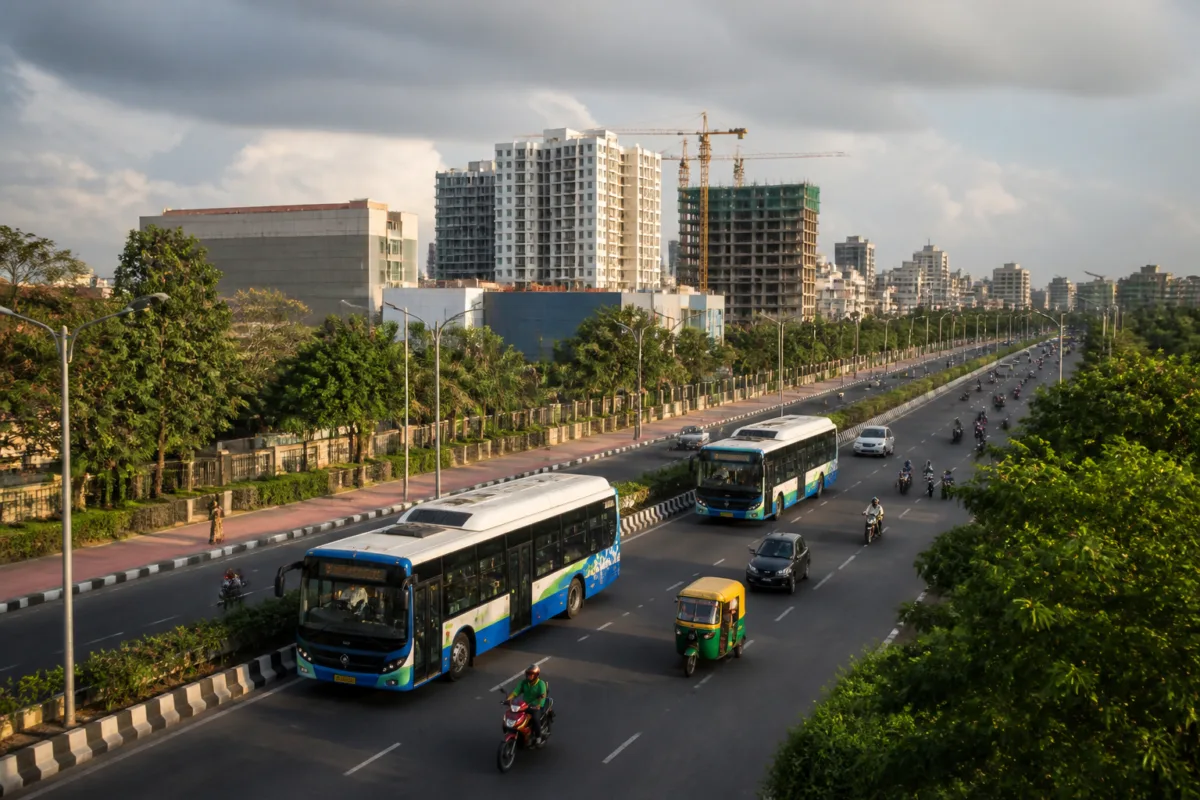
The state also began expanding its electric bus network. Majhi flagged off 26 electric buses under the PM e-Bus service, with 400 additional e-buses, 100 midi e-buses and 50 mini e-buses planned for addition to the fleet. Services currently operated by the Capital Region Urban Transport system in seven cities are expected to reach nine more urban centres: Baripada, Angul, Jharsuguda, Balasore, Jajpur, Rayagada, Jeypore, Bhadrak and Balangir.
Water supply was another focus of the conclave. Chief secretary Anu Garg said the Drink From Tap initiative, which began in Puri, had expanded to 11 cities. She said piped drinking water was being supplied to households in all 114 urban local bodies in Odisha, with IITs assisting in regular water-quality monitoring and jalasathis supporting implementation.
The government’s next steps, as presented at the conclave, include expanding the regional economic corridor, developing satellite townships, adding electric buses and implementing the approved PMAY Urban Bandhu funding over the next five years.

