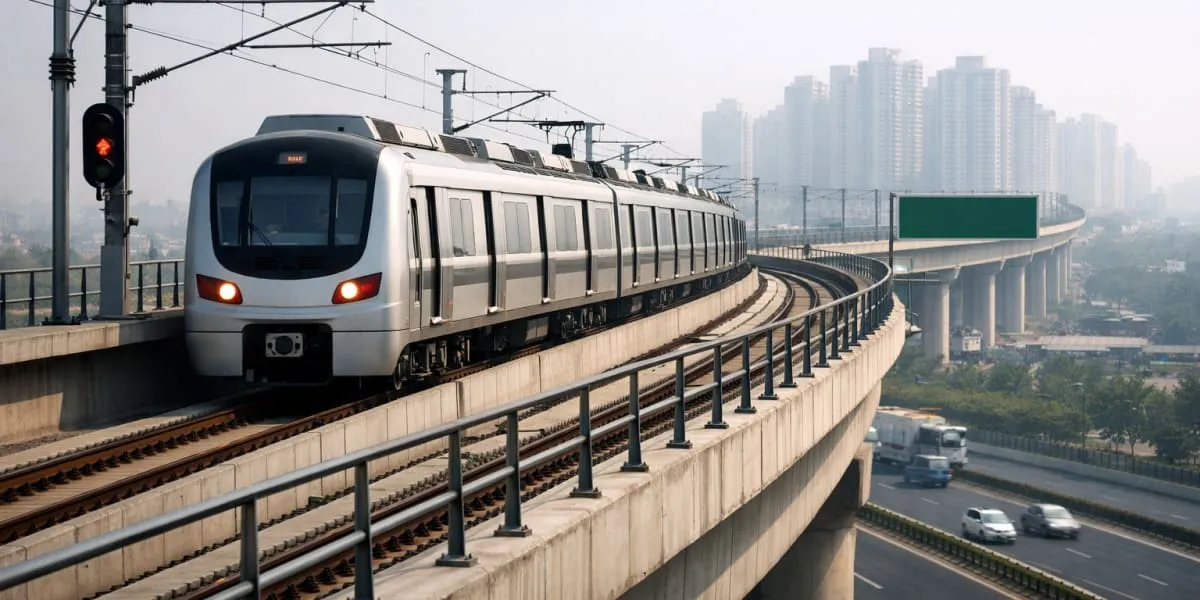
A new metro link connecting Delhi and Faridabad has been operationalised, strengthening public transport connectivity across the National Capital Region and offering relief to thousands of daily commuters. The corridor is expected to ease pressure on congested road networks while improving access between residential zones in Faridabad and employment hubs in the capital.
The Delhi Faridabad metro line extends existing rapid transit infrastructure deeper into Haryana, reinforcing Faridabad’s integration with Delhi’s economic ecosystem. For a city that has witnessed steady residential growth over the past decade, improved rail-based connectivity is likely to reshape commuting patterns and reduce dependence on private vehicles.
Urban mobility experts highlight that such expansions are critical in a region where road congestion and air pollution remain persistent challenges. By offering a reliable and time-efficient alternative, the metro system can help reduce vehicular traffic along key arterial routes, particularly during peak hours. This, in turn, has implications for lowering emissions and improving air quality across the corridor.
The new line also underscores a broader shift towards transit-oriented development in NCR. Areas along metro corridors tend to attract higher-density residential and commercial activity, driven by improved accessibility and reduced travel times. In Faridabad, this could translate into increased demand for housing and mixed-use developments near stations, reshaping local real estate dynamics.
However, the expansion of the Delhi Faridabad metro line also raises planning considerations. Experts caution that infrastructure-led growth must be accompanied by adequate last-mile connectivity, including feeder buses, pedestrian pathways, and cycling infrastructure. Without these, the full benefits of metro connectivity may not reach a wider population, particularly those living beyond immediate station catchment areas.
Affordability remains another key factor. While metro systems offer efficiency, fare structures need to remain accessible to ensure widespread adoption across income groups. Ensuring equitable access to public transport is essential for building inclusive cities where mobility is not constrained by economic barriers.
From an environmental standpoint, the metro expansion aligns with long-term goals of reducing carbon-intensive transport. Rail-based transit systems are significantly more energy-efficient compared to road transport, especially when supported by clean energy sources. As NCR grapples with worsening air quality, investments in mass transit infrastructure are increasingly being viewed as climate-critical interventions.
The Delhi Faridabad metro line also reflects the importance of inter-state coordination in managing regional mobility. NCR’s urban sprawl cuts across administrative boundaries, requiring integrated planning between Delhi and Haryana to ensure seamless connectivity, consistent service standards, and coordinated infrastructure development.
For commuters, the immediate impact is likely to be reduced travel time and improved reliability. For the region, the longer-term implications include reshaped urban growth patterns, enhanced economic linkages, and a gradual shift towards more sustainable mobility systems.
As NCR continues to expand, the success of such projects will depend on how well they integrate with broader urban planning frameworks. Strengthening last-mile connectivity, ensuring affordability, and aligning transit expansion with land use planning will be key to unlocking the full potential of the Delhi Faridabad metro line in building a more connected and climate-resilient urban region.
A new metro link connecting Delhi and Faridabad has been operationalised, strengthening public transport connectivity across the National Capital Region and offering relief to thousands of daily commuters. The corridor is expected to ease pressure on congested road networks while improving access between residential zones in Faridabad and employment hubs in the capital.
The Delhi Faridabad metro line extends existing rapid transit infrastructure deeper into Haryana, reinforcing Faridabad’s integration with Delhi’s economic ecosystem. For a city that has witnessed steady residential growth over the past decade, improved rail-based connectivity is likely to reshape commuting patterns and reduce dependence on private vehicles. Urban mobility experts highlight that such expansions are critical in a region where road congestion and air pollution remain persistent challenges. By offering a reliable and time-efficient alternative, the metro system can help reduce vehicular traffic along key arterial routes, particularly during peak hours. This, in turn, has implications for lowering emissions and improving air quality across the corridor. The new line also underscores a broader shift towards transit-oriented development in NCR. Areas along metro corridors tend to attract higher-density residential and commercial activity, driven by improved accessibility and reduced travel times. In Faridabad, this could translate into increased demand for housing and mixed-use developments near stations, reshaping local real estate dynamics.
However, the expansion of the Delhi Faridabad metro line also raises planning considerations. Experts caution that infrastructure-led growth must be accompanied by adequate last-mile connectivity, including feeder buses, pedestrian pathways, and cycling infrastructure. Without these, the full benefits of metro connectivity may not reach a wider population, particularly those living beyond immediate station catchment areas. Affordability remains another key factor. While metro systems offer efficiency, fare structures need to remain accessible to ensure widespread adoption across income groups. Ensuring equitable access to public transport is essential for building inclusive cities where mobility is not constrained by economic barriers. From an environmental standpoint, the metro expansion aligns with long-term goals of reducing carbon-intensive transport. Rail-based transit systems are significantly more energy-efficient compared to road transport, especially when supported by clean energy sources. As NCR grapples with worsening air quality, investments in mass transit infrastructure are increasingly being viewed as climate-critical interventions.
The Delhi Faridabad metro line also reflects the importance of inter-state coordination in managing regional mobility. NCR’s urban sprawl cuts across administrative boundaries, requiring integrated planning between Delhi and Haryana to ensure seamless connectivity, consistent service standards, and coordinated infrastructure development. For commuters, the immediate impact is likely to be reduced travel time and improved reliability. For the region, the longer-term implications include reshaped urban growth patterns, enhanced economic linkages, and a gradual shift towards more sustainable mobility systems. As NCR continues to expand, the success of such projects will depend on how well they integrate with broader urban planning frameworks. Strengthening last-mile connectivity, ensuring affordability, and aligning transit expansion with land use planning will be key to unlocking the full potential of the Delhi Faridabad metro line in building a more connected and climate-resilient urban region.