


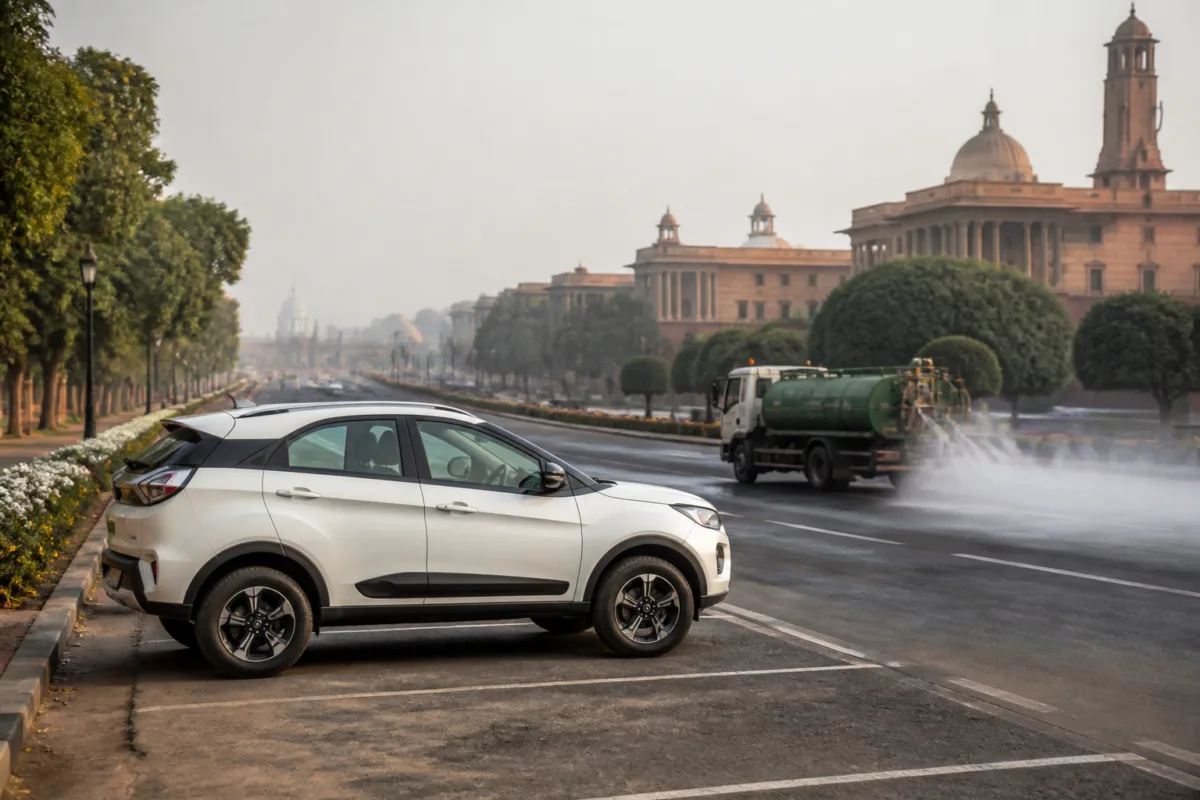
Delhi EV parking fee will remain unchanged in Lutyens’ Delhi this winter, while the New Delhi Municipal Council will double parking charges for non-electric vehicles from November 1 as part of its pollution-control plan. The fee for electric four-wheelers will stay at Rs 10 per hour, compared with Rs 40 per hour for non-electric four-wheelers.
NDMC vice-chairman Kuljeet Chahal announced the decision at a news conference on the council’s winter action plan, prepared following directions from the Delhi government. He said retaining the 50% rebate for electric vehicles was intended to encourage cleaner transport and provide relief to citizens.
“The decision will naturally promote cleaner transport options and reduce pollution,” Chahal said. He added that NDMC was also expanding the use of electric vehicles in its own fleet, with 32 vehicles already engaged and 28 more hired.
The council currently has 157 electric-vehicle charging stations in its area and plans to increase the number to 204 by December 31. The NDMC area covers 42.7 square kilometres, and Chahal said the planned expansion would give the council one of the highest concentrations of charging stations among such civic jurisdictions in the country.
The winter plan also includes dust-control measures on major roads. NDMC is installing mist-spray systems on 24 road stretches, covering about 1,200 electric poles and 27 kilometres of roads. The systems are already operational on Man Singh Road, Shahjahan Road, Bhagwan Das Road, Tilak Marg, Subramania Bharati Marg and Dr Zakir Hussain Marg. Six more stretches, including Aurobindo Marg, Prithviraj Road and Barakhamba Road, are expected to receive the systems within a week, while the remaining locations are scheduled for completion by the end of November.
NDMC has deployed 12 truck-mounted or mobile anti-smog guns and installed additional units at 10 private high-rise buildings and several council properties. Another 115 anti-smog guns have been deployed at construction and demolition sites, including sites operated by NBCC. The council is also using three pressure-jetting machines and 18 water tankers, of which 10 have sprinkler systems, for road washing and dust suppression.
The council said it was working to eliminate unpaved road surfaces, maintain roads and footpaths, and improve greenery along 20 kilometres of central verges and roadside stretches. Its smart irrigation programme covers 11 road locations spanning about 19.6 kilometres and is intended to increase the use of treated water in green spaces.
NDMC currently operates nine decentralised sewage treatment plants with a combined capacity of about 2,900 kilolitres per day. It has proposed eight more sewage treatment plants with a combined capacity of 2,250 kilolitres per day and five effluent treatment plants with a capacity of 180 kilolitres per day under the public-private partnership model.

