


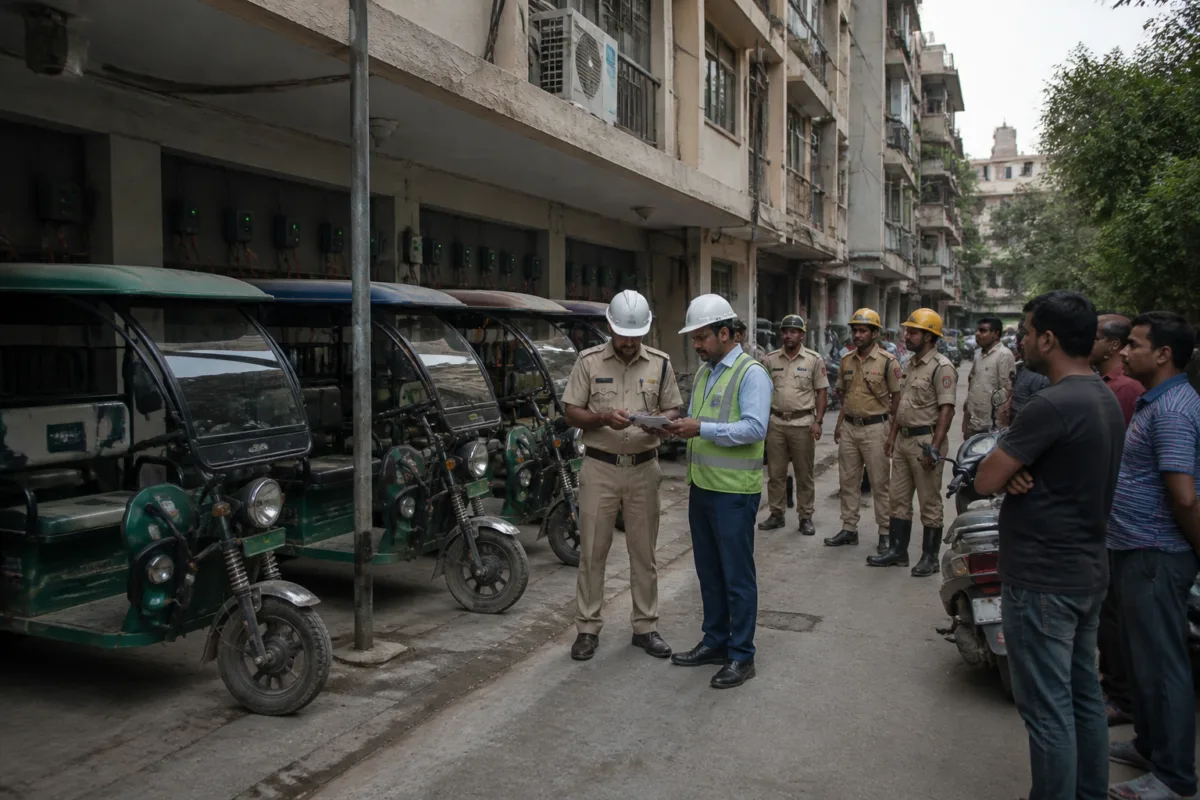
Delhi e-rickshaw charging safety concerns have come into sharper focus after a residential-building fire in Vishwas Nagar killed four men on Sunday and a separate fire in northwest Delhi gutted more than 15 e-rickshaws. The precise cause of the Vishwas Nagar blaze has not been established, although investigators suspect an overloaded electrical network or a substandard battery.
The fire began in the ground-floor parking area of a residential building where several e-rickshaws were reportedly being charged in a cramped space, according to a report by Hindustan Times. Officials cited in the report said the incident was part of a wider pattern involving poorly maintained, overloaded or illegal charging points across the Capital.
In the second incident on Sunday, at least six people, including two children, were rescued after a fire broke out inside a residential building with an e-rickshaw parking area in northwest Delhi. Police said nobody was injured, but more than 15 e-rickshaws were destroyed.
The reported risks are linked to the rapid expansion of informal charging facilities in basements, parking areas and warehouses. These locations often provide cheaper charging for drivers but may lack proper electrical protection, ventilation and fire-safety arrangements. Officials said some operators allegedly draw electricity directly from transmission lines, while exposed wires and ordinary electrical sockets can increase the risk of sparks, short circuits and electrocution.
Delhi is estimated to have about 400,000 e-rickshaws, but only 205,665 are officially registered, leaving nearly 200,000 vehicles outside the registration system, according to official estimates cited in the report. The informal charging network has expanded alongside the fleet, with vehicles commonly charged in batches overnight for six to seven hours.
An official speaking anonymously estimated that illegal charging could cause annual power-theft losses of ₹100-120 crore in Delhi. The official said about 200 e-rickshaw charging locations, with a combined load of roughly 2-3 MW, are booked for electricity theft each year. The report also cited an estimate that around half of the city’s e-rickshaws may be involved in power theft, representing 15-20 MW of demand.
Officials said large, unplanned charging clusters can place pressure on local electricity networks, potentially causing breakdowns and voltage fluctuations for other consumers. Drivers and owners typically pay charging and parking operators ₹200-400 per vehicle per day, making informal facilities attractive where regulated alternatives are limited.
Areas identified by officials as having high levels of e-rickshaw-related power theft include Mukherjee Nagar, Rohini, Bawana and Narela in north Delhi; Sangam Vihar, Jamia, Batla House, Kalkaji, Tughlakabad, Sarai Kale Khan, Dakshinpuri and Govind Puri in south Delhi; and Raghubir Nagar, Tagore Garden, East Sagarpur, Madipur, Nangloi, Paschim Vihar, Matiyala and Mahavir Enclave in west Delhi.
The Delhi government has proposed capping the city’s e-rickshaw fleet at 250,000, limiting individual ownership to five vehicles and requiring each vehicle to obtain a digital compliance certificate. The provisions were included in a draft policy issued for public consultation in October. The reported fires have intensified attention on whether registration, charging safety and electricity connections can be brought under a coordinated enforcement framework.

