


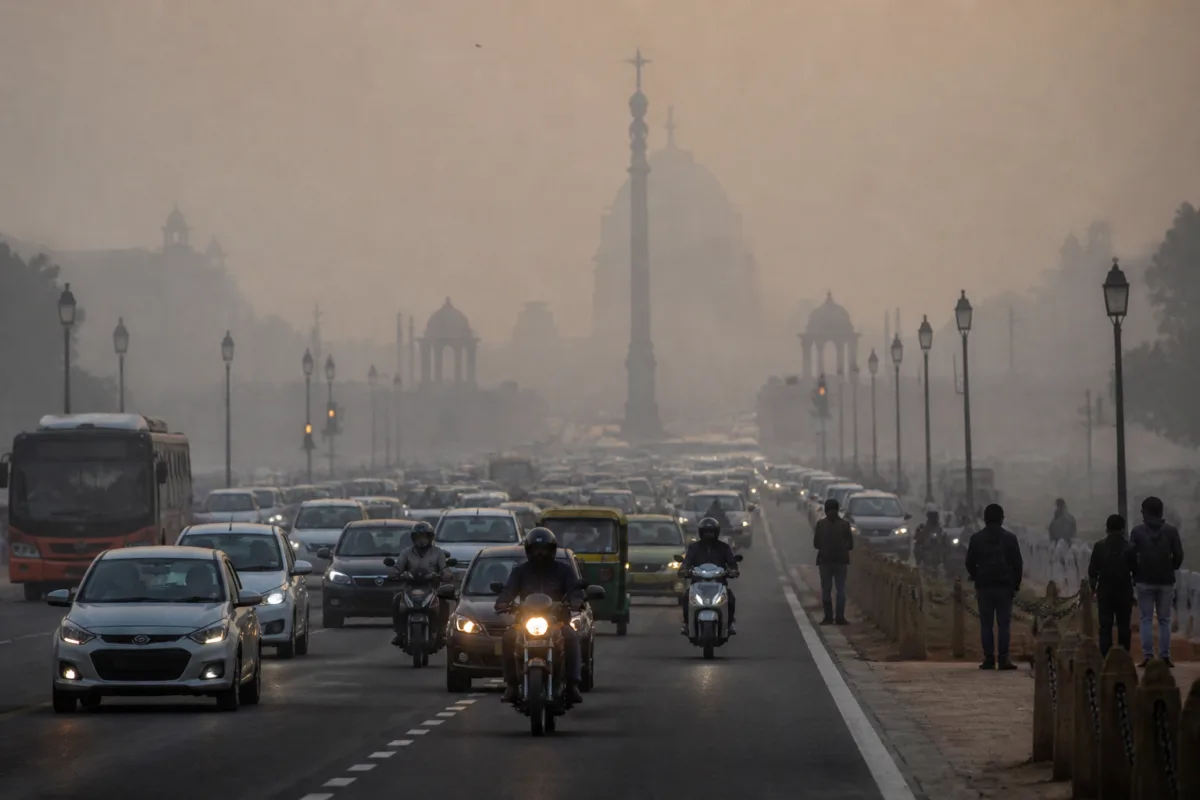
Delhi’s air quality crossed into the severe category at 16 monitoring stations for the first time this season on Friday, as stagnant winds allowed a thick layer of smog to remain over the capital. The city’s overall Air Quality Index reached 403 at 8 am before improving to 373 by 4 pm after sunlight and a modest increase in wind speed.
The IIT area recorded the worst reading at 452, placing it in the severe-plus category, for which an AQI above 450 is considered critical. North Campus recorded 446, followed by NIH Narela and Pusa at 437 each. Burari Crossing recorded 433, Punjabi Bagh 431, Commonwealth Complex 428, Chandni Chowk 427 and Mathura Road 421.
Other locations in the severe category included ITO at 419, NSUT Jaffarpur at 418, Jawaharlal Nehru University at 413, Jahangirpuri at 409, Talkatora Garden at 407, DTU at 404 and NSIT Dwarka at 402. The readings show that the deterioration was spread across residential, institutional and high-traffic areas rather than being confined to one part of the city.
Neighbouring National Capital Region cities also recorded poor air quality. Ghaziabad’s AQI was 368, followed by Greater Noida at 348, Gurugram at 324, Noida at 313 and Faridabad at 298.
The weather is expected to provide some short-term relief. The India Meteorological Department has forecast light rain at different locations in Delhi on Sunday, along with wind speeds of 15 to 20 kmph. According to the report, stronger winds and rainfall could help disperse pollutant particles. The city recorded both maximum and minimum temperatures above normal on Friday.
Data from the Decision Support System identified transport as Delhi’s largest listed pollution contributor on Friday, accounting for 18.5 per cent. Residential sources contributed 4.6 per cent, industries outside Delhi 3.7 per cent, construction activity 2.5 per cent and road dust 1.3 per cent. The report also attributed shares of 7.2 per cent to Jhajjar and 5.4 per cent to Gurugram.
The Indian Institute of Tropical Meteorology identified biomass burning and secondary organic aerosol as the two biggest factors in Delhi’s pollution on Thursday, with each accounting for up to 25.4 per cent of the city’s total pollution. Vehicle emissions were the third-largest factor. Secondary organic aerosols are extremely small solid particles formed in the atmosphere from other pollutants.
Enforcement action has also increased. The municipal administration issued more than 12,000 challans against pollution violators between November 2 and November 13, according to the report. The penalties imposed through these challans exceeded Rs 1.30 crore.
The immediate weather-related relief will depend on the arrival and spread of the forecast rain and stronger winds. The next significant monitoring point will be Sunday’s weather conditions and their effect on Delhi’s station-wise AQI readings.

