


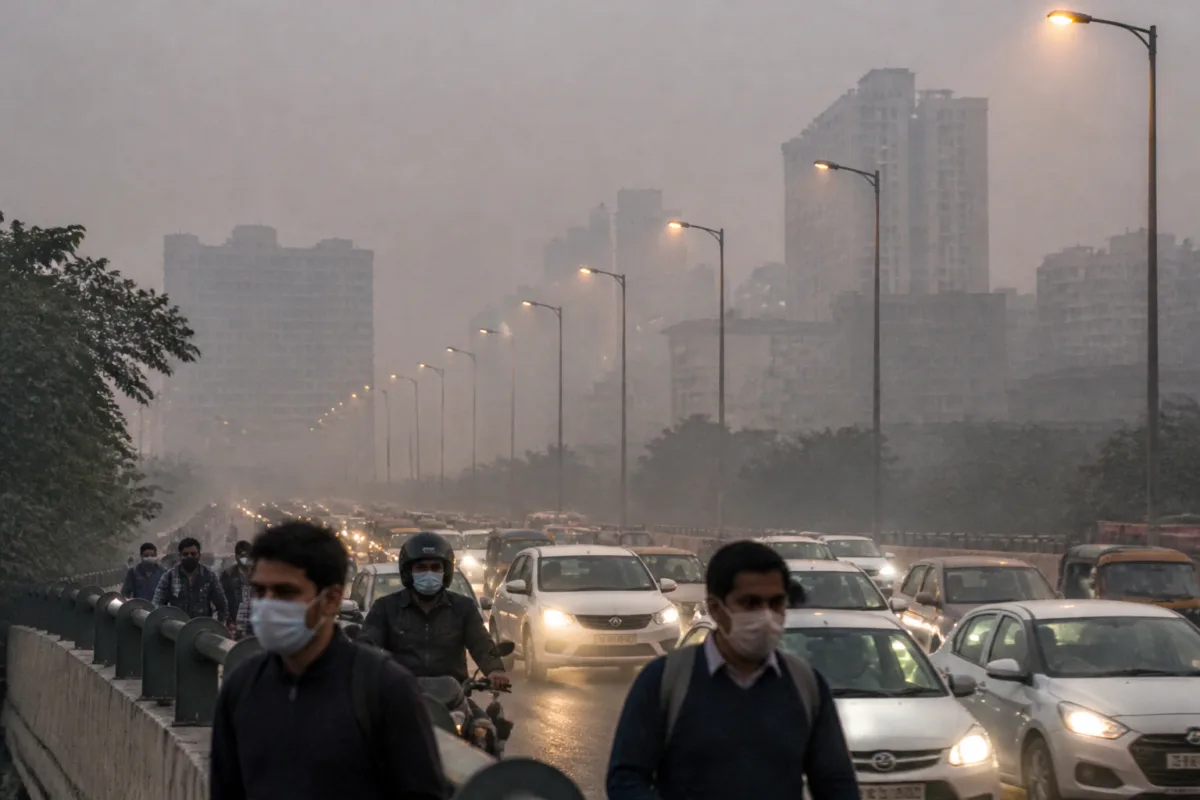
Delhi’s air quality deteriorated again on Wednesday, with the city-wide Air Quality Index rising to 313 and the DTU monitoring station recording a severe AQI of 414, as lower wind speeds limited the dispersal of pollutants across the National Capital Region.
The Central Pollution Control Board recorded Delhi’s average AQI in the “very poor” category on Wednesday evening. The reading was 14 points higher than Tuesday’s AQI of 299, when stronger winds had brought a brief improvement in air quality.
DTU recorded the worst conditions among the city’s monitoring locations, with the AQI crossing 400. An AQI above 400 falls in the “severe” category and indicates a sharper deterioration in ambient air conditions than the city-wide average. The report said only one of Delhi’s 58 monitoring stations recorded a severe-category reading on Wednesday.
Air quality experts cited the reduction in wind speed as a key factor behind the renewed rise in pollution. When winds weaken, particulate matter remains concentrated closer to the ground instead of dispersing more quickly. The air-quality trend therefore worsened despite the improvement recorded a day earlier.
Delhi’s Air Quality Early Warning System has forecast a continued rise in particulate pollution over the next two days. Concentrations of PM2.5 and PM10 are expected to remain elevated, with the system indicating that weather-related conditions could keep Delhi’s air in the “poor” to “very poor” range.
The forecast means that the short-lived improvement on Tuesday has not translated into a sustained recovery. For residents, the change highlights how quickly pollution levels can move between categories when wind conditions shift, even without a new pollution source being identified in the supplied report.
The weather outlook is also limiting the prospect of immediate relief from rain in Delhi and the NCR. The India Meteorological Department has forecast scattered to widespread rain or snowfall in the western Himalayan region under the influence of a western disturbance until November 13, with the possibility of heavy rain or snowfall at isolated places in the Kashmir Valley on November 12. However, no rainfall has been forecast for Delhi and the NCR this week.
Rain and stronger winds can influence the removal or dispersal of pollutants, but the current forecast does not indicate that either factor will provide near-term relief in the capital region. The early warning system’s projection of elevated PM2.5 and PM10 therefore remains the immediate operational outlook for Delhi.
The next two days will determine whether the city’s AQI remains in the very poor category or worsens further at individual monitoring locations. Authorities and residents will be guided by station-level readings as well as the city-wide average, with DTU currently showing the sharpest deterioration among the monitored sites.

