


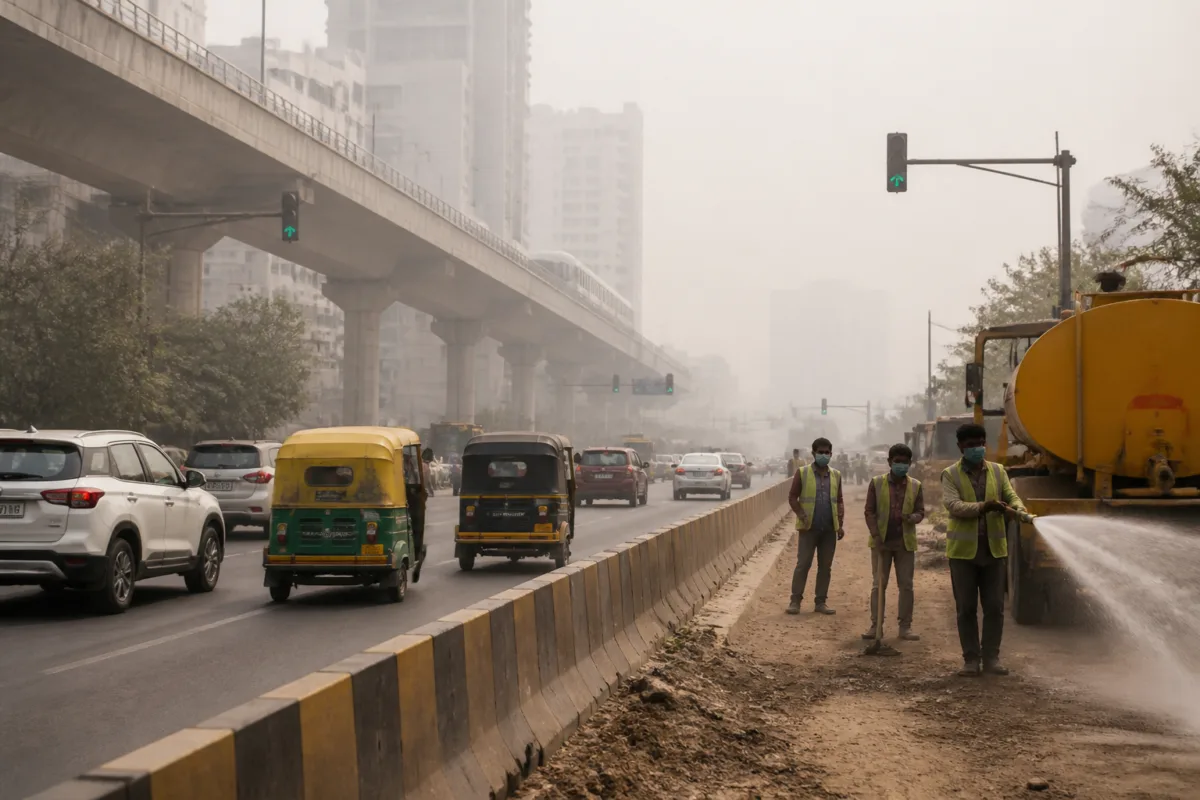
The Delhi government has ordered intensified monitoring of pollution hotspots and faster field-level action after Chief Minister Rekha Gupta chaired a high-level review meeting at the Integrated Command and Control Centre (ICCC) on 18 November. The meeting brought together cabinet ministers and senior officials from departments involved in controlling air pollution across the capital.
The review focused on the steps already taken to address Delhi’s deteriorating pollution situation and on improving coordination between the agencies responsible for enforcement. According to the report by Jagran – New Delhi, the chief minister directed officials to identify heavily polluted areas and maintain continuous surveillance at these locations.
The instructions cover three major sources identified in the meeting: dust, vehicle emissions and industrial emissions. Officials were told to undertake prompt and effective action on the ground to control these sources. The report did not specify new numerical targets, enforcement deadlines or the number of hotspots that will be monitored.
The ICCC meeting also placed interdepartmental coordination at the centre of the government’s response. Pollution control in Delhi involves multiple agencies and operational departments, making coordination important for activities such as monitoring, enforcement and action against violations. The chief minister asked the departments concerned to work together and strengthen their coordination for the campaign.
The government’s directions include strict action against those found violating pollution-control rules. The report said that the chief minister made clear that negligence at any level would not be tolerated. However, it did not identify the specific agencies responsible for enforcement in individual hotspots or outline the penalties to be applied.
The meeting reflects the administrative challenge of managing air pollution through several urban systems at once. Dust can arise from roads and construction activity, while vehicle emissions are linked to the movement of people and goods across the city. Industrial emissions require monitoring of commercial and production activity. The government’s stated approach is therefore based on combining surveillance, field inspections and enforcement rather than relying on a single intervention.
The use of the ICCC for the review also indicates an effort to bring pollution-related information and departmental action into a central monitoring framework. The supplied report does not, however, provide details on the data systems used, the frequency of hotspot reviews, or whether residents will be able to access monitoring information.
For citizens, the immediate significance of the directives will depend on how quickly they translate into visible action in polluted neighbourhoods. The report does not provide air-quality readings, locations of specific hotspots, the number of violations recorded or details of any action already taken against individuals or establishments.
The Delhi government has directed all concerned departments to act collectively and continue measures aimed at providing cleaner air to residents. Further implementation details, including hotspot lists, enforcement outcomes and department-wise action, were not included in the report.

