


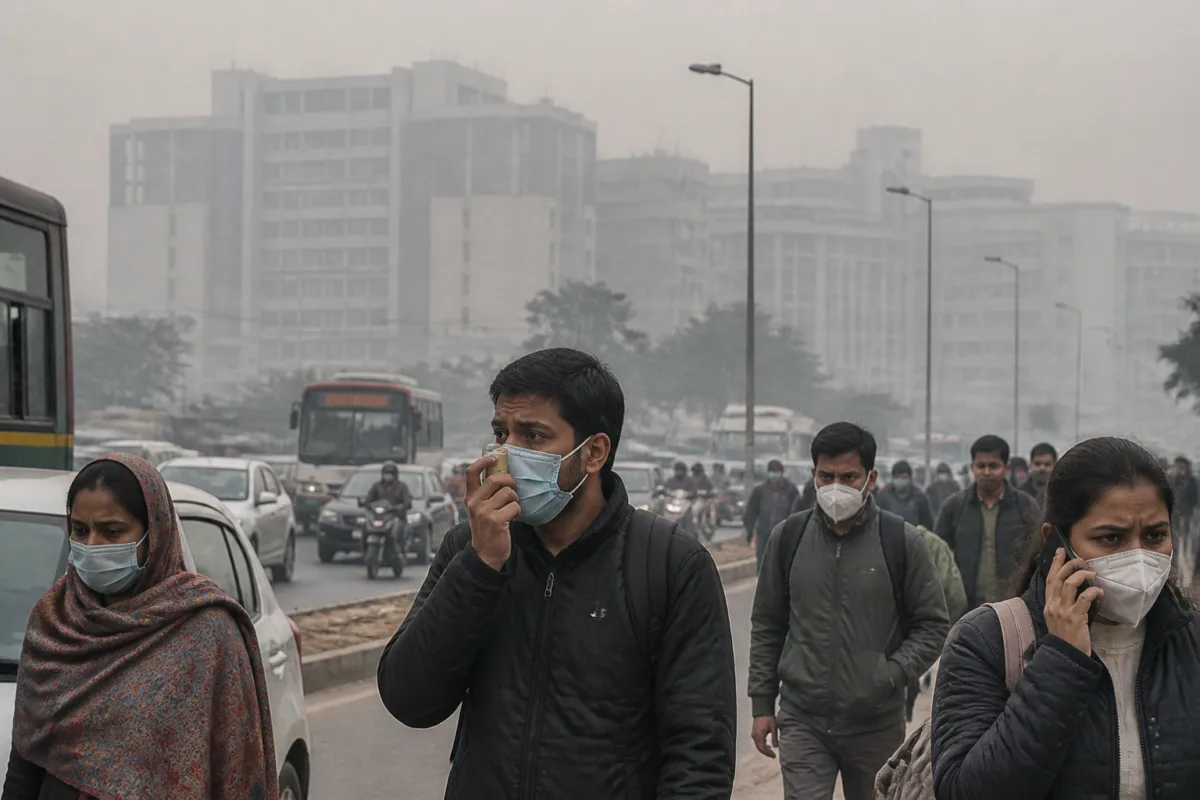
Delhi air pollution is increasingly being understood as a city-wide health risk rather than a problem confined to the lungs. Warnings from senior doctors at AIIMS, along with figures presented by the Union Health Ministry in Parliament, point to a wider burden involving the heart, blood vessels, brain, kidneys and other bodily systems, while hospitals continue to receive patients with serious respiratory illness.
The immediate concern is exposure to PM2.5, a category of very fine particulate matter that can travel deep into the lungs. The report, citing former AIIMS pulmonary department head Professor G.C. Khilnani, states that these particles may enter the bloodstream after reaching the lungs. That process can increase inflammation and oxidative stress in the body, affecting the functioning of blood vessels.
The importance of this warning lies in the way it changes the urban health question. Air pollution is often discussed through air-quality readings, visibility and respiratory symptoms. But the evidence cited by the report places the issue across multiple medical systems. The possible consequences described include a higher risk of heart disease, heart attacks and strokes, alongside effects on the kidneys and digestive system.
Professor Anant Mohan, head of the AIIMS pulmonary department, has also warned that pollution affects the heart, brain and other bodily functions. These statements do not establish that every case of cardiovascular or neurological illness in Delhi is caused by pollution. They do, however, underline the medical concern that fine particulate exposure can have consequences beyond short-term breathing discomfort.
That distinction matters for a city where exposure is not limited to a single location or occupation. Residents encounter polluted air while commuting, working outdoors, attending school, shopping and carrying out routine activities. The report does not provide a detailed exposure map or break down risks by neighbourhood, occupation or income. It does show that the public-health response cannot be limited to treating people after they arrive at an emergency department.
The hospital data cited in the report provides a measure of the pressure already reaching Delhi’s medical institutions. Figures from the Union Health Ministry, presented in Parliament, show that more than 204,758 patients with serious respiratory diseases reached the emergency departments of six major hospitals between 2022 and 2024. The hospitals listed are AIIMS, Safdarjung Hospital, Dr Ram Manohar Lohia Hospital, the Lady Hardinge Medical College group, the National Institute of Tuberculosis and Respiratory Diseases, and Vallabhbhai Patel Chest Institute.
This figure does not, by itself, identify how many cases were caused by air pollution. It is a count of patients with serious respiratory illnesses who reached emergency departments at the named institutions over the three-year period. Its value is therefore as an indicator of healthcare demand, not as a direct calculation of pollution-attributable disease.
The same caution applies to the report’s account of the period after Diwali last year, when it says the number of patients reporting breathing difficulties rose by around 15 per cent. The report attributes this observation to the AIIMS pulmonary department. It does not provide the underlying patient count, the comparison period or a complete account of other factors that may have influenced hospital attendance. The figure nevertheless illustrates how short-term pollution episodes can become visible through emergency-care demand.
For Delhi’s health system, the operational consequence is that pollution-related risk may arrive in waves. Patients with asthma and chronic obstructive pulmonary disease can face worsening symptoms, while people with cardiovascular conditions may require urgent care. The report specifically notes an increase in patients reaching emergency departments with asthma, COPD and heart attacks. It does not establish a complete trend across all hospitals, but it connects polluted-air episodes with the need for hospitals to manage both respiratory and cardiovascular emergencies.
The institutional picture is also significant. AIIMS doctors are providing clinical warnings, while national-level figures are being cited from the Union Health Ministry in Parliament. This places air pollution at the intersection of clinical medicine, public health administration and urban governance. Hospitals treat the consequences, but the exposure occurs across the city’s wider environment. The report does not identify a single agency responsible for reducing all sources of pollution, nor does it provide a current emissions breakdown. That absence is itself important: the available material describes the health burden more clearly than it explains the complete administrative chain for preventing it.
The recommended precautions focus on reducing individual exposure during periods when the air-quality index is poor. People who must go outdoors are advised to wear a well-fitting N95 mask. Children, older people, pregnant women, and those with heart or respiratory conditions are advised to take particular care. The report also recommends using an appropriately sized air purifier indoors, continuing prescribed medicines for asthma and COPD, carrying inhalers, and seeking medical advice in case of persistent coughing, breathlessness or chest tightness.
These steps reflect the practical limits faced by residents during pollution episodes. A mask, indoor filtration and regular medication can reduce personal risk or help manage existing conditions, but they do not eliminate exposure across the city. The source material does not quantify how effective each measure is under Delhi’s conditions, and it does not present them as substitutes for pollution control. They are described as precautions for residents, especially those at higher risk.
The distinction between public guidance and structural action is central to the pollution debate. Individual measures can help people respond to bad air, while the underlying exposure remains a matter of urban systems, enforcement and environmental management. The report does not provide details of emission sources, enforcement operations, construction controls, transport policy or seasonal pollution plans. As a result, it cannot support conclusions about which intervention is most responsible for changes in air quality.
What the supplied evidence does confirm is narrower but consequential. Delhi’s polluted air is being associated by senior AIIMS specialists with risks extending beyond the respiratory system. Major hospitals recorded more than two lakh emergency presentations for serious respiratory diseases between 2022 and 2024, according to figures cited from the Health Ministry. The report also records a roughly 15 per cent increase in patients with breathing difficulties after Diwali last year, as observed by the AIIMS pulmonary department.
The larger urban question is how the city measures and responds to health damage that may not appear immediately. Air pollution can present as a breathing complaint, but the warnings cited here involve blood vessels, the heart, the brain, kidneys and the digestive system. Emergency-department data can show pressure on hospitals, while a fuller public-health picture would require more detailed information on exposure, diagnosis, age, location and underlying conditions. Those details are not supplied in the report.
For now, the clearest next step for residents is to follow the precautions outlined by the doctors and seek medical advice when symptoms persist or worsen. For institutions, the evidence reinforces the need to track pollution-related illness across more than one medical category. The report establishes the health concern and the hospital burden; it leaves the scale of pollution-attributable disease and the effectiveness of individual protective measures to be established through more detailed data.

