


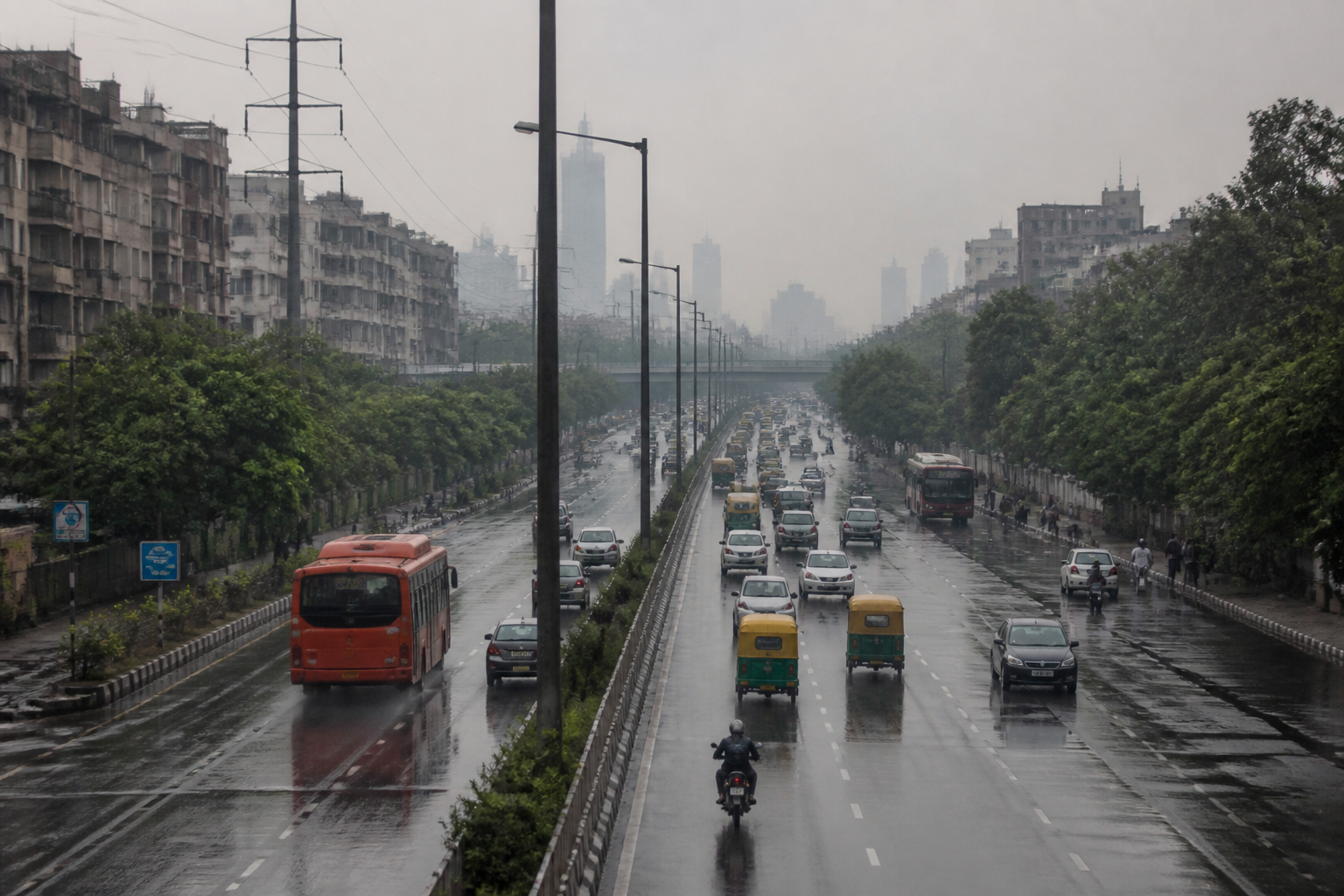
Delhi’s monsoon offered only brief relief from air pollution, with the city’s average PM2.5 concentration rising sharply after rainfall stopped. A Centre for Science and Environment assessment found that Delhi recorded just one day of “good” air quality across the 92 days from June to August, while PM2.5 levels rose 37.9% within 48 hours of rain events.
The findings challenge the assumption that heavy rainfall can substantially resolve Delhi’s air pollution problem. The city received 576.9 mm of rain during the monsoon period, but the improvement in air quality was temporary. Rain removed some particulate pollution from the atmosphere, yet gaseous pollutants remained, allowing pollution levels to rebound soon after the weather cleared.
That distinction matters because Delhi’s air quality problem is not limited to the winter months. The CSE assessment shows that the city experienced pollution across the monsoon, although at lower average levels than during summer. Delhi’s average PM2.5 concentration during the monsoon was 40.2 micrograms per cubic metre, 33.2% lower than the summer average of 60.2 micrograms per cubic metre. Lower pollution, however, did not translate into consistently clean air.
Of the 92 monsoon days analysed, 53, or 57.6%, fell in the “moderate” air quality category. Another 35 days were classified as “satisfactory”, three as “poor” and only one as “good”. The single good-air day was recorded on 9 July, when 67.75 mm of rain fell. On 8 August, Delhi received the season’s highest rainfall of 101.05 mm, but air quality reached only the “satisfactory” category.
The pattern indicates that rainfall can temporarily suppress particulate matter without removing the emissions that continuously enter the urban atmosphere. In its analysis of six separate rainfall events, CSE found that the average PM2.5 level stood at 40.6 micrograms per cubic metre before rain. It fell to 32.7 during rainfall, a reduction of 19.5%.
The improvement began to reverse almost immediately. PM2.5 rose to 36.2 micrograms per cubic metre 24 hours after rainfall and reached 45.1 micrograms per cubic metre after 48 hours. The level two days after rain was therefore 37.9% higher than during the rainfall event and 11.1% higher than the pre-rain average.
This rebound is the central evidence in the assessment. Rainfall changes atmospheric conditions for a short period, but it does not address the sources producing pollution on the ground. Once rainfall ends, emissions from transport, industry, waste burning, construction-related activity and other urban sources continue to enter the air. The data supplied by CSE does not assign a precise share of the post-rain increase to each source, but it demonstrates that weather-driven improvement is not equivalent to emissions reduction.
The pollutant mix also complicates the idea that rain alone can deliver clean air. CSE found that ground-level ozone was the dominant pollutant on 20 monsoon days. Nitrogen dioxide and carbon monoxide were also significant. While rain can wash particulate pollutants out of the air, gaseous pollutants can persist, allowing air quality to deteriorate even during a season associated with frequent showers.
This is an important governance distinction. A city can record a visible and measurable fall in PM2.5 during rain without having improved its underlying emissions profile. If pollution returns within one or two days, the immediate atmospheric benefit has not been matched by a change in the systems that generate emissions. The result is a cycle in which residents receive intermittent relief but remain exposed to pollution for much of the year.
The findings also place Delhi’s winter pollution debate in a wider annual context. CSE’s executive director for research and advocacy, Anumita Roychowdhury, said rainfall provides temporary relief but does not eliminate the root sources of pollution. She called for year-round emission reduction across the National Capital Region rather than reliance on temporary measures during winter.
That recommendation points to the institutional challenge created by Delhi’s air basin. Pollution does not stop at municipal or state boundaries, and the assessment specifically calls for an integrated “airshed” approach across the NCR. Such an approach would require authorities to treat the region’s air as a shared environmental system rather than as a problem belonging to Delhi alone.
The policy measures cited by CSE cover several urban systems. These include an electricity-based transport system, cleaner industrial fuels, a ban on open waste burning, recycling of construction waste, uninterrupted electricity supply and integrated air-quality management across the NCR. Together, they show that air pollution is connected to mobility, industrial production, waste management, construction and power reliability.
Each of these areas is administered through different institutions and enforcement arrangements. Transport policy involves public agencies, vehicle operators and commuters. Industrial fuel decisions involve factories, regulators and energy suppliers. Waste burning is linked to collection, disposal and enforcement by local authorities. Construction-waste recycling depends on the capacity to collect and process material. Reliable electricity can reduce dependence on polluting backup systems. An airshed strategy would have to coordinate these responsibilities across jurisdictions.
The monsoon data also exposes the limits of using seasonal averages as the sole measure of progress. Delhi’s average PM2.5 level was substantially lower during the monsoon than in summer, but the city still had only one good-air day. The average therefore captures an overall reduction while obscuring the frequency with which residents experienced air that remained moderate or worse.
The six rainfall events provide a more dynamic picture. They show how quickly air quality changes before, during and after rain. A decline from 40.6 to 32.7 micrograms per cubic metre may appear significant while the rain is falling, but the subsequent rise to 45.1 within 48 hours shows that the improvement was not durable. For urban policy, duration matters as much as the size of a temporary decline.
The evidence also raises a question about how authorities define success. If clean-air conditions appear only during exceptional weather and disappear soon afterwards, weather is doing more of the work than policy. A durable improvement would require pollution levels to remain lower after atmospheric conditions return to normal. The assessment does not establish that such a shift has occurred in Delhi.
For residents, the implications are practical. The end of a rainfall spell cannot be treated as the end of an air-pollution episode. People may experience visibly clearer conditions during rain, followed by a rapid return of fine particulate pollution and continued exposure to ozone, nitrogen dioxide and carbon monoxide. The city’s daily experience of air quality is therefore shaped by both weather and the performance of urban systems.
What the CSE assessment confirms is that Delhi’s monsoon pollution is not a contradiction but a structural signal. Rain can lower PM2.5 temporarily, yet the city’s emissions sources remain active. What remains unresolved is how quickly and effectively institutions across the NCR can reduce those emissions throughout the year. The next test is whether the measures identified by CSE are implemented as coordinated systems rather than activated only when winter pollution becomes an emergency.

