


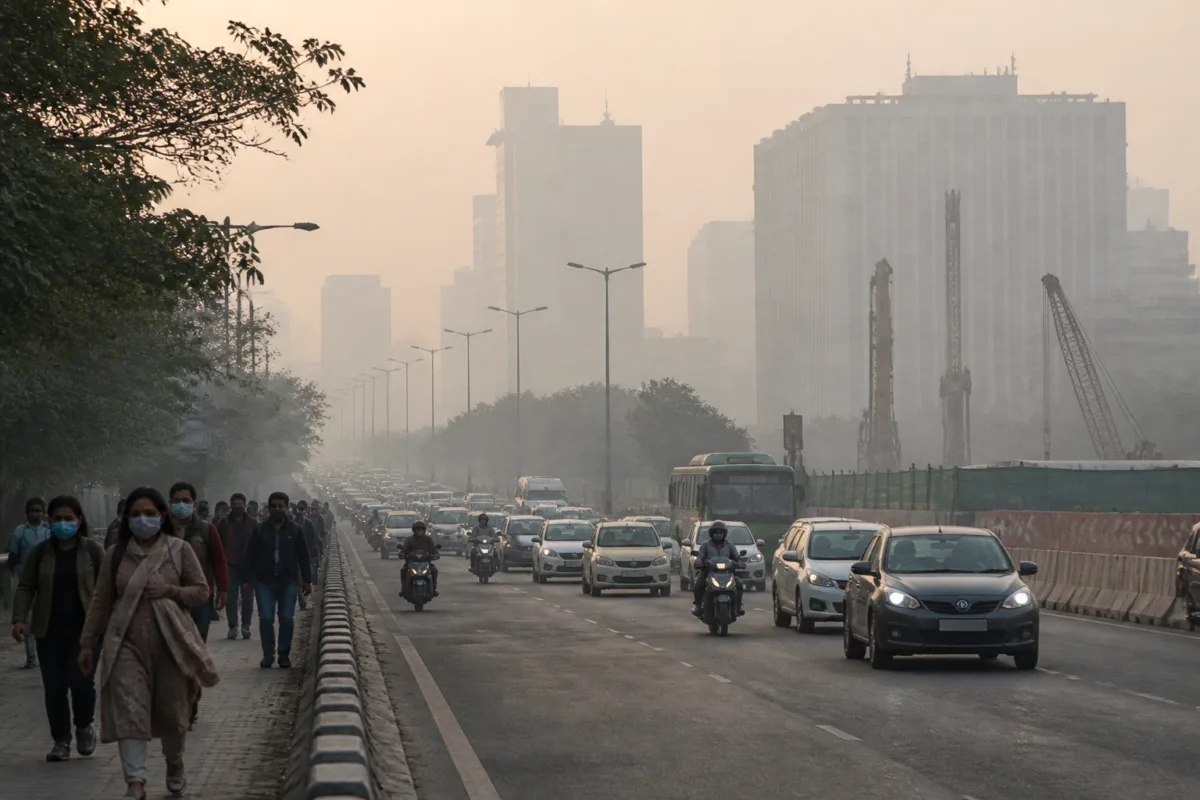
Delhi-NCR has moved to stricter pollution controls after the Commission for Air Quality Management imposed Stage 3 measures under the Graded Response Action Plan, as the capital’s air quality deteriorated sharply and citizens demanded stronger action against the sources of pollution.
Delhi recorded an overall Air Quality Index of 391 on Friday, placing it in the ‘very poor’ category and close to the ‘severe’ threshold. The Air Quality Early Warning System said the city was likely to record its first severe air-quality day of the season on Friday, with the deterioration expected to continue until November 8, around Diwali.
In its daily bulletin, the Indian Institute of Tropical Meteorology, Pune, forecast that Delhi’s air quality would remain in the ‘very poor’ category on November 6 and could enter the ‘severe’ category from November 7 to 9. The outlook for the following six days indicated conditions ranging from ‘severe’ to ‘very poor’.
Under GRAP-3, dust-generating and air-pollution-causing construction and demolition activities are subject to strict restrictions across the entire National Capital Region. The measures directly affect construction sites, demolition work and other activities that can add dust to already polluted air.
The Delhi government and the governments of other NCR states must also decide whether public, municipal and private offices should operate at 50 per cent strength, with the remaining employees working from home. The source report did not specify whether all administrations had taken that decision by Friday evening.
GRAP is an emergency framework designed to prevent further deterioration once air pollution reaches specified levels. The first stage is triggered when the AQI is between 201 and 300, while the second stage applies between 301 and 400. Stage 3 covers the 401-500 range, according to the framework described in the report, while Stage 4 is invoked when the AQI exceeds 450.
The announcement came as citizens, environmental activists and student leaders met at the Press Club of India to demand urgent action. Speakers accused authorities of shifting responsibility for the crisis instead of addressing pollution from major sources. AISA president Neha called for immediate action and said the consequences were falling disproportionately on children, workers and economically weaker sections.
Environment activist Bhavreen Khandari alleged that authorities had not adequately addressed emissions from thermal power plants and waste-to-energy facilities. Environment researcher and activist Soutrik Goswami identified vehicular and industrial emissions as major contributors to Delhi’s poor air quality and criticised the continued focus on farm fires in neighbouring states.
JNUSU vice-president K Gopika Babu questioned whether access to clean air was becoming a privilege, noting that air purifiers, work-from-home arrangements and online classes were not equally available to all residents. AISA leader Anjali, who moderated the meeting, said the effects were particularly severe for working-class and poor families.
The immediate official measures are the restrictions on construction and demolition activity and the pending decision on reduced office attendance across NCR. The IITM forecast indicates that residents and authorities will face at least several more days of very poor to severe air quality, with the next major monitoring period extending through November 9.

