


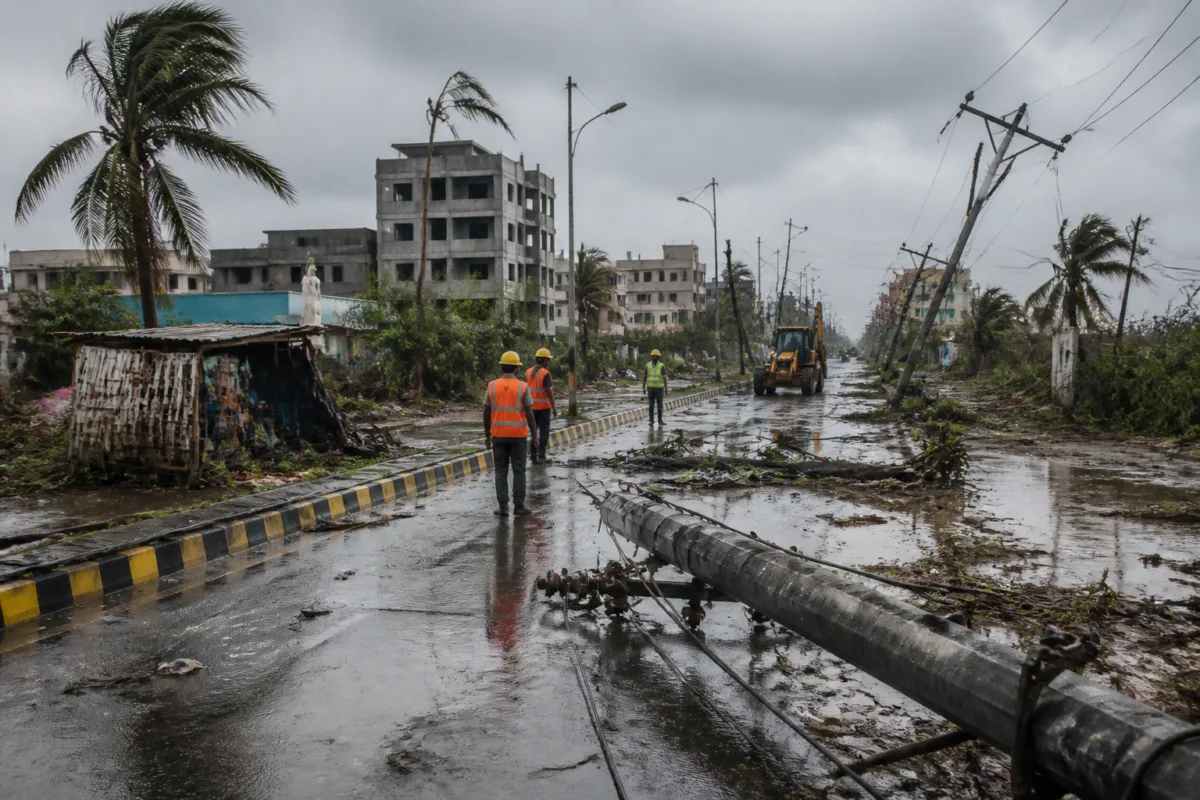
A new study on Cyclone Arnab has put a measurable figure on a problem that coastal infrastructure systems are increasingly being forced to confront: human-induced warming made the storm’s direct physical damage in India 33 per cent higher than it would have been in a pre-industrial climate. The finding does not describe climate change as a distant environmental risk. It connects warmer conditions directly to the performance and repair burden of infrastructure exposed to intense wind and rainfall.
Cyclone Arnab struck eastern India on October 28, bringing intense rain and peak one-minute sustained winds of up to 202 kilometres per hour, according to the report by Deccan Chronicle, which cited a study by researchers at Imperial College London’s Grantham Institute. The storm caused severe damage to infrastructure across Andhra Pradesh. The study estimated that the additional losses associated with the warmer climate amounted to tens of millions of dollars in direct economic damage.
The significance of the research lies in its comparison. Researchers used the Imperial College Storm Model, or IRIS, to simulate Cyclone Arnab under two conditions: the current climate, described as approximately 1.3 degrees Celsius warmer than the pre-industrial baseline, and a counterfactual climate without human-induced warming. This approach enabled the researchers to compare the storm that occurred with a modelled version of the same event under cooler historical conditions.
That comparison changes the question policymakers need to ask after a cyclone. It is no longer sufficient to consider only whether a storm was unusually strong or whether infrastructure was built to an earlier design standard. The study examines how the background climate altered the storm itself and, in turn, increased the damage imposed on physical assets. The result is a direct connection between atmospheric warming and the financial consequences borne by communities, public agencies, infrastructure owners and insurers.
The study found that climate change increased Cyclone Arnab’s maximum wind speed by approximately 5 per cent. It also intensified the storm’s eyewall rainfall rate by 11 per cent at landfall. These are not interchangeable hazards. Stronger winds place additional stress on structures, power-related assets and other exposed facilities, while more intense rainfall can increase the pressure on drainage, roads and other systems that must continue functioning during and after a storm. The supplied report does not identify every damaged asset or provide a facility-by-facility loss breakdown, but it confirms severe infrastructure damage across Andhra Pradesh.
The 33 per cent estimate refers to direct damage to physical assets in India compared with the pre-industrial climate baseline. The researchers also attributed roughly 25 per cent of the total economic damage to climate change. The difference between these two figures is important because they measure related but distinct dimensions of the event. One describes the increase in direct physical-asset damage, while the other expresses the estimated share of total economic damage attributable to climate change. Neither figure should be read as a complete account of the storm’s wider social cost.
The study’s use of a counterfactual scenario also provides a way to separate the storm’s inherent destructive force from the additional effect of warming. Cyclone Arnab would have caused damage in the pre-industrial baseline as well; the research does not suggest that climate change created the entire event. Instead, it estimates how much more damaging the storm became under current warming conditions. That distinction matters for infrastructure planning because it points to a changing risk environment rather than a simple increase in the number of extreme events.
For cities and settlements in cyclone-exposed regions, infrastructure damage is not limited to the moment when winds make landfall. Physical assets are part of connected systems. Roads support emergency access and the movement of repair crews. Drainage networks determine how quickly intense rain can be cleared. Buildings, utility installations and public facilities must withstand the combined effects of wind and water. When one part of that system is damaged, the disruption can extend beyond the asset itself. However, the supplied study report does not quantify service outages, repair periods, displacement or household-level losses from Cyclone Arnab, so those consequences cannot be assigned a numerical value here.
The evidence nevertheless points to a governance problem. Public agencies typically plan, finance and maintain infrastructure over long periods, while the climate conditions affecting that infrastructure are changing during its operating life. A road, building or utility installation designed using historical assumptions may face a different level of exposure when the same type of storm occurs under warmer conditions. The study’s comparison between current conditions and a pre-industrial baseline does not prescribe a particular engineering standard, but it shows why historical averages alone may not capture the full cost of present-day hazards.
The institutional implications extend across departments. Disaster management authorities respond to the immediate event, while municipal bodies, state agencies and infrastructure operators are responsible for assets and services. The report identifies Andhra Pradesh as the location of severe infrastructure damage but does not specify which agencies owned the affected assets, how reconstruction was financed or whether existing design standards were exceeded. Those unanswered questions are central to understanding how a quantified increase in climate-related damage translates into public expenditure and recovery decisions.
The study also places economic losses within a physical geography shaped by exposure. Cyclone Arnab struck eastern India, and the report identifies coastal communities as being affected by the costs of climate change. Coastal infrastructure is particularly important because it frequently supports dense settlements, transport links, utilities and economic activity while remaining exposed to powerful storms and intense rainfall. The supplied material does not provide population, asset-value or land-use data for the affected areas, so it cannot establish how exposure was distributed across neighbourhoods or income groups.
What it does establish is a sequence of measurable changes. Current conditions were modelled at about 1.3 degrees Celsius above the pre-industrial level. Maximum wind speed was approximately 5 per cent higher. Eyewall rainfall at landfall was 11 per cent more intense. Direct damage to physical assets was estimated to be 33 per cent higher, with roughly 25 per cent of total economic damage attributed directly to climate change. Together, these figures show how a relatively small change in the storm’s physical characteristics can correspond to a much larger increase in damage.
That relationship is one of the most important findings for urban infrastructure policy. Damage does not necessarily rise in a simple one-to-one relationship with wind speed or rainfall intensity. Infrastructure can be pushed past thresholds at which failures multiply, repair becomes more complex or interconnected services stop operating. The supplied report does not describe the model’s damage functions or identify such thresholds for specific assets, so the mechanism cannot be quantified further from the available evidence. But the gap itself highlights why asset-level climate-risk assessment matters.
The research was conducted by Imperial College London’s Grantham Institute and published on Thursday, according to the report. Dr Nathan Sparks, a researcher at the institution’s Department of Physics, said the findings showed that the costs of climate change were affecting coastal communities in eastern India in the present, rather than representing only future projections. His statement frames the study as an assessment of realised damage associated with a recent storm, while the modelling provides the comparison used to estimate climate change’s contribution.
This combination of event reconstruction and counterfactual modelling is useful for public administration because it creates a basis for reviewing losses after a disaster. A conventional post-storm assessment can document what was damaged and how much repair may cost. An attribution study adds another question: how much of the observed intensity and damage was associated with the warmer climate? That information can inform the way governments interpret recurring losses, although the supplied material does not say whether the study will be used in any specific Indian planning, funding or insurance process.
The policy landscape described in the report remains limited. No new government scheme, revised building code, infrastructure standard, funding allocation or official response is identified. It would therefore be inaccurate to claim that Andhra Pradesh or any other authority has adopted measures because of this study. What can be said is that the research provides evidence relevant to decisions about cyclone preparedness, infrastructure design, asset maintenance and post-disaster recovery. The administrative responsibility for acting on that evidence is not established in the supplied material.
The same limitation applies to long-term trends. The report concerns one cyclone and compares it with a modelled version of that event under a pre-industrial climate. It does not provide a time series of cyclones, a comparison with earlier storms, a statewide inventory of infrastructure losses or a national estimate of climate-attributed damage. The findings should therefore not be used to claim that every future cyclone will produce a 33 per cent increase in damage. They demonstrate the estimated influence of warming on Cyclone Arnab specifically.
Even within those limits, the event raises a larger urban question: whether infrastructure systems are being evaluated only for their construction cost or also for the changing hazard conditions that will determine their durability. The study’s numbers suggest that the cost of inaction is not confined to emissions policy or environmental damage. It can appear in damaged physical assets and in the additional economic burden created when a storm develops greater wind intensity and rainfall under warmer conditions.
For citizens, the practical consequences depend on the assets and services affected, details that the supplied report does not provide. For governments, the immediate next step identified by the evidence is not a particular project but a clearer understanding of how climate attribution should enter infrastructure risk assessment. The study confirms that climate change increased the estimated damage from Cyclone Arnab. It does not establish the adequacy of current protective infrastructure, the effectiveness of the response or the cost of future adaptation. Those are the questions that further asset-level assessments, official loss data and implementation records would need to answer.

