


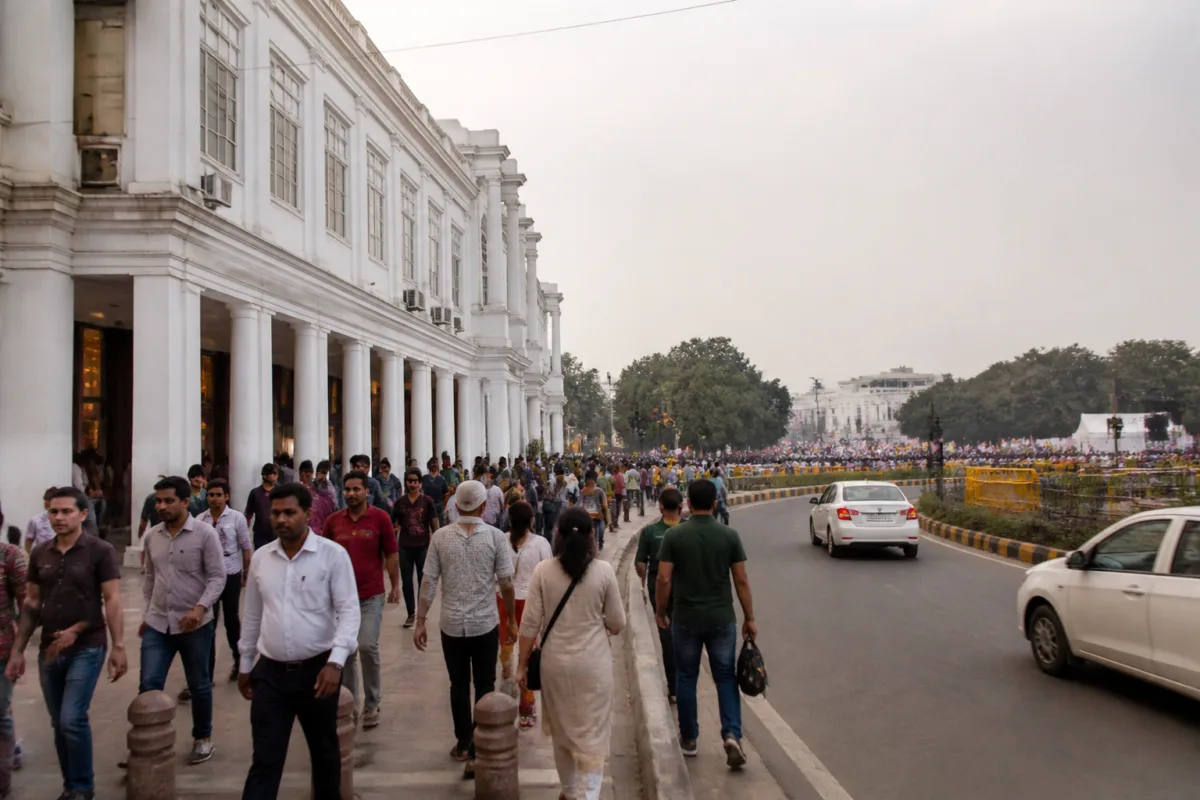
A political dispute over Connaught Place shops has brought Delhi’s recurring conflict between public demonstrations and commercial activity into focus, with Congress leader Rahul Gandhi alleging that stores were forcibly closed during an INDIA bloc march ahead of Diwali. The allegation has not been independently established in the supplied report, which does not include responses from shopkeepers, the police, civic authorities or the BJP.
Gandhi made the claim during the INDIA bloc’s “Chalo Delhi” march and rally at Ramlila Maidan. The demonstration was organised over alleged irregularities in electoral rolls and criticism of the Election Commission and Chief Election Commissioner Gyanesh Kumar. The march took place six days before Diwali, a period when retailers typically depend on increased customer movement, according to the report’s account of the concerns raised by Delhi trader organisations.
In a video shared from his official X account, Gandhi said supporters had been asked to shop at local markets while attending the march. He said that, on reaching Connaught Place, they found that “all the shops” had allegedly been forcibly closed by the BJP. He used the claim to challenge assertions that the political mobilisation itself had harmed traders and asked who was responsible for the alleged business losses.
The report does not provide the number of shops that were closed, the duration of any closure, the identity of the agency or group that ordered it, or an estimate of the financial loss. It also does not establish whether the closures affected the entire Connaught Place market or only particular shops or blocks. These details are central to determining whether the disruption was caused by an official security arrangement, a voluntary decision by traders, a political directive or another operational factor.
The trader organisations cited in the report had earlier expressed concern that the march could affect business. They reportedly objected to the timing and venue because the event was scheduled shortly before Diwali, when markets face heightened commercial activity. In response to those concerns, Gandhi appealed to supporters to combine participation in the rally with shopping at local markets so that traders would not suffer losses.
The episode illustrates a practical governance problem in central commercial districts: public demonstrations require crowd management, traffic controls and security arrangements, while markets depend on predictable access for customers, workers, deliveries and emergency services. The supplied report, however, does not specify what restrictions were imposed around Connaught Place, which authority managed them, or whether any formal closure order was issued.
Connaught Place is both a major retail and hospitality destination and a prominent public gathering point in the national capital. When political events are held nearby, the effect on businesses can extend beyond the immediate venue through changes in pedestrian access, vehicle movement and customer decisions. Establishing that effect requires evidence from traders, market associations, enforcement agencies and the relevant civic administration rather than political claims alone.
The timing of the event adds significance to the dispute. A demonstration held shortly before Diwali can coincide with a period of high commercial expectations, making even a short interruption a matter of concern for retailers. At the same time, the report does not include a comparison of sales before and after the march, footfall data, transaction figures or a verified assessment of losses. The scale of the economic impact therefore remains unquantified.
The supplied account also does not include a response from the BJP to Gandhi’s allegation. Nor does it record statements from Delhi Police, the New Delhi Municipal Council or Connaught Place’s trader representatives confirming whether shops were closed forcibly. Without those responses, the central question—who ordered or caused the reported closures—remains unresolved.
The political dispute therefore rests on two separate claims that should not be conflated. The first is that trader organisations feared disruption from the march and objected to its timing and location. That concern is reported in the supplied material. The second is Gandhi’s allegation that the BJP forcibly shut shops in Connaught Place. That claim is attributable to him but is not independently confirmed in the report.
Further reporting would need to establish the exact security and traffic plan for the march, whether any written closure instruction was issued, how many businesses were affected and what traders recorded about their losses. Statements from the police, civic agencies, market associations, affected shopkeepers and the BJP would be necessary to determine whether the reported disruption was an organised closure, a precautionary response or a broader effect of the rally.
For now, the Connaught Place shops controversy demonstrates how Delhi’s commercial districts can become entangled in the logistics of political mobilisation, particularly during major retail periods. The available evidence confirms a dispute over anticipated and alleged business disruption, but it does not yet establish the responsibility, extent or financial consequences of the reported closures.

