


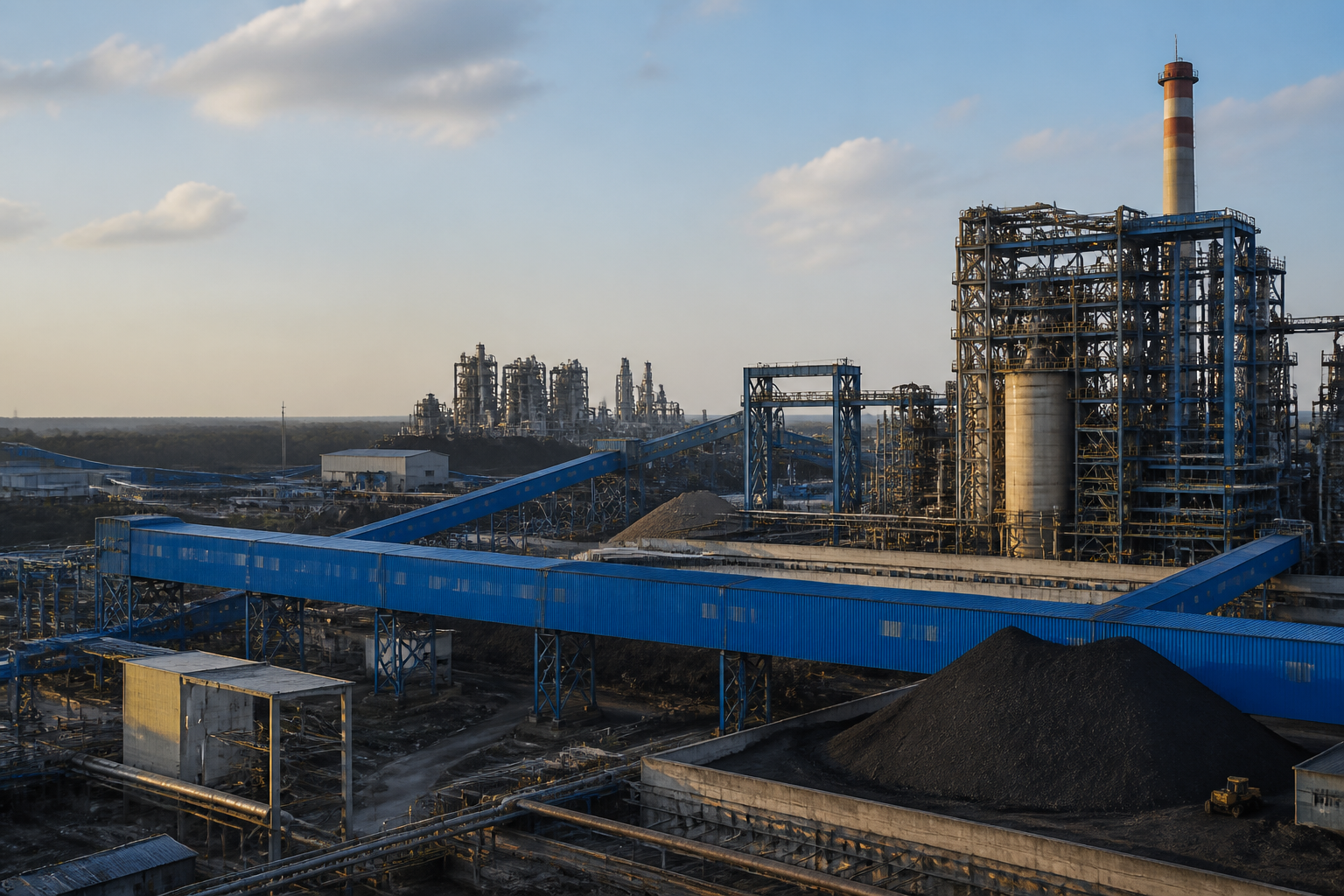
Subheadline: Seven applications have opened the first round of a ₹37,500-crore programme designed to turn domestic coal into industrial feedstocks and fuels while reducing import dependence.
Standfirst: India’s coal gasification programme has moved from policy design to project selection, with seven applications submitted in its first round. The proposals span urea, direct reduced iron, syngas and synthetic natural gas, indicating that the scheme is intended to serve several industrial uses rather than a single fuel market. Its stated objective is to expand domestic coal gasification capacity to 100 million tonnes by 2030, including 75 million tonnes supported through the scheme. The scale of the proposed public outlay, the estimated investment it could attract and the technical preparation required point to a long implementation cycle. This analysis examines what the first round reveals about India’s attempt to use coal for industrial substitution, the limits of that strategy and the institutional work that will determine whether applications become operating projects.
The first round of India’s coal gasification scheme has received seven applications, including three separate proposals from Adani Enterprises. The applications were submitted after the coal ministry opened the process in July, with the first-round window closing on September 7, according to a report by Economic Times. Other applicants named in the report are NTPC, Talcher Fertilisers, Gallantt Ispat and Shyam Sel & Power.
The Cabinet approved the scheme with a financial outlay of ₹37,500 crore. Its stated purpose is to scale up coal gasification so that domestic coal can be converted into industrial feedstocks and fuels. The policy is also intended to reduce India’s dependence on imports of liquefied natural gas, urea, ammonia and methanol. Together, those imports were valued at around ₹2.77 lakh crore in FY25, the report said.
The application mix provides an early indication of how the programme may be structured in practice. Adani Enterprises has applied for three urea projects. Talcher Fertilisers has also sought support for a urea project, while Gallantt Ispat has proposed a project involving direct reduced iron and syngas. NTPC has applied for a synthetic natural gas project and Shyam Sel & Power has proposed syngas production.
This spread of proposals matters because coal gasification is not a single end-use technology. Gasification converts coal into a synthesis gas, or syngas, that can be processed into products such as hydrogen, ammonia, methanol, synthetic natural gas and fuels. In the projects identified in the first round, the intended outputs range from fertiliser inputs to steelmaking-related materials and gas substitutes. The scheme therefore links coal policy to fertiliser production, metals, gas markets and industrial manufacturing.
The government’s stated objective is to achieve 100 million tonnes of coal gasification capacity by 2030. Of that total, 75 million tonnes is expected to be developed under the ₹37,500-crore scheme. The report said the programme could catalyse investments estimated at ₹2.5 lakh crore to ₹3 lakh crore. These figures position the scheme as an industrial investment programme as much as a coal-sector initiative.
The numbers also show the difference between public support and total project cost. The government’s financial outlay is intended to enable a much larger pool of private and public investment. Whether that leverage is achieved will depend on the ability of applicants to complete feasibility studies, select workable technologies, secure financing, obtain environmental approvals and establish reliable feedstock and product arrangements.
The scheme builds on the National Coal Gasification Mission and an ₹8,500-crore scheme approved in January 2024. Eight projects are currently under implementation under that earlier programme, according to the Economic Times report. The new round is therefore not the beginning of India’s coal gasification policy, but an attempt to enlarge its scale and broaden its industrial application.
The policy logic is rooted in India’s dependence on imported industrial inputs. Urea and ammonia are closely tied to fertiliser production, while methanol and LNG serve different industrial and energy uses. Replacing a portion of these imports with products derived from domestic coal could improve domestic supply security, provided the resulting projects are technically viable and economically competitive. The supplied material does not establish how much import substitution the seven applications could deliver, or when any of the proposed facilities may begin operations.
The proposal involving direct reduced iron illustrates the programme’s connection with the steel industry. Gallantt Ispat has applied for a project producing direct reduced iron and syngas. Direct reduced iron is an intermediate used in steelmaking, while syngas can serve as a chemical or energy input. The application suggests that the scheme could support integrated industrial projects in which coal gasification is linked to downstream manufacturing rather than treated as a standalone fuel process.
The proposals for urea show another part of the government’s strategy. Fertiliser production depends on ammonia, and ammonia production requires hydrogen. Coal gasification can provide syngas that is subsequently processed into these industrial inputs. However, the source material does not provide project capacities, proposed locations, technology providers, emissions profiles or expected production timelines for the urea proposals. Those details will be necessary to judge their likely contribution to import reduction.
The programme’s implementation challenge is visible in the preparation required before construction can begin. The projects are described as large-scale and capital-intensive, requiring pre-feasibility studies, technology assessments, environmental considerations and detailed financial planning. An application is therefore an early administrative milestone, not evidence that a commercial plant has secured all approvals or reached financial closure.
This distinction is important for evaluating the target of 100 million tonnes by 2030. The target covers total coal gasification capacity, while 75 million tonnes is expected to be developed through the new scheme. Meeting it will require a sequence of decisions after application: technical screening, project selection, financial arrangements, land and infrastructure planning, environmental permissions, coal supply and construction. The supplied report does not specify the timetable for these stages.
Coal supply will be a central operational question. Gasification projects need consistent access to suitable coal, and their economics depend on the relationship between feedstock cost, conversion efficiency, capital expenditure and the prices of the resulting products. The source identifies domestic coal utilisation as a policy goal but does not provide details on coal grades, allocation arrangements or pricing mechanisms for the proposed projects.
The programme also sits within a broader transition in how India defines energy and industrial security. The policy does not seek only to produce electricity from coal. It seeks to convert coal into feedstocks that are currently imported or produced through other industrial pathways. That makes the initiative relevant to manufacturing and trade as well as to mining. At the same time, the supplied material does not establish the projects’ comparative emissions performance, carbon-management requirements or environmental safeguards. Those questions will need to be addressed through the project approval process.
The role of public-sector and private-sector applicants is another feature of the first round. NTPC, a major public-sector power company, has proposed synthetic natural gas, while private and industrial applicants have proposed urea, syngas and direct reduced iron. Talcher Fertilisers brings a fertiliser-sector application, while Adani Enterprises has submitted three proposals. The range of applicants indicates that the scheme is being presented as an industrial platform with multiple participating sectors.
The first round also creates a test for how the government balances scale with project quality. A large financial outlay and an ambitious capacity target can accelerate investment, but gasification projects require substantial technical and financial preparation. The programme’s results will depend not only on how many applications are received, but on how many become viable projects and eventually operating capacity.
For cities and the built environment, the immediate effects are indirect but significant. Large industrial projects can generate demand for land, transport links, water, power, worker housing and logistics infrastructure. Fertiliser, steel and gasification facilities can also reshape industrial clusters and supply chains. The source does not identify project locations, so the local infrastructure and settlement implications cannot yet be assessed.
What the first round confirms is that India is attempting to use domestic coal beyond conventional combustion, with the government linking gasification to import substitution and industrial production. What remains uncertain is the scale, location, technology, financing and environmental performance of the projects behind the applications. The next significant milestones will be the evaluation of proposals, selection under the scheme, project development approvals and evidence that the proposed facilities can move from applications to construction and commercial operation.

