


Seven of 16 climate-related planetary vital signs have reached record extremes, according to a study published in BioScience. The findings do more than describe worsening global environmental conditions: they show why cities must now treat climate change as an active infrastructure, energy, food and public-safety challenge rather than a distant environmental threat.
The study tracked greenhouse gas concentrations, temperatures, the oceans, ice, Earth’s energy balance and wildfire, while also monitoring human activities driving these changes. Its authors said Earth’s climate system is moving deeper into “uncharted territory” and described the present moment as a diagnosis rather than a warning about the future.
That distinction matters for urban areas because cities concentrate people, buildings, transport networks, energy demand and economic activity. The supplied report does not provide city-level measurements or identify specific Indian urban areas facing immediate thresholds. It does, however, set out a global physical context in which decisions about land, energy, mobility, housing and public infrastructure will be made under growing climate pressure.
The study found that concentrations of carbon dioxide, methane and nitrous oxide all reached record levels again in 2026. Fossil fuel consumption increased by 0.9 per cent in 2025, with oil, coal and gas each reaching record highs. Annual energy-related carbon dioxide emissions also crossed 41 gigatonnes for the first time, according to the researchers.
These figures link urban development to the climate system through the energy that powers buildings, transport, industry and public services. They also expose the limits of treating emissions as an issue confined to power plants or heavy industry. Urban demand influences energy use, food consumption, construction activity, land-use change and the scale of infrastructure required to support economic growth.
The researchers said the rate of global warming may have accelerated from approximately 0.05 degrees Celsius per decade between 1880 and 1970 to around 0.36 degrees Celsius per decade between 2010 and 2024. At current rates, they said, global temperatures could reach 2 degrees Celsius above pre-industrial levels before 2050.
The report does not establish how individual cities will experience that threshold, nor does it provide a forecast for a particular region. Its significance for urban policy lies in the narrowing time available for infrastructure and governance systems to adjust. Roads, drainage networks, power systems, housing and public-health services are long-lived assets. Decisions made today can lock cities into energy-intensive and climate-exposed patterns for decades.
The authors also highlighted risks associated with climate tipping elements. The Amazon rainforest, they said, faces increasing vulnerability because of the combined effects of warming and deforestation. They identified a possible irreversible threshold at between 1.5 degrees Celsius and 1.9 degrees Celsius of warming.
That finding illustrates why climate risk cannot be assessed only through annual averages or isolated extreme events. A city may plan for a flood, heat episode, storm or power disruption as a discrete emergency. Tipping elements point to a different type of risk: changes in natural systems that can alter the conditions on which economies, food systems and settlements depend.
For urban governments, this complicates the division between mitigation and adaptation. Mitigation addresses the emissions produced by energy, buildings, transport and land use. Adaptation addresses the ability of residents and institutions to withstand hazards and changing conditions. The study’s authors said emissions cuts remain essential but must now be accompanied by rapid adaptation and “fast-track” measures to reduce near-term risks.
The language of fast-tracking is important because adaptation is often treated as a separate project rather than as a standard requirement for public investment. A drainage upgrade, transport expansion, housing programme or electricity project can either reduce exposure and vulnerability or reinforce them, depending on its design and location. The supplied study does not assess specific projects, but its findings strengthen the case for considering climate performance across ordinary urban decisions.
The report also records evidence of a potentially significant energy transition. Low-carbon sources supplied roughly 43 per cent of global electricity generation in 2025, while solar and wind energy consumption grew by approximately 18 per cent. The authors said renewable energy sources, including solar, wind, hydropower and other renewables, surpassed coal globally in electricity generation in 2025 for the first time in more than a century of coal-dominated generation.
This is the study’s clearest positive signal, but it is not presented as a completed transition. The researchers said progress remains far below the scale and speed needed to stabilise the climate system. For cities, that means the availability of cleaner electricity does not automatically resolve questions of demand, reliability, affordability or access.
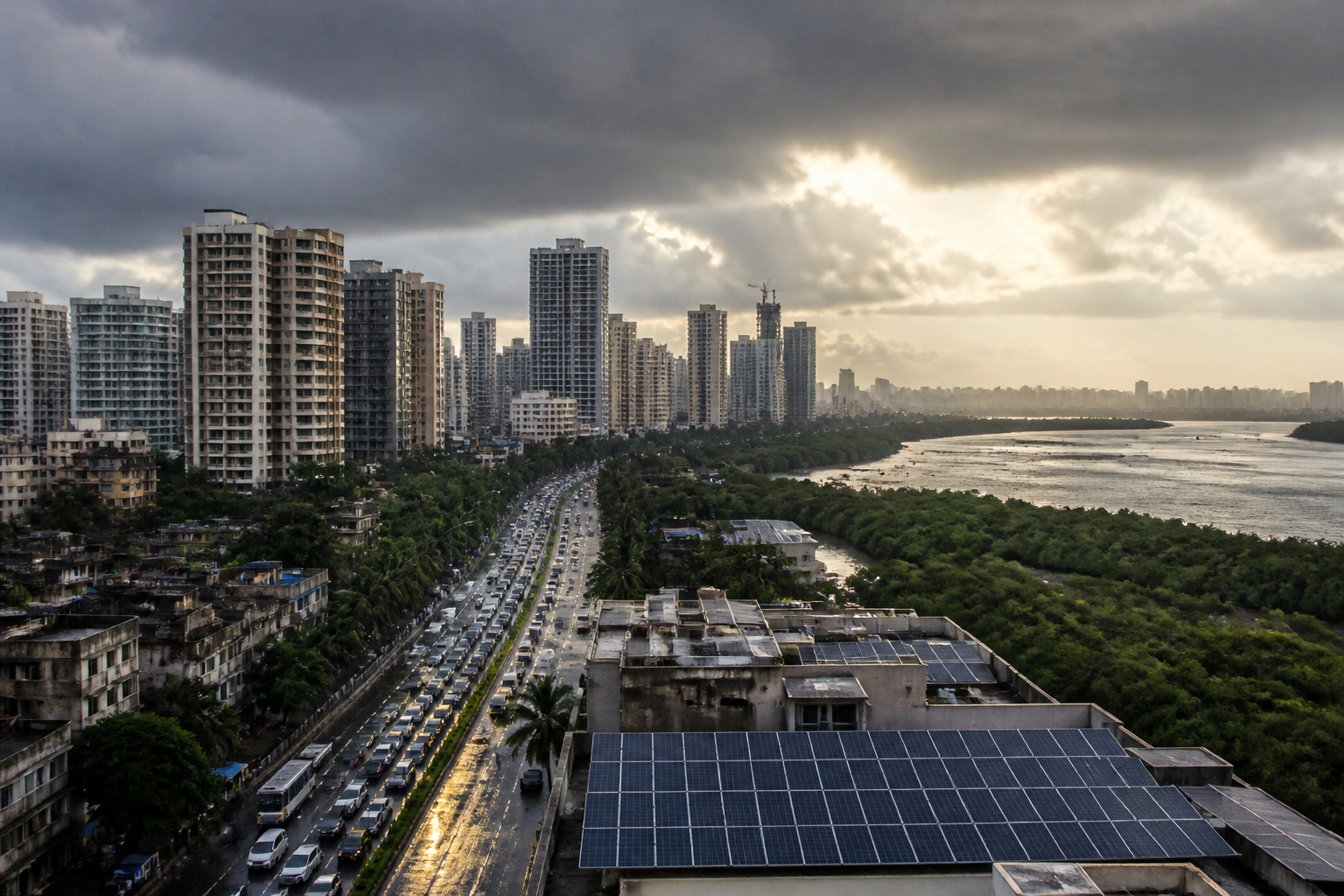
Urban energy systems must support essential services during heat, storms and other disruptions. The authors specifically identified distributed solar as a measure that can reduce the risk of storm-related grid failure while increasing energy security. The report does not specify where such systems should be deployed or how they should be financed. Those questions remain matters for local governments, utilities, regulators and communities.
The study also connects climate response to land and food systems. Mangrove restoration was identified as a measure that can protect against storm surges while increasing carbon sequestration. Shifts towards plant-based diets were linked by the researchers to lower risks of climate-related food-system instability, higher soil carbon and reduced pressure on biodiversity.
These examples widen the meaning of urban resilience. It is not limited to stronger roads, larger drains or more emergency equipment. Coastal ecosystems, food supply chains, electricity networks and land-use decisions all influence whether cities can continue functioning during environmental stress. At the same time, the report’s proposals should not be read as a substitute for emissions reduction. The authors explicitly place adaptation alongside, rather than instead of, cutting emissions.
The institutional challenge is therefore one of coordination. Climate action involves energy agencies, municipal bodies, transport authorities, water and power utilities, housing departments, land-use planners and public-health systems. The study does not evaluate the performance of any particular government or institution. It does show that the drivers and consequences of climate change cross administrative boundaries, while urban decisions are often made through separate departments and funding channels.
The data presented by the researchers also expose a tension between transition and continued expansion of fossil-fuel use. Renewable energy growth and the reported crossing of coal by low-carbon electricity are important changes. Yet fossil fuel consumption, energy-related emissions and greenhouse gas concentrations all reached new records in the same period. The evidence therefore describes a transition that is advancing without yet displacing the wider pattern of rising energy and emissions.
That tension is central to the urban question. Cities need energy to provide housing, mobility, employment, water, sanitation and public services. If rising demand is met through high-emission sources, urban growth adds to climate pressure. If the transition is not reliable or affordable, vulnerable households may bear the cost of both climate impacts and energy insecurity. The supplied material does not quantify these distributional effects, but it establishes the broader conditions in which they must be considered.
The study’s main conclusion is not that a single threshold has already determined the future of cities. Rather, it shows that several indicators of the Earth system are already at record extremes while some responses are beginning to change. That combination makes climate governance more urgent and more complex: cities must reduce the emissions associated with growth while preparing for risks that are already intensifying.
What remains unresolved is the speed at which governments, utilities, industries and communities can translate global signals into local action. The evidence supports close monitoring of emissions, energy demand, renewable deployment, climate adaptation and the condition of ecosystems that protect settlements. It also confirms that urban resilience can no longer be separated from the stability of the wider climate system.

