


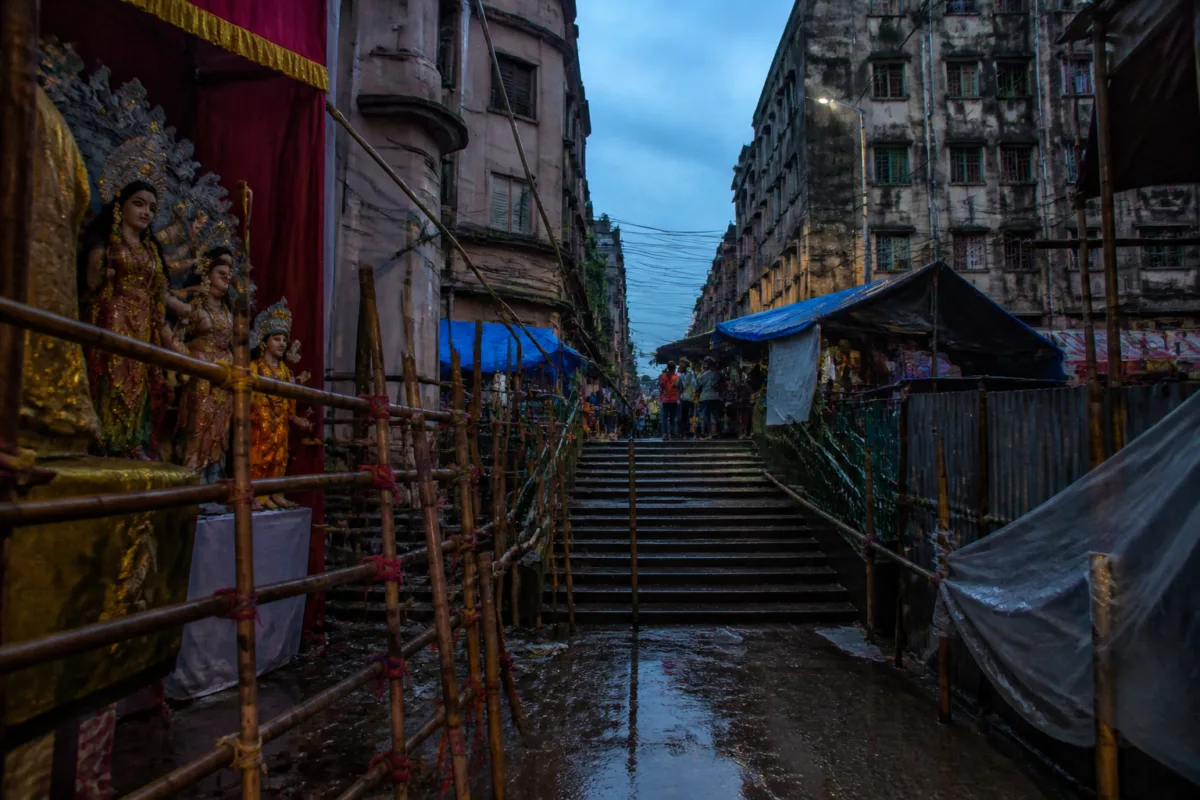
The Chorbagan stampede in Kolkata was not caused by a single obstruction or one moment of panic, according to findings reported from the Special Investigation Team’s inquiry. Nineteen people died after rain triggered a crowd surge at a Durga Puja venue where a narrow exit, a locked emergency door, poor lighting, temporary stalls, stairs and weak crowd guidance combined to turn movement into a fatal bottleneck. The incident shows how a temporary public venue can become an urban safety system in miniature—and how failures in design, operations and oversight can reinforce one another.
The most important finding is spatial. The exit passage at the pandal was only 2.7 metres wide at its narrowest point and 4.7 metres at its widest, with investigators describing it as roughly 7 feet 7 inches wide in one section. A flight of stairs stood near the exit, while cooler units and temporary stalls obstructed movement. The stalls were reportedly located barely 10 metres from the exit. An emergency door remained locked, and lighting and signage were inadequate for visitors trying to identify a safe way out.
These details matter because crowd disasters are often treated as sudden and unpredictable events. The reported evidence from Chorbagan instead points to a chain of foreseeable conditions. People were queuing at Radha Madhab Saha Lane, off Muktaram Babu Street, when rain began at around 7.15pm. Visitors attempted to move into the pandal, while people already inside tried to leave. With no volunteers directing visitors towards the emergency gate, the narrow passage became a pressure point. Several people fell on the stairs and were trampled.
The temporary structure itself appears to have increased the concentration of people. An elevated, gallery-like structure encircled the idol and allowed visitors a 360-degree view. That arrangement created a visually attractive attraction, but it also concentrated movement around a circular, grille-enclosed platform. Investigators found no evidence of structural failure, meaning the reported collapse warning did not correspond to an actual failure of the pandal. The danger came instead from the way visitors were directed and confined within the venue during a sudden surge.
This distinction is central to understanding the incident. A venue can remain physically standing and still become unsafe. Structural stability is only one part of public-event safety. The movement of people, the visibility of exits, the separation of incoming and outgoing flows, the availability of emergency access and the ability of staff to communicate clearly are equally important. At Chorbagan, the reported problems were distributed across each of these functions.
The warning that the pandal might collapse appears to have intensified the emergency. Police identified the organising club’s treasurer, Sanjeev Raha, also known as Sentu, as the announcer who urged people to leave. Investigators suspect that this announcement, combined with rain and existing congestion, triggered the stampede. Raha was arrested in Nadia and was identified as the eighth person arrested in the case. The report says he had gone into hiding, switched off his phone and was traced through CCTV footage and eight phone numbers.
The announcement alone, however, does not explain why so many people were unable to move safely. The reported conditions meant that a sudden instruction to evacuate was delivered into a venue with restricted circulation and limited guidance. The emergency gate also doubled as a VIP exit, according to the investigation reported by the Times of India. A door intended to provide an alternative route therefore did not function as an immediately available public escape path.
The incident also raises questions about how the venue’s layout changed from previous years. Former members of the Chorbagan puja committee told investigators that visitors had earlier moved along either side of the idol while an iron perimeter gate could be shut during a sudden crowd surge. This year, the movement pattern was altered to accommodate the circular grille-enclosed platform. The change appears to have affected not only the visitor experience but the basic geometry of entry, circulation and exit.
The evidence also points to a gap between popularity and preparedness. The Chorbagan puja had become a major attraction with its theme, ‘Beyond Sound’, and reportedly recorded the highest footfall among north Kolkata pujas on three days. Yet organisers did not introduce additional crowd-management measures on Saptami, when the fatal incident occurred. A venue that draws large numbers cannot be managed as though its visitor load were unchanged. Capacity is not simply a count of people inside; it depends on how quickly they can enter, move, disperse and exit under ordinary and emergency conditions.
Staffing decisions formed another part of the problem. In previous years, around 100 Kolkata Police personnel, led by three assistant commissioners, had been deployed at the venue. This year, the initial deployment was reduced to 25 personnel under an inspector. The force was later increased to 100 on Tritiya, with two deputy commissioners taking charge from Chaturthi. Lalbazar sources said both officers were serving in Kolkata Police for the first time. The supplied report does not establish why the initial deployment was reduced or how staffing decisions were made, but the change is relevant to the question of whether crowd-control planning matched the venue’s growing footfall.
The investigation has also exposed an institutional complication: the agencies that approved the venue were kept out of the SIT. The state government formed a six-member Special Investigation Team to identify the causes, fix responsibility and recommend measures to prevent similar incidents. The team is headed by retired Calcutta High Court judge Justice Anindita Roy Saraswati and includes Jawed Shamim, ADG of the Bengal STF, other state government officials and a National Disaster Response Force representative. Kolkata Police, the Kolkata Municipal Corporation and the fire department were excluded because they had granted permissions for the pandal.
That arrangement is intended to create distance between the investigators and the authorities whose approvals may be scrutinised. Justice Roy Saraswati said every allegation would be examined with an open mind and that the role of the police might also be investigated. A separate fact-finding committee headed by a sitting or retired judge had also been proposed at a meeting at Bhabani Bhawan. The coexistence of these proposed and active inquiries indicates that responsibility is being examined at more than one administrative level.
The operational evidence is unusually detailed. Investigators conducted 3D mapping of the site, cross-referenced postmortem reports with CCTV footage and inspected structures, stalls and hoardings using site plans. Of the 30 CCTV cameras installed at the venue, 13 captured footage of the incident. The footage analysis indicated that rain caused severe congestion at the narrow exit. Initial postmortem reports suggested that at least seven victims died of suffocation, while others suffered severe rib fractures, ruptured lungs or traumatic head injuries.
This combination of evidence is important because it connects the physical site to the human consequences. The width of a passage, the location of a stall or the availability of a door can appear minor when assessed individually. In a crowded temporary venue, however, each decision affects the next one. A narrow exit increases pressure; poor lighting makes the route harder to identify; stairs increase the risk of falls; a locked emergency door removes redundancy; and absent volunteers leave visitors without a common direction. Rain then becomes the trigger that exposes the accumulated weakness.
The Chorbagan case therefore belongs to a wider urban governance question: who is responsible for safety when a private or community-organised temporary event occupies public streets and attracts city-scale crowds? Permissions may involve police, fire services and the municipal corporation, while organisers control the internal layout, announcements, stalls and volunteers. Unless responsibilities are clearly translated into measurable conditions—such as unobstructed exits, visible signage, emergency-door access, separation of flows and adequate staffing—approval can become a procedural act rather than a live safety assessment.
The report does not establish the final allocation of responsibility, and the SIT’s conclusions are still awaited. It does establish that the venue’s safety depended on several interacting decisions: a changed circulation plan, a narrow passage, an inaccessible emergency route, limited lighting, insufficient guidance, temporary obstructions, crowding and an evacuation warning during rain. The arrests address alleged individual responsibility, but the inquiry’s broader significance lies in determining whether the system that permitted and managed the venue recognised these risks before the crowd entered.
The next stage will be the completion of the SIT’s investigation, including examination of the police, fire department and municipal roles, further analysis of CCTV and site mapping, and recommendations to prevent similar incidents. Until those findings are released, the evidence reported from Chorbagan confirms a failure of crowd movement and emergency planning, while leaving the precise division of responsibility between organisers and approving agencies to be determined.

