


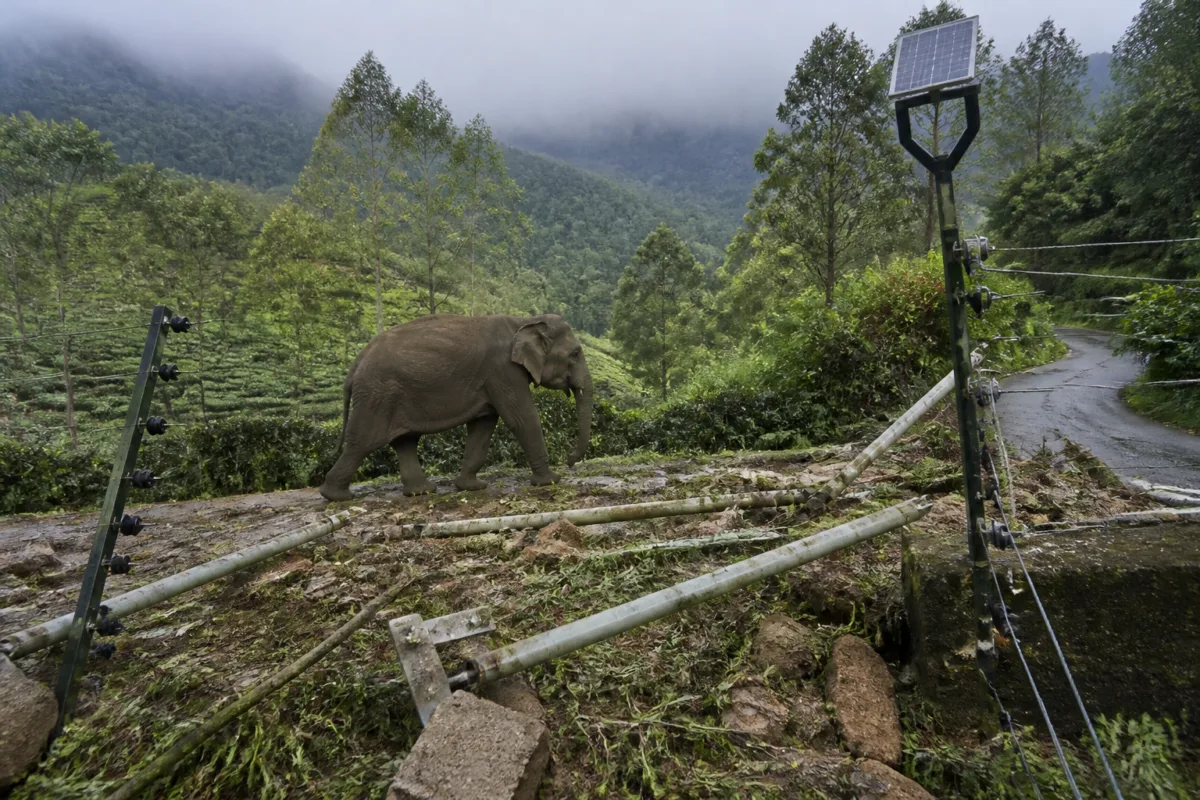
The Chinnakkanal elephant conflict in Kerala’s Idukki district has exposed a failure that cannot be understood only as an animal entering a human settlement. A tribal farmer was killed after a wild tusker became trapped in a landscape where illegal resort fences, steel cables and other barriers had obstructed traditional movement routes. When officials later removed one of those barriers, the elephant moved into Mathikettan Shola National Park. The sequence has turned a local tragedy into evidence of how fragmented land use can intensify human-wildlife conflict.
The incident took place on September 23, 2026, near the Panthadikkalam settlement in Chinnakkanal. The 47-year-old farmer had stepped outside his workplace shed after the forest department’s rapid response team warned residents the previous night that the tusker known locally as Chakkakomban had entered farmland. He believed the elephant had returned to the forest, but encountered it on the road and was trampled to death.
The response from local residents differed from the familiar pattern of compensation and removal of the animal. Relatives and neighbours held the victim’s body for five hours and demanded livelihood support for his family, but also called for the removal of illegal fences blocking elephant routes. Their demand placed land-use enforcement at the centre of the crisis rather than treating the animal as the sole cause of danger.
That distinction matters because Chinnakkanal is not a simple boundary between forest and settlement. The 66.74-square-kilometre panchayat includes tea estates, eucalyptus plantations, cardamom holdings, tribal settlements, reservoirs and expanding high-range tourism infrastructure. It lies between the Anamalai hills and Mathikettan Shola National Park. In such a mixed landscape, wildlife movement depends on passages that may not appear as formally notified national corridors but still function as routes between forest patches, slopes, water sources and feeding areas.
According to the report, the forest department identified three obstructed movement routes: the connection between Mathikettan–Thondimala and Chinnakkanal, the passage from Shankarapandyamettu to the PPK Estate, and the link between Devikulam and Old Devikulam. Private resorts and other encroachers had reportedly installed solar fences, trenches and heavy steel ropes across government and revenue land. These structures restricted movement through a landscape already divided by plantations, roads and settlements.
The district’s conflict data shows the human cost of that pressure. Figures compiled by the Idukki district administration recorded 81 human deaths and 486 injuries from human-wildlife conflict between 2015–16 and 2026–27. Annual fatalities varied between four and ten, but injuries rose sharply in the years before the Chinnakkanal intervention—from 28 in 2019–20 to 79 in 2023–24 and 103 in 2024–25. In the first nine months of 2026–27, five people were killed and 13 injured.
These figures do not by themselves prove that every encounter was caused by illegal barriers. They do, however, show a pattern of increasing contact between people and wildlife. The report’s central argument is that rising injuries alongside persistent deaths are consistent with spatial compression: people and elephants are being forced into increasingly overlapping spaces.
The administrative response followed the Panthadikkalam protest. On September 23, the Idukki district collector, acting as chairperson of the district disaster management authority, directed the forest department and local authorities to remove unauthorised structures, steel ropes tied to trees and illegal fences obstructing identified elephant paths. On September 28, plantation inspectors in Munnar, Peermade and Udumbanchola were instructed to advise estates in conflict hotspots to suspend worker movement and plantation operations between 6pm and 6am when rapid response team warnings were active.
The latter instruction became the subject of public controversy. Political leaders, merchant groups and others reportedly described it as a blanket night curfew across Idukki. The collector and a local MLA publicly clarified that it was a safety advisory for designated conflict-hotspot plantations during active wildlife alerts, not a restriction on public movement throughout the district. The distinction is important because inaccurate descriptions of emergency advisories can make targeted safety measures appear to be general civil restrictions.
The administration also maintained that the demolition drive was limited to illegal fences, steel ropes and unauthorised resort structures on encroached government or forest land. Farmers would retain the right to protect legal patta holdings with solar fencing, according to clarifications cited in the report. This distinction separates the enforcement question from the wider debate over whether all fencing is harmful. A fence around a compact legal homestead may protect people and crops; a continuous barrier across a valley or ridge can redirect animals towards roads and settlements.
Forest department teams subsequently dismantled an unauthorised solar fence near the RS Estate, cleared an encroachment near the Anayirankal reservoir and removed a barrier along National Highway-85 between Mathikettan and Chinnakkanal. The report states that Chakkakomban, which had remained in the human-dominated pocket for about 18 months, moved through the reopened passage into Mathikettan Shola National Park.
That movement is the strongest evidence presented in the report, but it must be interpreted carefully. The observation period after the barrier was removed was only about a fortnight, and officials relied on field sightings rather than satellite telemetry. The reported reduction in daily encounters therefore cannot establish a permanent end to conflict. The forest department also issued legal notices to 16 violators who allegedly rebuilt illegal fences and solar barriers across the corridor by October 10.
The immediate movement of the tusker nevertheless supports a basic institutional lesson: removing an individual elephant does not necessarily resolve the conditions that produce repeated encounters. The 2023 capture and translocation of another Chinnakkanal tusker, Arikomban, had already become part of the local debate. If routes remain blocked, another animal—or the same animal if it returns—can face the same constrained landscape.
The disagreement over elephant corridors reveals a second governance problem. The report notes that the Union government’s 2023 inventory listed 150 elephant corridors nationally, including six in Kerala, but did not identify a macro-corridor in Idukki. Some political and local groups used that omission to question the existence of movement routes in Chinnakkanal. But a national inventory and a local functional passage do not necessarily describe the same scale of geography. A formally mapped corridor may connect major forest divisions, while animals may also depend on smaller routes between shola patches, plantations, reservoirs and settlements.
This is where administrative mapping can fall behind ecological reality. Land-use decisions are often taken parcel by parcel—estate, resort, road, revenue plot or forest boundary—while elephants move across the entire landscape. A route that has no single legal designation may still be essential when considered against terrain, water and seasonal movement. If planning systems recognise only formally notified corridors, they may fail to protect the smaller links that keep a wider habitat connected.
The report also places local and tribal knowledge at the centre of the response. Residents of Panthadikkalam identified the blocked route as a cause of danger while authorities were initially responding through the established cycle of compensation, warnings and animal removal. Their intervention suggests that communities living closest to the forest are not only recipients of conflict mitigation; they can provide critical information about movement patterns, barriers and changes in the landscape.
The larger question is therefore not whether people or elephants should have priority over the other. It is whether land-use governance can prevent infrastructure and private construction from converting shared landscapes into traps. The Chinnakkanal episode shows that enforcement must cover illegal resort expansion and encroachment, while safety advisories must remain precise and targeted. It also shows that conservation decisions require coordination between forest officials, district administration, plantation management, local governments and affected communities.
The evidence currently confirms a link between the removal of at least one illegal barrier and the tusker’s movement into the adjoining national park. It does not establish that all conflict in Idukki has the same cause or that the intervention will produce lasting safety. The next tests are whether the reopened routes remain free of barriers, whether the 16 notices lead to enforcement, and what long-term recommendations emerge from the four-member expert committee appointed after the protest. Until those questions are answered, Chinnakkanal remains a warning that wildlife conflict is also a consequence of how landscapes are fenced, divided and governed.

