


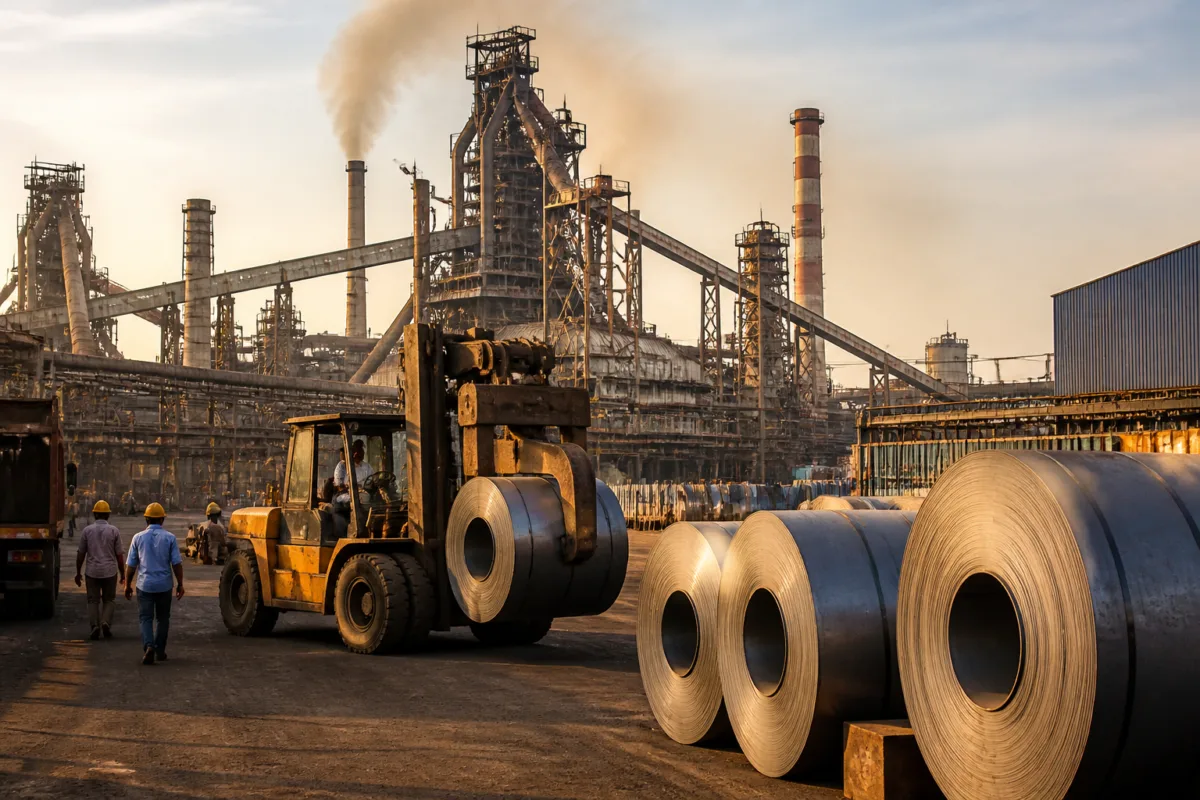
Chinese steel imports are exposing a central tension in India’s industrial strategy: the country is encouraging large domestic investments in steel capacity while producers face cheaper overseas supply, rising raw-material costs and increasingly demanding trade rules. Tata Steel MD and CEO T V Narendran’s latest comments bring that tension into focus, linking import competition to the economics of building the steel base required by India’s construction and infrastructure expansion.
Narendran said Chinese steel exports currently exceed 10 million tonnes a month and could reach 130 million tonnes in 2026. China accounted for nearly a third of India’s finished steel imports in the first half of the current financial year, according to the report. For Indian producers, the concern is not simply that imports are rising. It is that a large inflow of cheaper steel could weaken the commercial case for investments that take years and substantial capital to complete.
“We should make sure that Indian industry which is investing significant capital in building capacity, should not be unfairly impacted,” Narendran told reporters on the sidelines of an event in New Delhi. He said steel producers were continuing discussions with the government on measures to protect the domestic industry.
The policy dilemma is difficult because steel sits between industrial capacity and urban delivery. Domestic steel is an essential input for construction, manufacturing and infrastructure, but protection measures can also affect the price and availability of material for projects. The supplied report does not establish how any future government action would affect downstream prices or project costs. It does show, however, that import policy is being debated alongside a major expansion of Indian production capacity.
India’s capacity expansion is not a short-term response to one import cycle. Narendran said Tata Steel had the potential to increase annual production capacity to 40 million tonnes between 2033 and 2035, with existing capacities offering scope to eventually reach 50 million tonnes. He indicated that the 40-million-tonne target may not be achieved by 2030, although construction to reach it would be well underway across the company’s sites.
The next major step is the third phase of Tata Steel’s Kalinganagar expansion, which the company plans to finalise next year. The expansion is expected to take the plant’s capacity to 13 million tonnes. Bhushan Steel’s capacity is also expected to rise to 6.5 million tonnes, while expansion of Neelachal Ispat Nigam Limited has already been announced. Tata Steel is additionally considering one or two electric arc furnace projects.
These figures reveal the time scale of the investment challenge. A steel company may be planning capacity several years ahead, while import prices and trade flows can change much faster. That mismatch is at the heart of the industry’s request for a level playing field. Producers investing in furnaces, plants and downstream operations need a market in which the returns on those investments are not rapidly eroded by external supply conditions. At the same time, any policy response has to account for users of steel across the wider economy.
The company’s cost structure adds another layer to the problem. Narendran said iron ore costs were increasing in India, while Tata Steel would continue importing 60-70 per cent of its coking coal requirements because imported coal has lower ash content. Most of that imported coal comes from Australia, with smaller volumes sourced from Indonesia. Tata Steel prefers to remain a buyer rather than invest in overseas coal mines and has no plans to invest in overseas coking coal mines, he said.
This means the domestic steel industry is exposed to two different cost pressures. It faces competition from imported finished steel while also relying significantly on imported coking coal for production. The company’s choice to buy rather than own overseas coal assets keeps its supply strategy tied to commercial partnerships and international markets. The report does not provide a forecast for how higher iron ore costs or coal prices will affect steel prices, margins or construction projects.
The government’s immediate policy position remains important. Reuters reported in October that India’s steel ministry was unlikely to seek fresh curbs on cheap imports in the near term, despite calls from domestic producers for stronger protection. That reported stance suggests that the government has not resolved the balance between supporting domestic investment and keeping steel markets open to buyers.
The issue also extends beyond India’s borders. The European Union’s approach to carbon costs is creating another pressure point for Indian producers. Narendran described the debate as a clash between the interests of European and Indian steelmakers, with both sides seeking a level playing field based on their manufacturing costs.
European steelmakers argue that imported steel should face the same carbon tax as steel manufactured locally. Indian producers, by contrast, oppose paying an additional tax to access the European market. “As a producer of steel in the EU, there is a carbon tax that we pay in the EU, so obviously the steel industry in the EU will say that if I’m paying a carbon tax, anyone who sells in Europe should pay the same carbon tax,” Narendran said. “If I’m sitting in India, I will say why should I pay a carbon tax if I have to sell in the EU,” he added.
The trade consequences are already visible. The European Commission imposed a 9.5 per cent anti-dumping duty on certain cold-rolled flat steel products from India, including products manufactured by Tata Steel and JSW Steel. The duties took effect on November 17 and form part of a wider measure covering five countries, with rates reaching up to 27.9 per cent, according to Reuters. The investigation followed a complaint filed by the European steel association Eurofer in 2025. The European Commission cited government measures that it said had distorted domestic iron ore prices in India.
For Indian steelmakers, this creates a two-sided trade environment. Chinese imports are described as a threat in the domestic market, while Indian products face additional duties in an important overseas market. The same producer therefore has to manage competition at home and market-access constraints abroad. The report does not establish whether the European duties will alter Tata Steel’s export volumes or investment plans, but it places the company’s expansion strategy within a more contested global trade framework.
Public support for large industrial projects is another part of the equation. Narendran said Tata Steel had sought financial assistance from the Dutch government for a project, with discussions still underway. He said the general benchmark in Europe was for governments to support at least 40 per cent of a project’s capital expenditure. The report does not identify the project’s total cost or confirm the level of assistance under discussion.
Taken together, the figures point to a steel sector being shaped by investment cycles, import policy, energy and raw-material choices, carbon regulation and state support. Tata Steel’s proposed 40-million-tonne capacity target, the 13-million-tonne Kalinganagar expansion and the company’s possible electric arc furnace projects show the scale of the domestic capacity ambition. The 10-million-tonne monthly level of Chinese exports and the potential for 130 million tonnes in 2026 show why import competition has become a central concern for producers.
The larger urban question is how India will manage the material base behind its construction and infrastructure ambitions while keeping projects commercially viable. Domestic capacity can strengthen supply security, but it requires long-term investment and predictable market conditions. Imported steel can add competitive pressure, but restrictions may have consequences for buyers. Carbon duties add a further requirement: future competitiveness will depend not only on volume and price, but also on how production is treated under changing environmental trade rules.
What is established so far is that Tata Steel is pursuing a large capacity expansion while seeking protection from what it describes as unfair import competition. The government’s position on additional curbs, the outcome of discussions with steel producers, the finalisation of the Kalinganagar expansion and the Dutch government’s response to Tata Steel’s funding request will determine how this industrial strategy develops. The next phase of the debate will show whether India’s policy framework can support new steel capacity without placing excessive costs on the industries and urban projects that depend on it.

