


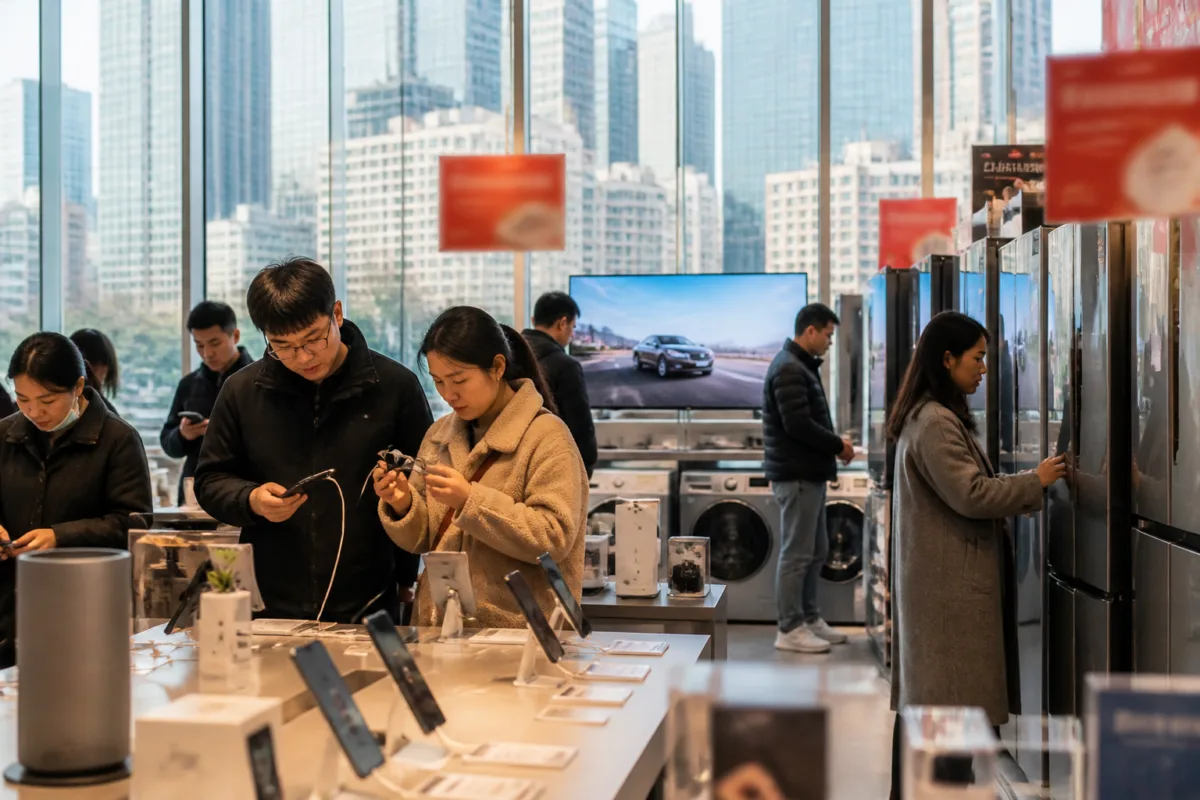
China’s consumer subsidies are generating large sales numbers, but they have not yet solved the deeper weakness in household demand. The 250 billion yuan programme, worth about $37 billion, is designed to encourage people to replace old smartphones, appliances and vehicles. It is also being used to create markets for artificial intelligence devices, energy-efficient products and other technologies that Beijing wants Chinese manufacturers to dominate.
That dual purpose is central to understanding the programme. It is not simply a short-term effort to persuade households to shop. It is an attempt to connect consumer demand with industrial policy at a time when exports remain strong but property, investment and domestic spending are under pressure.
By August, the trade-in programme had supported sales worth 1.55 trillion yuan, according to a Barron’s report quoting China’s National Development and Reform Commission. The Commerce Ministry said the programme had subsidised purchases of 108 million digital and smart products. Communications equipment sales at major retailers rose 27.3 per cent year-on-year in August, while sales of smart glasses on major online shopping platforms increased 120 per cent during the first eight months of the year.
These figures show that subsidies can move demand quickly into selected product categories. Eligible smartphones, tablets, smartwatches and smart glasses priced at up to 6,000 yuan qualify for a 15 per cent subsidy, capped at 500 yuan per item. Household appliances are also covered, but only when they meet the highest energy- or water-efficiency standards. Consumers who scrap older vehicles and buy qualifying electric vehicles can receive up to 12 per cent of the new vehicle’s price, capped at 20,000 yuan.
The design of the programme therefore directs spending rather than simply increasing it. By attaching incentives to specific technologies and efficiency standards, the government is attempting to shape what households buy. The policy gives consumers a financial reason to purchase newer products while giving manufacturers a larger market for devices, components and vehicles aligned with national industrial priorities.
Vice Commerce Minister Sheng Qiuping described the approach as using “new demand to guide new supply, and new supply to create new demand”. The intended cycle is straightforward: discounts encourage consumers to try new products; stronger demand supports higher production; greater scale can help manufacturers reduce costs and develop technologies further.
The policy may benefit Chinese technology companies such as Huawei and Xiaomi, which are expanding in artificial intelligence-enabled devices. Component manufacturers producing optical systems, sensors and speakers could also gain if smart-glasses demand continues to rise. Goertek, a Shenzhen-listed electronics supplier, told institutional investors in September that AI smart glasses could be among the product categories with the greatest growth potential.
The incentives are not formally limited to domestic brands. Eligible Apple iPhones can also qualify, while Tesla can benefit from electric-vehicle subsidies. Omdia estimated that Apple accounted for 19 per cent of China’s smartphone shipments in the second quarter, behind Huawei. In the vehicle market, however, subsidies have not removed intense competition. Tesla has also offered limited-period price reductions of 5,000 yuan on the Model 3 and 7,000 yuan on the Model Y in China.
The more difficult question is whether a programme that raises sales in targeted categories can produce a broad recovery in consumption. China’s economic data suggests that the answer remains uncertain. The economy grew 4.5 per cent year-on-year in the July-September quarter, improving from 4.3 per cent in the previous quarter. Growth for the first nine months of 2026 was 4.6 per cent.
Exports of chips, electronic components and other high-technology products have supported that performance. But retail sales grew only 0.4 per cent in August before improving to 1.1 per cent in September. The improvement is positive, but the pace remains modest relative to the scale of the policy effort and does not establish that household demand has entered a durable recovery.
Investment data is weaker still. Fixed-asset investment, which includes infrastructure, factories and property, fell 7.2 per cent in the first nine months of 2026 compared with the same period in 2025. Property investment plunged 20.2 per cent during the first three quarters. That decline is significant for cities because property is not only a construction and real-estate issue; it also affects household wealth, local economic activity, employment and confidence.
China’s property downturn creates a constraint that discounts on consumer products cannot easily remove. When households hold a large share of their wealth in property, falling confidence in the housing market can make them more cautious about spending. A subsidy may reduce the price of a smartphone or appliance, but it does not directly repair the balance sheets, expectations or asset values that influence larger household decisions.
Professor Abhinav Tripathi, a senior economic expert quoted by NDTV, described the situation as a “two-speed economy”. The export-oriented manufacturing sector continues to perform strongly, while domestic demand and investment struggle to gain momentum. That divide is visible in the contrast between rising overseas sales and falling property and fixed-asset investment.
Exports rose 36.3 per cent year-on-year in September, according to customs data cited in the supplied report. China’s trade surplus reached $938.1 billion in the first nine months of 2026, compared with $875.1 billion in the corresponding period a year earlier. AI-related products and green technologies, including batteries, have contributed to overseas sales.
For urban economies, this creates an uneven pattern of growth. Manufacturing capacity, technology supply chains and export logistics can remain active even as construction, property investment and domestic services weaken. The result is not a uniform economic slowdown across cities, but a separation between sectors linked to global production and those dependent on domestic confidence.
That imbalance also increases the importance of government intervention. The consumer trade-in programme is one of several targeted measures introduced as Beijing responds to weak demand. Other measures cited in the report include support for first-time homebuyers and selected interest-rate cuts. Each addresses a different part of the economy, but together they show the difficulty of reviving demand when the property sector remains under pressure.
The programme’s institutional logic is therefore broader than consumer relief. It links household purchasing power to industrial upgrading, energy efficiency and technology adoption. The requirement that covered appliances meet the highest efficiency standards means public funds are being used to accelerate a preferred product mix. The same principle applies to AI-enabled devices and electric vehicles, where subsidies can help create early demand for emerging technologies.
However, a targeted increase in product sales is not identical to a recovery in total consumption. Dr Tripathi told NDTV that some consumers may bring forward purchases they would otherwise have made months later. Others may buy discounted electronics instead of spending on travel, restaurants or other services. In those cases, the programme changes the timing or composition of spending rather than increasing overall demand.
This distinction matters for cities because services, housing and construction have different employment and multiplier effects from consumer electronics. A household buying a subsidised device may support a manufacturer and its suppliers, but that purchase does not necessarily restore activity in neighbourhood services, property transactions or construction-related employment.
The International Monetary Fund has also identified the same structural tension. It lowered its 2026 growth forecast for China from 4.6 per cent to 4.5 per cent and cut its 2027 projection from 4.1 per cent to 4 per cent. The IMF attributed the weaker outlook to sluggish consumption and weakening investment amid continued property-sector problems, partly offset by strong exports.
The evidence therefore confirms what the subsidy programme can do, but also what it cannot yet establish. It can push sales towards selected technologies, support manufacturers and encourage purchases of efficient products. It has not, on the available evidence, demonstrated a broad or self-sustaining recovery in household demand, property investment or fixed-asset investment.
China’s larger urban question is whether industrial strength can compensate for weakened domestic confidence. The answer will depend on whether targeted incentives generate new spending or mainly redirect existing spending, and whether measures supporting technology demand are accompanied by a stabilisation of the property sector. The next indicators to watch are retail sales, property investment, fixed-asset investment and the durability of demand after subsidy-supported purchases are made.

