


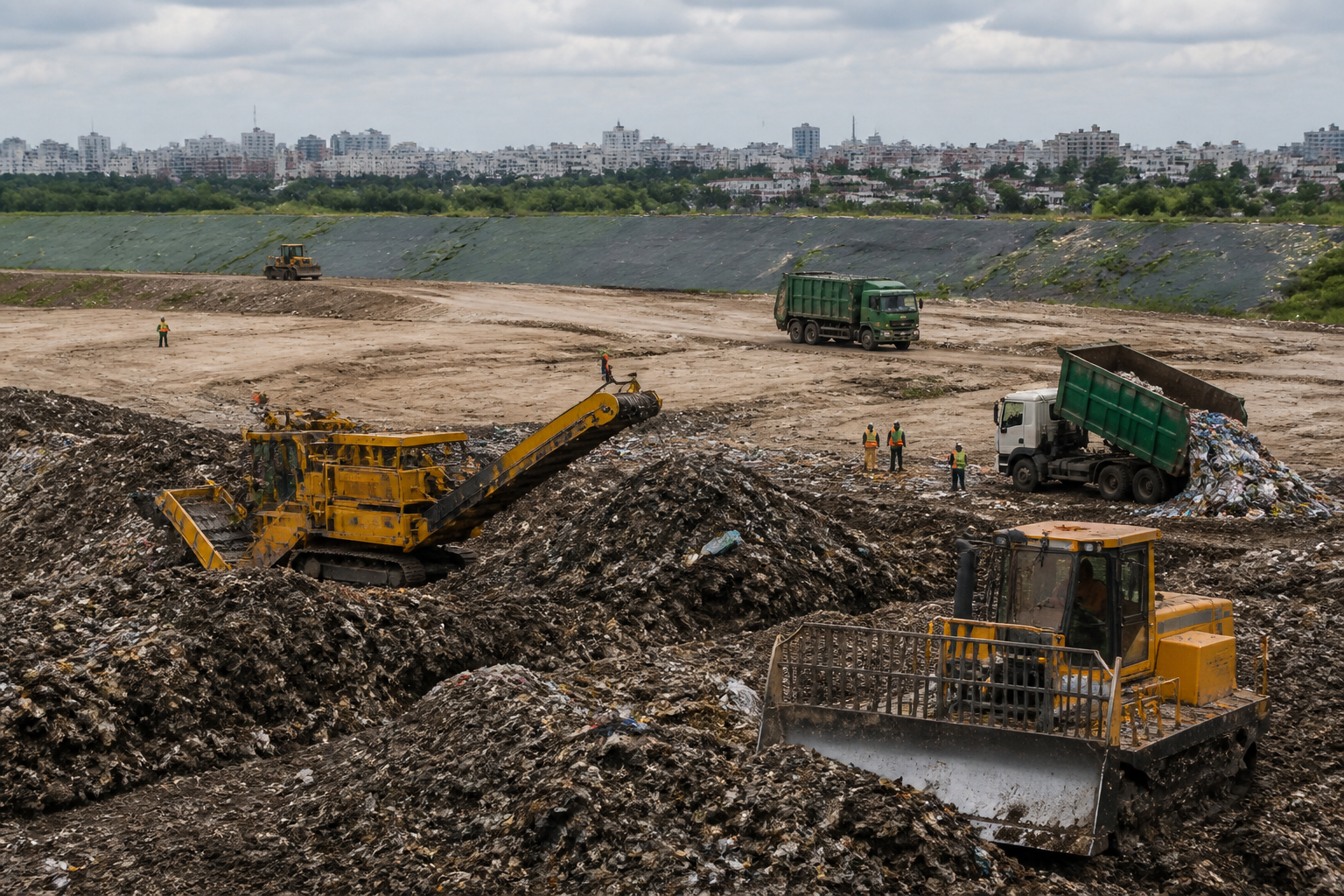
Chennai’s biomining programme is reclaiming land from decades-old garbage, but the city’s current waste system is losing the local processing capacity needed to prevent new waste from joining the same dumps. The Greater Chennai Corporation is clearing legacy waste at Perungudi, Kodungaiyur and Athipattu while 168 of its 190 micro composting centres have been shut, leaving a widening gap between the volume of waste generated and the infrastructure available to process it.
That contradiction is at the centre of Chennai’s waste-management challenge. Biomining can remove accumulated waste and recover land, but it cannot by itself manage the city’s daily waste stream. The city generates around 6,150 tonnes per day of municipal solid waste, including approximately 3,200 tonnes of wet waste and 2,450 tonnes of dry waste. Against that volume, the closure of most micro composting centres has reduced the GCC’s listed processing capacity from 531 metric tonnes to 115 metric tonnes.
The capacity reduction followed a GCC council resolution on February 27, 2025. The change matters because wet waste is most effectively handled close to where it is generated. Transporting it over longer distances increases the dependence on transfer points, dumpyards and large centralised facilities, while also making segregation and timely processing more difficult. The supplied report does not establish how much of Chennai’s daily waste is currently being processed through each route, but the scale of the capacity gap indicates why fresh waste continues to be a concern even as legacy waste is removed.
The GCC has sought to compensate through other facilities. Commissioner G S Sameeran said zones had been instructed to use alternative wet-waste processing infrastructure wherever feasible. This includes two bio-CNG plants with a combined capacity of 320 tonnes per day, two windrow composting plants with 100 tonnes per day, and two garden-waste processing plants with 160 tonnes per day. Together, these facilities account for 580 tonnes per day of stated capacity.
Two additional facilities have completed trial runs. A 100-tonne-per-day windrow composting plant at Perungudi and a 140-tonne-per-day bio-CNG plant at Sholinganallur were expected to add roughly 240 tonnes per day by the end of September, according to Sameeran. These facilities could partly restore processing capacity, but their commissioning does not automatically resolve the wider system problem. The effectiveness of the network will depend on segregation, collection practices, operating conditions, maintenance and the ability of zones to direct waste to the appropriate facility.
The scale of Chennai’s legacy waste explains the urgency of the biomining exercise. At Perungudi, the second phase covers 5.5 lakh metric tonnes and is expected to reclaim another 80 acres. At Kodungaiyur, 44 lakh metric tonnes of the estimated 66.52 lakh metric tonnes of legacy waste has been cleared. The GCC has also planted 880 native saplings across three acres as part of ecological restoration. The civic body is spending several hundred crores of rupees on the clearance programme, making biomining one of the city’s significant urban remediation efforts.
Yet the land-reclamation objective and the daily waste-management objective are separate administrative tasks. Biomining addresses the historical stock that has accumulated over approximately two decades. It does not stop the flow of new waste into the system. Geo Damin of Poovulagin Nanbargal said biomining was necessary to clear legacy waste and reclaim land, but should not be treated as a complete or long-term solution. He warned that the exercise would lose meaning if fresh waste continued to be mixed with legacy waste and dumped.
This distinction is important for assessing the city’s progress. A cleared dumpyard can create a visible sign of improvement, while the underlying collection and processing system may remain weak. If source-segregated waste is not consistently separated and processed, the city can reduce an old waste mound while creating new accumulations elsewhere. The supplied evidence does not show that Chennai has resolved this operational risk; instead, residents continue to report that waste accumulates at dumpyards year after year.
The controversy over the micro composting centres also points to a governance problem rather than a simple shortage of machinery. Environmental activist K Raju said several centres had failed because of poor regulation and maintenance, including cases where waste was allegedly burned inside burial grounds. His position was not that decentralised processing should be abandoned, but that it should be redesigned and regulated. He argued that composting centres should be customised to local conditions, including locations near fruit and vegetable markets and industrial pockets.
That local planning question is central to decentralised waste management. A single citywide model may not suit residential neighbourhoods, markets, industrial areas and suburban growth corridors in the same way. Wet waste from a vegetable market has a different composition and collection pattern from household waste. Garden waste requires another processing arrangement. Dry waste depends on sorting and recycling linkages. The report indicates that Chennai’s system has struggled not only with capacity but also with matching facilities to the waste streams and urban areas they serve.
D Neelakannan, president of the Tamil Nadu Alliance of Resident Welfare Associations, described the deeper failure as the absence of a sustainable decentralised system over several decades. He identified source segregation, nearby processing, recycling, composting, biomethanation and scientific management of residual waste as parts of that system. These elements are not interchangeable. Composting cannot process all waste, bio-CNG plants cannot replace dry-waste recovery, and biomining cannot substitute for handling daily generation. The city therefore needs an integrated chain rather than a single flagship intervention.
The institutional geography of Chennai makes coordination more difficult. Raju said roadside dumping was increasing as development moved into the suburbs and called for continuous coordination between the GCC and the Chennai Metropolitan Development Authority. Waste collection is experienced at the neighbourhood level, but land-use change, suburban expansion, road access and facility siting are shaped by broader metropolitan decisions. If these responsibilities are handled separately, new residential and commercial growth can outpace the provision of waste infrastructure.
The report also connects waste management to public health and environmental risk. Residents living near the dumpyards have cited odour and dust, while recurring fires and leachate contamination add to the burden. These impacts are not limited to the boundary of a waste facility. Fires affect surrounding air quality, leachate can threaten soil and water systems, and truck movements can expose nearby communities to traffic and dust. The article does not provide measurements of contamination or health outcomes, so the extent of each impact cannot be quantified from the available evidence. Their recurrence, however, demonstrates why waste facilities remain a neighbourhood-level governance issue.
Chennai’s numbers reveal the imbalance between legacy remediation and current capacity. Kodungaiyur still contains more than 22 lakh metric tonnes of legacy waste even after 44 lakh metric tonnes has been cleared. Perungudi’s second biomining phase covers 5.5 lakh metric tonnes, while the city generates 6,150 tonnes of new municipal waste every day. Even where the units are not directly comparable as a clearance schedule, they show that the city is managing two large flows at once: a historic stock measured in lakh tonnes and a daily stream measured in thousands of tonnes.
The additional 240 tonnes per day expected from the Perungudi and Sholinganallur facilities would represent only a limited share of Chennai’s total daily generation. It is specifically intended to support processing capacity, particularly for wet waste, rather than absorb the entire municipal waste stream. The GCC’s broader set of alternative facilities has a stated capacity of 580 tonnes per day, which also remains a fraction of the city’s reported daily generation. This makes the role of segregation, recycling and distributed processing critical to preventing every tonne of waste from moving towards the major dumpyards.
The policy question is therefore not whether Chennai should biomine. The city’s accumulated waste and the land tied up by dumpyards make clearance necessary. The harder question is whether biomining is being embedded in a system that prevents the same conditions from returning. That requires the GCC to maintain adequate processing capacity while ensuring that facilities function safely, that waste is separated at source and that new urban areas are incorporated into the service network. The report provides evidence of planned capacity additions, but not yet of a fully functioning replacement for the closed micro composting centres.
The immediate milestones are operational. The GCC has directed officials to expedite biomining, while the Perungudi windrow plant and Sholinganallur bio-CNG plant are expected to add capacity after their trial runs. At the same time, the civic body’s ecological restoration work at reclaimed land will need to proceed alongside the management of fresh waste. Chennai’s waste crisis will be measured not only by how much old garbage is removed, but by whether new waste is kept out of the reclaimed land and processed through a reliable, decentralised system.
