


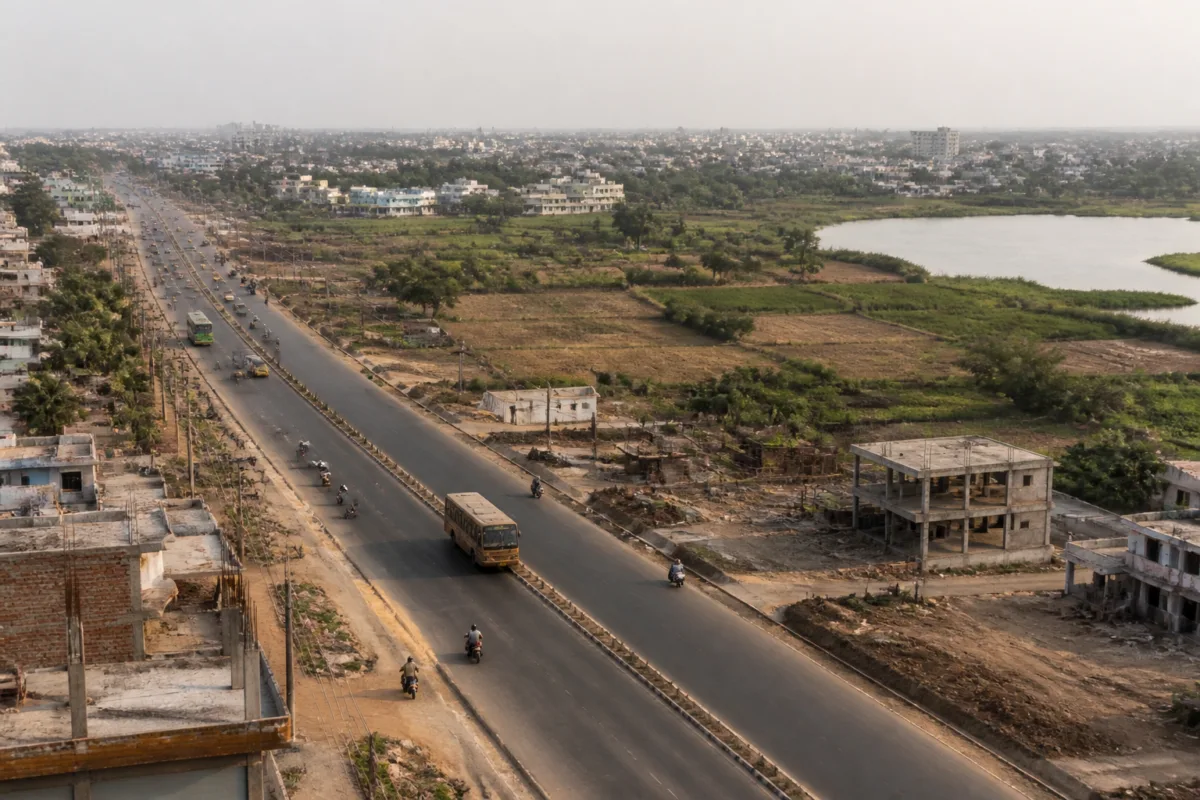
The Tamil Nadu government has sanctioned Rs. 45.5 crore to prepare a comprehensive master plan for the expanded Chennai Metropolitan Area (CMA), but the exercise will begin with a significant governance gap: 3,098 sq km of the 5,904-sq-km metropolitan region currently falls outside any formal planning area, according to a report by Deccan Chronicle.
The government order issued on November 11 proposes an integrated planning framework for the expanded CMA, which includes parts of Kancheepuram, Tiruvallur, Chengalpet and Ranipet districts. The metropolitan region was expanded from 1,189 sq km in 2022.
At present, 1,189 sq km of the expanded CMA is under the Chennai Metropolitan Development Authority (CMDA), while 1,617 sq km is covered by local planning areas under the Directorate of Town and Country Planning. The remaining 3,098 sq km is outside any planning area.
This division is central to the success of the third master plan. Development in the expanded areas has continued through existing DTCP and local planning arrangements, even as the government seeks to create a single framework for a metropolitan region that now extends well beyond Chennai’s core urban area.
The proposed plan is expected to cover land use, regional connectivity, integrated transport, housing, water security, flood and coastal resilience, climate adaptation and the protection of environmentally sensitive areas. It will also include mechanisms for implementation, financing and monitoring.
The government has allocated Rs. 10 crore for 2026-27, Rs. 22 crore for 2027-28 and Rs. 13.5 crore for 2028-29. An internationally reputed metropolitan planning consultant is to be selected through global competitive bidding. A high-level steering committee headed by the chief secretary will oversee the exercise, with CMDA serving as the nodal technical and coordinating agency.
The funding is intended to support preparation of the plan, but the larger challenge will be converting the document into enforceable decisions across multiple jurisdictions. CMDA has already prepared or commissioned studies covering transportation, logistics, economic development and flood management. The new exercise is expected to build on these studies to avoid duplication, according to the report.
CMDA, formerly known as the Madras Metropolitan Development Authority, implemented its first master plan in 1975 and its second in 2008. It began preparing the third master plan for the existing 1,189-sq-km CMA in 2020. That process is now being overtaken by the region’s expansion, notified by the government in October 2022.
The authority is simultaneously in the concluding stages of preparing the third master plan for the existing CMA. That plan includes land use, infrastructure, open spaces, coastal development, urban heat, blue-green infrastructure, climate adaptation, groundwater replenishment and water catchment conservation.
The expanded plan will therefore have to reconcile two related tasks: completing planning for the established metropolitan area and developing a coordinated framework for the much larger region. The immediate institutional question is how the two processes will be aligned so that peripheral growth does not proceed independently of metropolitan infrastructure and environmental priorities.
A CMDA official said an integrated plan was necessary to address challenges arising from the region’s expansion, including economic activity, infrastructure requirements, environmental characteristics and connectivity with adjoining areas.
The implications are particularly important for areas where urbanisation intersects with flood-prone land, water bodies, groundwater resources and agricultural land. Decisions on road connectivity, housing and industrial or commercial development can influence these systems across administrative boundaries, making separate local approvals difficult to reconcile with metropolitan objectives.
Builders’ Association of India representative S. Ramaprabhu said the expansion could bring development in peripheral areas under better monitoring. He said it could also contribute to land-value appreciation and enable infrastructure projects such as the Outer Ring Road to be taken up in the expanded areas.
Pavithra Sriram, co-founder of Project Thiruvanmiyur Mada Street and Design Co, said implementation should reflect the character of individual neighbourhoods. She said the long-term vision would need to translate into development that was sensitive to local needs.
These concerns point to the difference between preparing a regional plan and implementing one. A metropolitan framework can identify land-use priorities, transport links, environmental assets and infrastructure requirements, but its effectiveness will depend on how approvals, funding and monitoring are coordinated after notification.
Chennai’s third master plan is consequently being asked to perform more than a conventional land-use exercise. It must establish a common direction for a metropolitan area governed through CMDA, DTCP and local planning arrangements, while also addressing climate risks and the infrastructure demands of rapid peripheral development. The central test will be whether the Rs. 45.5-crore exercise produces an enforceable framework for the expanded CMA or remains another long-term blueprint without consistent implementation.

