


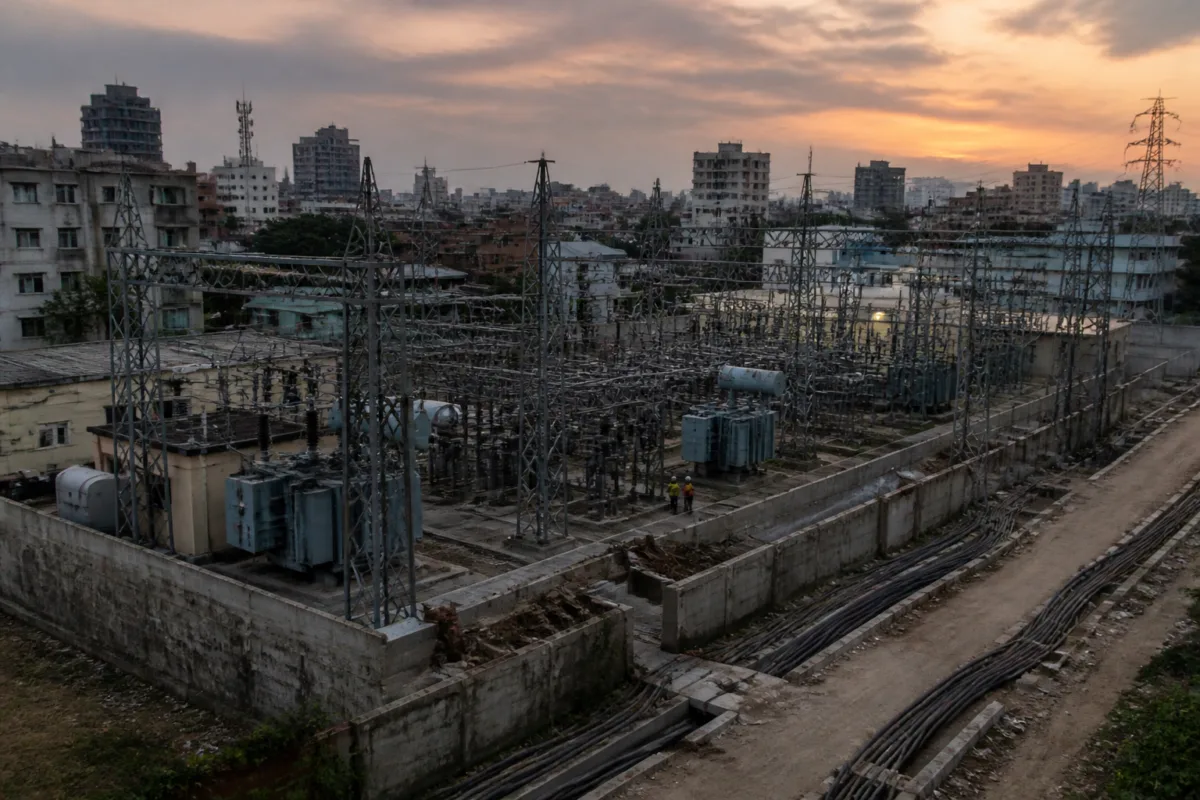
Chennai’s electricity network remains vulnerable to summer demand because major transmission and distribution upgrades are behind schedule, with 28 transmission substations alone missing their original deadlines, according to a Times of India report.
The delayed transmission projects involve a combined investment of Rs 3,028 crore. The most significant is a 400kV gas-insulated substation at Guindy, built at a cost of Rs 756 crore with funding from the Japan International Cooperation Agency. It was scheduled for completion in 2019-20 but has not yet been commissioned because Tantransco is still required to rectify a fault in an underground cable.
Tantransco director (projects) D Ashok Kumar told the newspaper that the Guindy substation is expected to be commissioned by December 2026 or January 2027. Once connected to two 230kV substations, the project is expected to ease pressure on the grid and improve supply reliability in central Chennai.
Other transmission links are also incomplete. At Alandur, a 230kV substation has not yet been connected to the 110kV substation at Velachery because of a damaged underground high-tension cable. At Thiruvanmiyur, a 230kV substation has been commissioned, but work to connect it to four 33kV substations has not begun.
In western Chennai, two 230kV substations at Panjetty and Avadi are intended to improve supply. The Avadi substation has been charged, but a Pattabiram resident, T Sadagopan, told the newspaper that local officials had said it was not fully functional and had cited technical reasons for keeping it out of use. The report also said the upgradation of the 400kV substation at Taramani remains incomplete, affecting supply reliability in south Chennai.
The delays are unfolding across a large service area. The Chennai region, which includes peripheral areas in Tiruvallur, Kancheepuram and Chengalpattu districts, serves around 38.80 lakh consumers through 253 substations, 40,798 distribution transformers, 16,582km of high-tension lines and nearly 55,000km of low-tension lines.
Tantransco is responsible for substations up to 110kV, while the Tamil Nadu Power Distribution Corporation, or TNPDCL, handles 33kV substations and 11kV feeders. The report said Tantransco is currently functioning without a managing director, with its joint managing director (finance) holding additional charge.
The distribution network has its own backlog. Seventeen 33kV substations announced during the previous DMK government, at an estimated cost of Rs 350 crore, remain at an early stage, according to the report. The TVK government has announced a further 36 substations at an estimated cost of Rs 1,736 crore, even as earlier projects remain incomplete.
TNPDCL has identified 20 existing 33kV substations in and around Chennai that require additional power sources. The proposed work includes laying 288km of underground cables at an estimated cost of Rs 59.52 crore, but work has not yet begun.
TNPDCL director (distribution) Leena said major infrastructure projects were reviewed periodically and that field officials had been instructed to expedite execution. The utility has also floated tenders for 1,386 transformers, 15,242 pillar boxes, 1,398km of underground low-tension cables, 725 circuit breakers and 285km of high-tension lines. A TNPDCL official said the tenders were at various stages of evaluation.
The procurement is intended to replace damaged equipment and address faults, but the report indicates that equipment purchases alone will not resolve the network’s structural constraints. Retired TNEB official S Neelakandan attributed delays to inadequate contractor accountability and questioned the decision to award one contractor work involving at least 13 33kV substations in Chennai. He also alleged that insufficient quality checks on contractor-supplied materials had contributed to recent equipment failures.
The immediate public concern is the prospect of another difficult summer. The report said extended outages since June had led to road blockades and confrontations with electricity officials in several neighbourhoods, exposing the consequences of an ageing network operating under rising demand.
The unfinished projects point to a wider implementation problem: new capacity is being announced while existing transmission connections, substations and underground cable works remain incomplete. For residents, the reliability of supply will depend not only on the number of projects sanctioned, but on whether faults are rectified, substations are connected and commissioned, contractors are held to schedules, and replacement equipment passes quality checks.
Until the Guindy, Alandur, Thiruvanmiyur, Taramani, Panjetty and Avadi works are fully integrated into the network, Chennai’s planned grid expansion will continue to provide less resilience than the investment figures suggest.

