


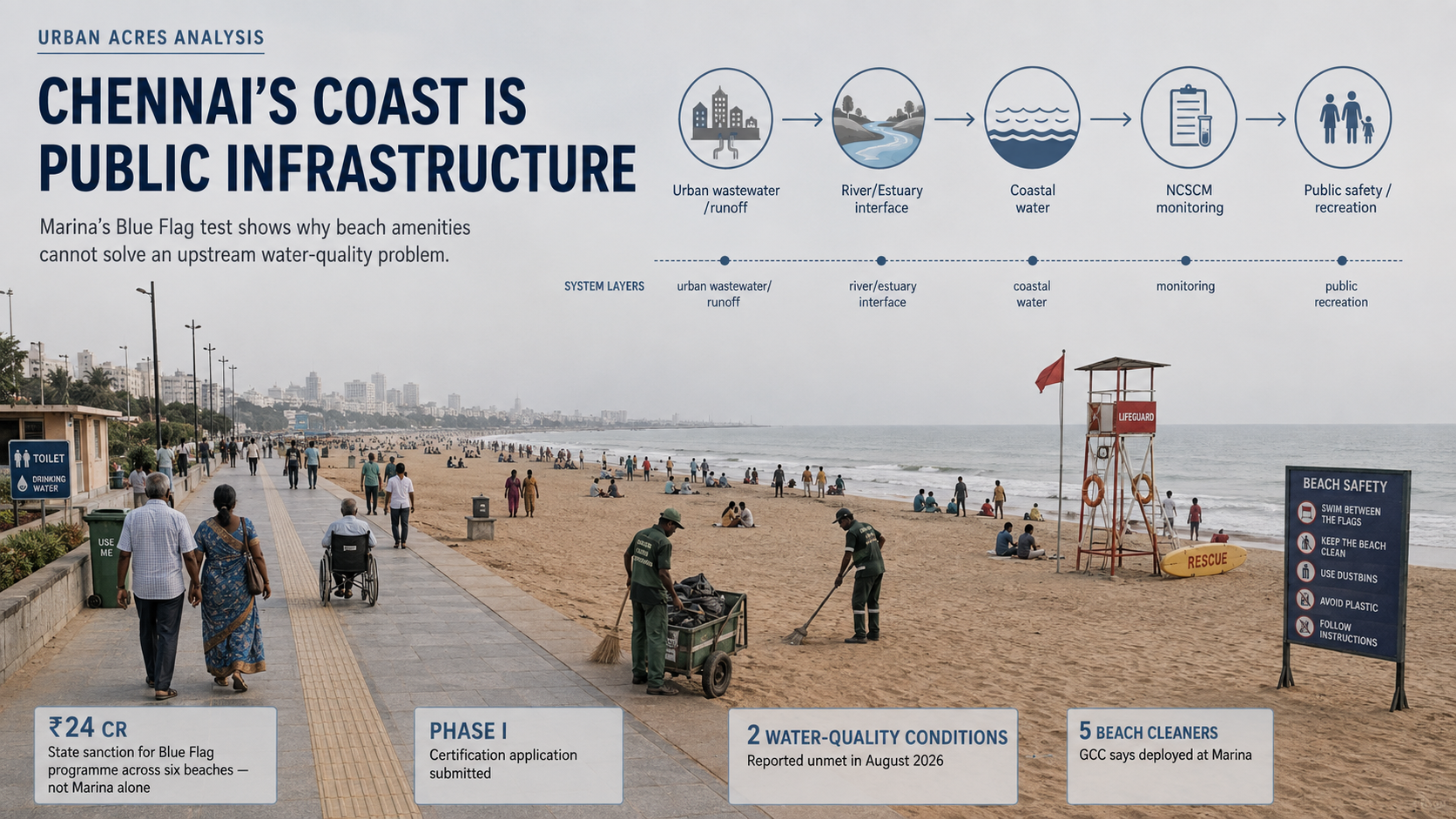
Chennai’s beaches may function as some of the city’s largest shared recreational spaces, but Marina’s ongoing Blue Flag exercise demonstrates a more demanding reality: managing the coast requires public-space design, wastewater control, bathing-water quality, sanitation, safety, livelihoods and maintenance to perform as one urban system.
CHENNAI — Describing Chennai’s coast as an enormous open-air arena captures something important about the city. The beachfront is simultaneously a promenade, meeting place, marketplace, playground, exercise ground, cultural venue and one of the few major urban spaces where access is not mediated by a ticket or membership.
But that description also raises a more consequential planning question.
What does it take to operate a coastline as dependable public infrastructure?
Marina Beach is providing a useful test.
Tamil Nadu and the Greater Chennai Corporation have been developing sections of Marina to meet Blue Flag standards, adding public amenities and environmental-management infrastructure. State documentation has described interventions ranging from toilets, drinking water, accessibility and safety facilities to solid-waste management, wastewater treatment, cleaning and environmental education.
Yet the project’s most recent significant milestone has exposed the difference between improving a beachfront and improving the underlying coastal system.
On August 20, The New Indian Express reported, citing senior GCC officials, that Marina’s Phase-I application had not met two of the prescribed water-quality conditions. Officials said the beach could consequently receive a Pilot Blue Flag or a status that excludes bathing rather than the full international certification being pursued. The international jury’s decision was still awaited.
That is not a minor certification technicality.
It goes to the centre of how Chennai manages its coast.
The beach begins upstream
A municipal corporation can install seating, toilets, pathways, lighting, surveillance systems and waste bins within a project boundary.
Bathing water does not respect that boundary.
According to the August 20 report, GCC officials pointed to the proximity of the Cooum River as one reason the required standards were difficult to achieve. The report said the latest NCSCM test cited by officials recorded E. coli at 320 CFU per 100 ml against the relevant 250 threshold and intestinal enterococci at 320 CFU per 100 ml against a 100 threshold.
Urban Acres has not independently obtained the underlying Marina laboratory report, so those individual readings should remain attributed to the published report. But the broader systems principle is independently established.
The National Centre for Sustainable Coastal Management says bathing-water testing is intended to support decisions including advisories and opening or closing beaches for recreational activities. Its beach-monitoring laboratory links routine water-quality assessment to rapid public notification when contamination is detected.
That means Marina’s service chain is larger than Marina itself:
Urban wastewater and runoff → river/estuary → coastal water → monitoring → public-health advisory → safe recreation.
A failure anywhere upstream can appear downstream at the beach.
This is precisely why coastal public-space policy cannot stop at the sand.
Blue Flag is a management standard, not a design style
There is another distinction worth preserving.
Blue Flag should not become shorthand for a landscaped or sanitised-looking stretch of beachfront.
NCSCM’s description of India’s beach-management framework identifies environmental management, environmental education, safety and security, and bathing-water quality as interdependent objectives.
The State’s 2024 environmental and social due-diligence work for Marina similarly contemplated both visible facilities and less visible operational systems: cleaning, waste segregation, wastewater management, rescue arrangements and environmental monitoring alongside visitor amenities.
This changes the metric of success.
A toilet can be counted when constructed. Its service outcome is whether it remains functional and hygienic.
A cleaning machine can be procured. Its outcome is whether litter actually stays off the beach and out of the sea.
An accessible pathway can be installed. Its outcome is whether a person with reduced mobility can complete the journey from street or transport stop to the usable beachfront.
A water-quality laboratory can collect samples. Its public-service outcome is whether residents receive timely information when conditions are unsafe.
And a Blue Flag application can be filed. The outcome is whether the underlying environmental and management conditions are sustained.
Chennai has already invested in the visible layer
GCC’s own mechanical-engineering information says eight mechanised beach cleaners are deployed in the city, with five operating at Marina and three at Besant Nagar to remove garbage, plastics, bottles and waste paper from the sand.
Meanwhile, Tamil Nadu issued a July 2025 sanction of ₹24 crore for a Blue Flag certification programme covering six beaches under the State’s broader coastal-restoration programme.
That financial distinction matters.
₹24 crore is not a Marina-only project cost.
Nor should the much larger ₹1,675-crore TN-SHORE programme be assigned to Marina. TNGCC describes that as a statewide coastal initiative financed through ₹1,172.5 crore of World Bank assistance and a ₹502.5-crore Tamil Nadu component, covering broader coastal resilience, biodiversity, livelihoods and pollution-abatement work.
Urban Acres could not reconcile from the public material reviewed a single authoritative figure covering all Marina Blue Flag phases, their individual contract values, expenditure to date and recurring O&M liabilities.
Those numbers should be disclosed separately.
Even the phase count needs clarification
Public reporting also produces an avoidable basic ambiguity.
In February, reports described GCC’s Marina Blue Flag programme as comprising four phases. A January report on proceedings before the Madras High Court likewise recorded the State’s Advocate General describing four designated Blue Flag phases.
On August 20, however, a GCC official was quoted saying two phases had been completed and work was continuing across the “remaining three phases”.
Urban Acres does not infer from that wording that a fifth phase has formally been added.
It instead identifies a disclosure problem: GCC should publish a definitive phase map and project ledger showing each stretch, area, scope, sanctioned cost, contract value, contractor, completion status and certification status.
That would prevent public-space development, certification and expenditure from being conflated.
Public space also has an equity test
A successful beachfront cannot simply become cleaner by making it less public.
Marina contains formal and informal economic uses alongside recreation. Vendor management has already become a legal and administrative issue: a January report on Madras High Court proceedings described a process for limiting and allocating vending shops while development of designated Blue Flag areas proceeded.
The relevant policy test is therefore not “vendors versus beautification”.
It is whether Chennai can establish a transparent spatial and operating framework that simultaneously manages sanitation, fire and food safety, pedestrian movement, waste, emergency access and livelihood opportunity.
The same applies to disability access.
Providing an accessible facility inside the beach is only one part of the journey. Kerbs, crossings, public transport, parking where required, pathways, toilets and usable beachfront infrastructure have to connect.
A city experiences these interfaces as one service even when municipal departments administer them separately.
The coast is also climate infrastructure
There is a final reason Chennai should resist treating its beachfront as conventional beautification.
GCC’s climate planning recognises sea-level rise and coastal flooding among Chennai’s long-term risks.
That makes the coastline simultaneously:
public space,
ecological system,
storm and flood interface,
tourism asset,
livelihood geography,
waste-management frontier,
and climate-resilience infrastructure.
Those functions will sometimes conflict.
More hard infrastructure can improve visitor convenience while increasing maintenance burdens or creating new coastal-management questions. Restricting activities may improve environmental management while imposing livelihood costs. Intensive recreational use may require more sanitation, waste collection and safety infrastructure without compromising free public access.
There is no single design intervention that resolves those trade-offs.
What matters is governance.
What Chennai should measure next
The most useful next step would not be another ceremonial project update. It would be a publicly accessible Chennai Beach Management Dashboard.
For each managed beach stretch, residents should be able to see the latest bathing-water results and advisories; Blue Flag application and certification status; capital and O&M expenditure; toilet and drinking-water availability; cleaning frequency; waste collected; accessibility status; lifeguard coverage; vendor allocation; complaints; closures; and environmental-performance indicators.
NCSCM already describes bathing-water information as something that should help beach users make informed decisions and enable public notification of contamination.
The city should extend that principle to the rest of beach management.
Chennai’s coast undoubtedly performs the social function of a vast open-air arena.
But the public-interest measure is more demanding than how many people gather there or how many new amenities appear on the sand.
The test is whether a resident can reach the coast freely, use it safely, find functioning sanitation, encounter a clean public realm, trust the water-quality information, coexist with legitimate livelihoods and return to a beach whose ecological condition has not been sacrificed to its popularity.
That is the difference between a beachfront project and coastal public infrastructure.
