


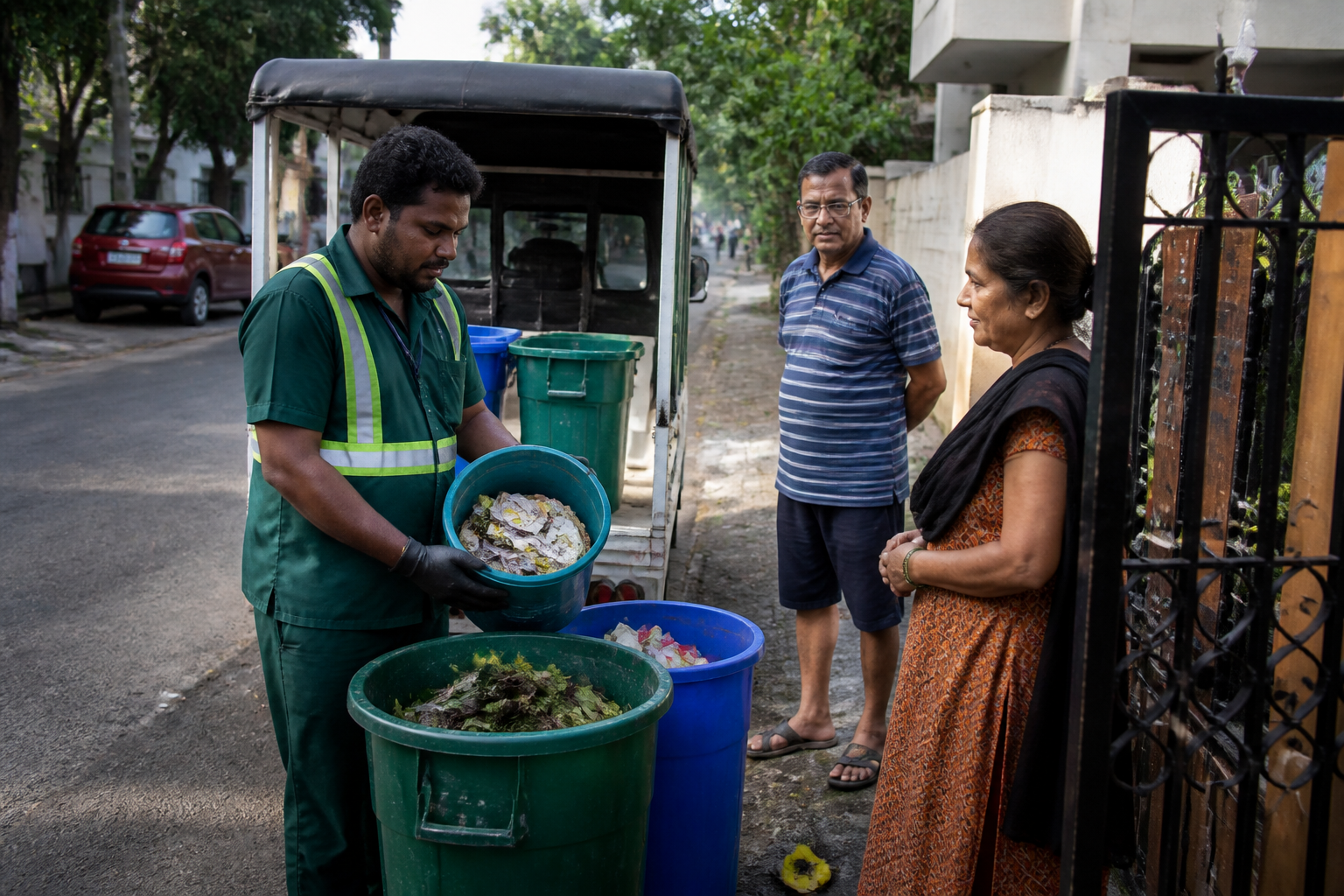
Chennai’s waste segregation drive has increased the number of households separating waste in five southern zones from 3,887 to 6,914, according to data shared by the Greater Chennai Corporation (GCC) and the private agency involved in the campaign.
The 40-day ‘Kuppai Pirippom–Naalai Kaapom’ campaign was conducted as a pilot across Valasaravakkam, Alandur, Adyar, Perungudi and Sholinganallur zones. The initiative focused on door-to-door awareness and tracking whether households were segregating their waste before collection.
Regional deputy commissioner Aftab Rasool said the campaign had produced a visible improvement across the five zones. The GCC also distributed 45,000 dry waste bags and pasted 51,436 stickers outside homes as part of the exercise.
The household figures were supplied by the private agency engaged by the corporation for solid waste management. At the beginning of the campaign, 3,887 households were recorded as segregating waste. The number had risen to 6,914 by September 28, according to the data cited in the report.
The campaign used battery-operated vehicles, whose drivers marked the status of each household on a sticker pasted outside the premises. The system was intended to create a visible record of compliance while allowing field workers to identify homes that needed further engagement.
An official from Sumeet Elko, the private solid waste management agency, said some residents initially removed the stickers. The official said field staff repeatedly explained the purpose of the campaign and that segregation had gradually become a routine for several households.
Adyar recorded the largest increase among the five zones, with the number of households segregating waste rising from 1,980 to 3,400. Alandur recorded an increase from 602 to 1,100 households, while Perungudi rose from 560 to 1,000. Sholinganallur increased from 450 to 789, and Valasaravakkam from 343 to 625.
The figures show that the strongest numerical increase occurred in Adyar, which added 1,420 households during the campaign. Alandur added 498 households, Perungudi 440, Sholinganallur 339 and Valasaravakkam 282. Across the five zones, the reported total increased by 3,027 households during the period.
The campaign’s approach combined material distribution, repeated communication and household-level monitoring. This placed the responsibility for the first stage of waste management at the point where waste is generated, while also involving collection workers in identifying whether residents were following the segregation process.
L J Singaravelan, president of the Adyar Kasturba Nagar-South Residents’ Welfare Association, said residents in the area segregate waste as a habit and that collection takes place regularly. His comments indicate that consistent collection and established resident practices were part of the experience in at least one neighbourhood.
However, Sholinganallur MLA P Saravanan said the progress was not sufficient and called for greater awareness through social media. The campaign’s next stage and whether the reported improvement will continue beyond the 40-day pilot were not detailed in the information available. The GCC’s reported results provide an initial measure of the campaign, while continued household participation will determine whether segregation becomes a sustained municipal practice.
