


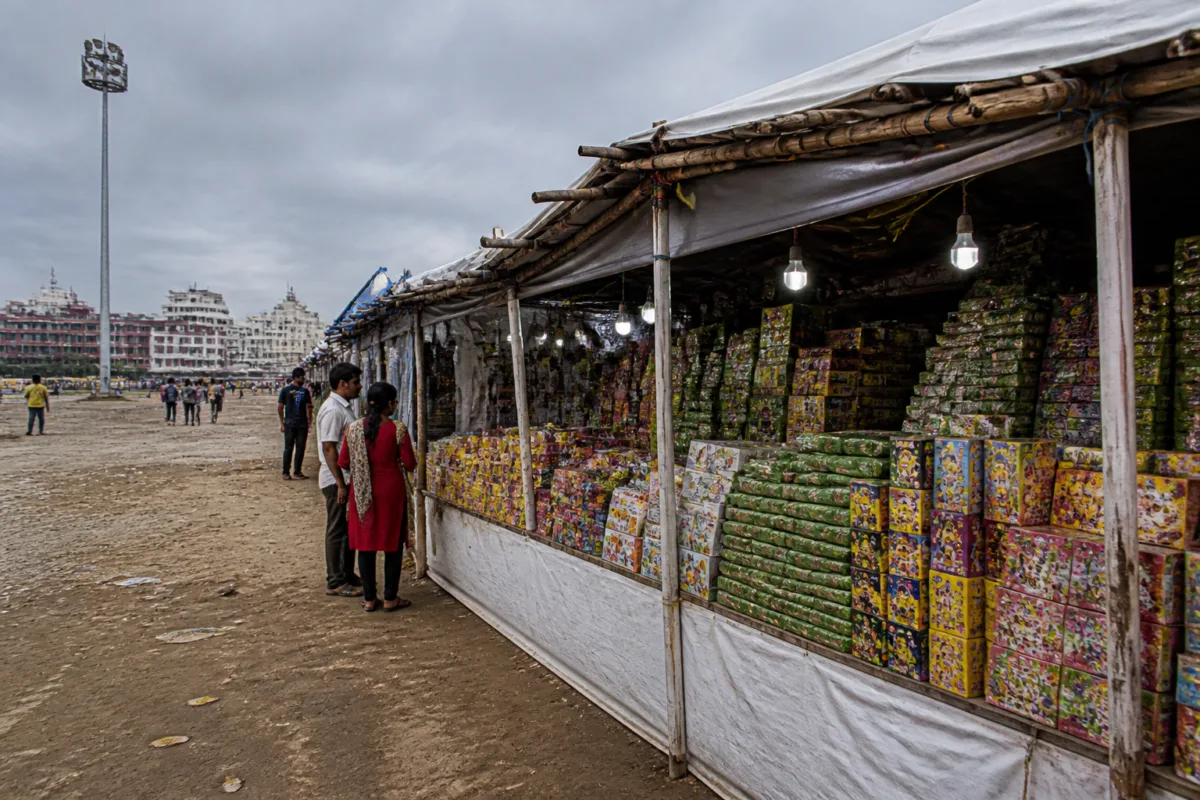
Chennai’s firecracker market is facing a compressed sales season after licensing delays pushed the opening of temporary stalls at Island Grounds beyond the period traders had planned for. The result is more than a weak start to Diwali shopping: it shows how a short administrative delay can affect temporary urban commerce, vendor incomes, consumer access and the use of public space.
The stalls were expected to open on November 3, but traders said licence approvals delayed the first sales until Wednesday. Vendors who had hoped to begin setting up on Friday and start selling on Saturday missed the weekend before Diwali, traditionally one of the busiest periods for families shopping together. They now say they have only about three days to sell their stock instead of the at least 10 days they are usually allotted.
That difference matters because these are not permanent shops with steady year-round demand. The temporary stalls depend on a narrow festival window, and their costs begin before the first customer arrives. Traders told the Times of India that they had already paid for rent and labour. With fewer selling days, those fixed costs must be recovered from a much smaller operating period.
The situation also illustrates the administrative fragility of temporary markets. Licensing is intended to regulate where and how seasonal stalls operate, but the timing of approvals determines whether vendors can use the market period at all. In this case, traders said the delay meant losing the weekend before Diwali, when customers typically arrive with their families. The approval process therefore affected not only compliance but also the commercial viability of the market.
At Island Grounds, the physical market was ready even though customer traffic was slow. Cutouts had been installed, green crackers were stacked and shutters were raised at 10am. Yet rain in parts of Chennai discouraged visitors, adding a weather-related risk to the licensing delay. The report said the India Meteorological Department had issued no official forecast for rain, while some weather bloggers had predicted that an easterly wave could bring widespread rain to coastal areas over the Diwali weekend.
The distinction between an official forecast and informal weather predictions is important for traders operating in a highly concentrated period. Even without a confirmed forecast, the possibility of rain can affect when families choose to shop and whether vendors can display goods comfortably in open or temporary premises. Traders were consequently hoping that Friday, Saturday and Sunday would bring a sales peak, provided rain did not interfere.
The market is also dealing with a price increase. One vendor said cracker prices had risen by at least 20%, compared with the usual annual increase of 10% to 15%. The explanation offered was that costs had increased across the supply chain, including chemicals used in manufacturing and transport. The report does not provide a detailed cost breakdown, but the figures indicate that both sides of the market are under pressure: traders have fewer days to sell, while consumers face higher prices.
For vendors, higher prices may help offset some of the additional costs, but they can also discourage purchases. That tension is particularly significant in a market where demand is concentrated around a single festival. A trader cannot easily extend the season or shift the same volume to another month. If customers delay purchases because of prices or weather, the lost sale may not be recovered later.
The stalls are responding by emphasising products designed to attract children. Traders are offering crackers shaped like drones, toy cars and guitars. Traditional flowerpots feature images of characters such as those from the Avengers, Shin Chan, Dora and Hulk. These products show how seasonal retail markets adapt their merchandise to compete for attention, particularly when families have less time to visit and are more cautious about spending.
The response also reveals the importance of family-led shopping in this market. Residents quoted in the report said crackers remained central to their Diwali celebrations. Murali N, from Koyambedu, said his family was planning a “thala Diwali” and intended to buy sparklers, 100-walas and louder crackers. A resident from Parrys Corner described Tamil Nadu as a major market for crackers and said the industry should be supported within existing regulations.
These comments point to a demand that has not disappeared, even though footfalls were initially poor. The issue is whether that demand reaches the temporary stalls in time. A delayed opening can redirect customers to other sellers, as one vendor feared after people who came to buy crackers on Tuesday found the stalls unavailable and left without purchasing. Once that customer journey is broken, vendors may struggle to bring shoppers back before the festival.
The numbers in the report underline the compressed nature of the problem. Traders lost a weekend that would normally have formed part of a selling period of at least 10 days and were left with roughly three days before the festival. At the same time, prices were reported to be 20% to 25% higher by one trader, compared with the normal annual increase of 10% to 15%. The reported increase is therefore not a marginal adjustment for a seasonal purchase; it arrives alongside a substantial reduction in the time available to sell.
For city authorities, temporary festival markets require coordination between licensing, site preparation, public safety and commercial activity. The report does not identify which specific authority caused the delay or explain the approval stages involved. That limitation is significant. It is possible to establish the commercial effect described by traders, but the available material does not establish the precise institutional reason for the late licences or whether the delay affected all stalls equally.
The report also does not provide the number of stalls, the total volume of stock, the licence application date or the number of licences approved. Nor does it state whether any formal extension of selling days was considered. These missing details prevent a full assessment of the administrative process, but they do not alter the immediate urban pattern: a regulated temporary market lost part of its operating window during the most important shopping period.
The Island Grounds market is a small example of a broader governance challenge in Indian cities. Seasonal commerce often depends on temporary permissions, short-term leases and tightly timed access to public or semi-public spaces. The economic model is vulnerable because costs are incurred before approvals are complete, while the revenue period cannot be extended easily. When approvals arrive late, the loss is distributed across vendors, workers, customers and the wider market.
The Chennai case also shows why urban administration cannot be measured only by whether a licence is eventually issued. Timing is part of the outcome. A permission granted after the peak shopping days may satisfy a formal requirement while failing to deliver the economic opportunity for which the market was organised. For temporary vendors, the difference between opening before and after a weekend can determine whether rent, labour and stock costs are recovered.
The immediate next step for traders is to depend on the final three days before Diwali, when they expect demand to peak. Their sales will be shaped by weather, prices and whether families continue to visit Island Grounds after the delayed start. The report confirms the effect of the lost selling days, but the final impact on trader incomes, customer prices and unsold stock will only be clear after the festival period ends.

