


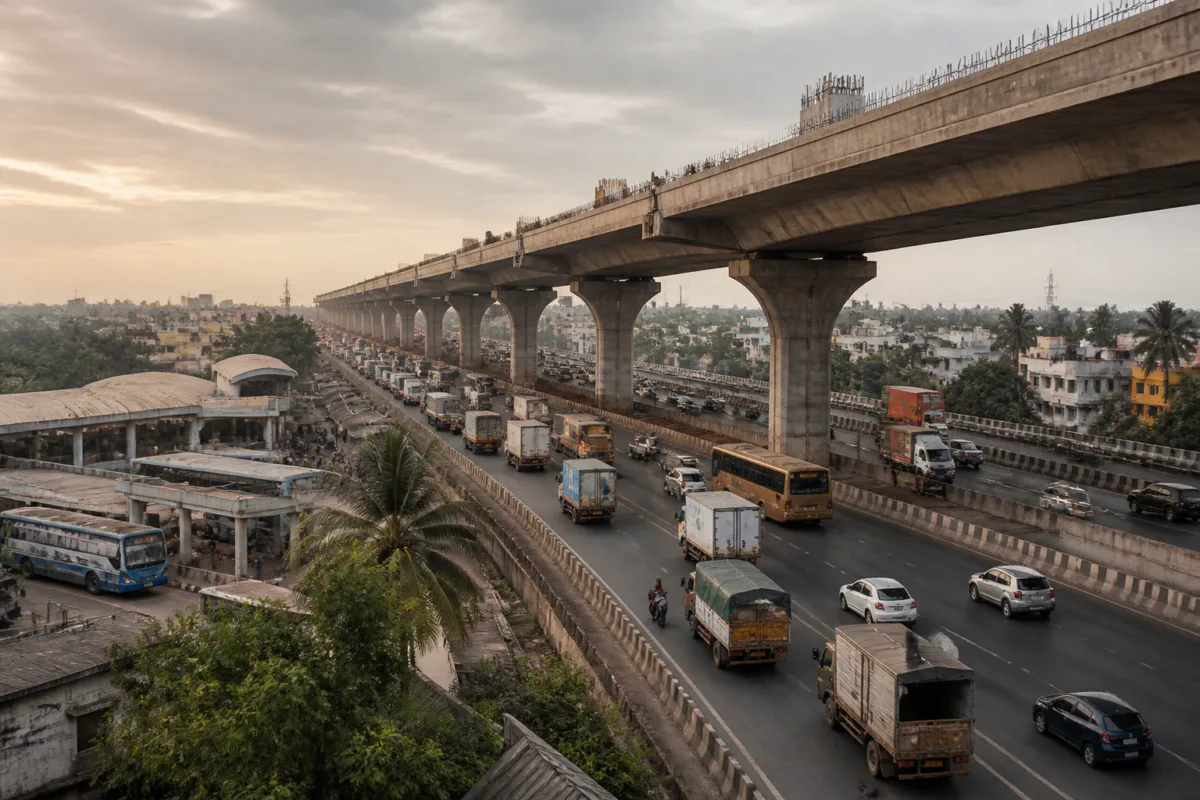
Four elevated highway corridors have been proposed around Chennai, linking Kilambakkam with Chengalpattu, Maduravoyal with Sriperumbudur, Padi with Thiruninravur and Madhavaram with Cholavaram. The proposals were discussed at a meeting between Tamil Nadu Highways Minister Aadhav Arjuna and Union Road Transport and Highways Minister Nitin Gadkari, according to a report by MagicBricks.
The proposed routes cover some of the region’s busiest connections to residential districts, industrial areas, transport terminals and neighbouring towns. The National Highways Authority of India (NHAI) has been asked to work with the Tamil Nadu State Highways Department on plans to address congestion at five major highway entry and exit points around Chennai, the report said.
The first proposed corridor would connect Kilambakkam with Chettipunniyam and Chengalpattu along the Chennai–Tiruchy Highway. Kilambakkam is home to the Kalaignar Centenary Bus Terminus, making the route important for passengers travelling between the southern suburbs, the terminus and destinations in southern Tamil Nadu.
A second corridor is proposed between Maduravoyal and Sriperumbudur on the Chennai–Bengaluru Highway. This route serves office commuters and heavy vehicles moving towards Sriperumbudur’s manufacturing belt. The third would run from Padi to Thiruninravur on the Chennai–Tirupati Highway, passing through Ambattur and Avadi, where residential, commercial and industrial activity is concentrated.
The fourth proposed corridor would connect Madhavaram and Cholavaram along the Chennai–Kolkata Highway. The stretch forms part of North Chennai’s road network, where congestion has been a persistent concern, according to the report.
The proposals are separate from two highway-widening decisions involving the GST Road. The Centre has agreed to widen the Chengalpattu–Madurai stretch to eight lanes and the Madurai–Kanniyakumari stretch to six lanes. Tamil Nadu had requested that the full 740-km Chengalpattu–Kanniyakumari route be developed to eight or 10 lanes, but the reported agreement provides for different lane configurations on the two sections.
The reported road decisions also indicate a possible shift in priorities for the Chengalpattu–Madurai connection. The proposed Singaperumal Koil–Madurai greenfield expressway is likely to be deferred, while NHAI prepares a detailed project report. The Centre is expected to favour widening the existing GST Road instead, the report said.
Other projects remain at different stages. The Centre has declined to fund proposed industrial corridors connecting Chennai, Coimbatore and Thoothukudi. The Tamil Nadu State Highways Authority is to develop those corridors, with tenders already invited for preparing their detailed project reports.
Construction on the Chennai–Bengaluru Expressway is also incomplete in Tamil Nadu. About 18.5 km of the state’s 106-km section remains pending. NHAI is separately in the process of awarding a tender for 15 km of the 26-km Arakkonam–Kancheepuram section; the work is expected to take about 18 months. The wider project has received an investment of more than Rs 16,000 crore, according to the report.
NHAI officials cited construction delays, high bank borrowings and difficulties in sourcing soil as reasons for a cautious approach towards new highway projects. These constraints are relevant to the four Chennai proposals because a proposal or inter-governmental discussion does not by itself establish a final alignment, funding arrangement, construction schedule or land-acquisition plan.
For residents and businesses, the proposed corridors could improve connections between housing areas, employment centres, highways and the KCBT if they are taken forward. They could also bring construction disruption and new planning requirements in built-up areas such as Ambattur, Avadi, Padi and Madhavaram. However, the report does not provide project costs, final designs, land requirements, approval dates or implementation schedules.
The possible effect on property markets is therefore uncertain. Kilambakkam, Chengalpattu, Sriperumbudur, Ambattur, Avadi and Madhavaram already have established residential or industrial activity, but any change in accessibility would depend on whether the corridors receive formal approval and how their access points are designed. For now, the four elevated highways should be treated as proposals rather than committed projects.

