


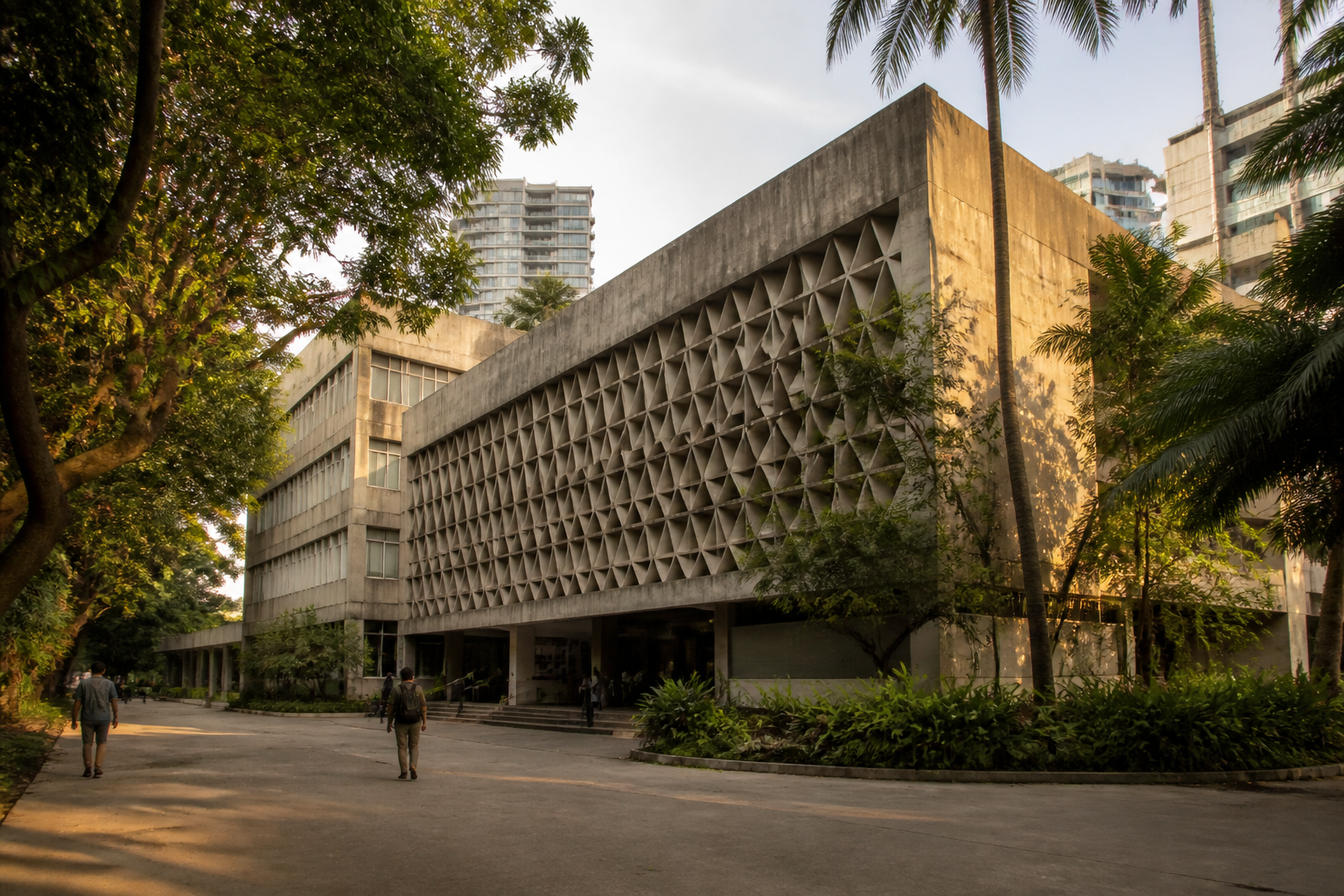
The publication of Chennai Contemporary Architecture, A Guide offers more than a new reading list for students and enthusiasts. It addresses a long-standing imbalance in the way Chennai’s built environment has been recorded: colonial buildings and Indo-Saracenic landmarks have attracted sustained attention, while the city’s post-Independence, modernist and post-economic-liberalisation architecture has often remained less visible in public memory.
Written by A. Srivathsan and Fiona Evangeline S., the slim volume was released at The Hindu’s boardroom earlier this week. Brought out by The Hindu Group of Publications and the Chennai Architecture Foundation, it surveys buildings and precincts across the South, East, Central and West zones of the city. The book does not treat contemporary construction as a uniform landscape of steel, glass and concrete. Instead, it records design decisions involving structure, climate control and landscape, making a case for examining newer buildings on their own architectural terms.
That approach matters because the history of Chennai’s architecture has long been organised around a relatively narrow set of periods and styles. Earlier surveys have concentrated on colonial architecture, Government Houses, Indo-Saracenic buildings and the work of prominent British architects. These accounts remain important, but they do not fully explain how the city changed after Independence, how local architects contributed to that change, or how buildings responded to Chennai’s climate and urban growth.
The review places the new book within a longer tradition of architectural documentation. Works such as Philip Davies’s Splendours of the Raj and Jan Morris’s Stones of the Empire presented Chennai as part of broader histories of colonial India. Mark Bence-Jones’s survey of Government Houses also included Madras within a larger account of imperial architecture. These books helped identify buildings and precincts worthy of attention at a time when colonial architecture was often dismissed as inconsequential.
The city later received a more focused survey through Madras, The Architectural Heritage, commissioned by the Indian National Trust for Arts and Cultural Heritage and published in 2003. Written by K. Kalpana and Frank Schiffer, with contributions reflecting the work of S. Muthiah, Tara Murali and Theodore Baskaran, it remains an important account of Chennai’s colonial architectural inheritance. Shanti Jayewardene Pillai’s Imperial Conversations, Indo-Britons and the Architecture of South India added another layer by examining the emergence of the Indo-Saracenic style and the role of Indian artisans in its development.
This history reveals a recurring feature of architectural memory: buildings are not remembered only because they exist. They become part of a city’s shared inheritance when researchers, writers, institutions and communities identify their significance and preserve knowledge about them. Without that work, buildings can become isolated objects, detached from the social, technological and administrative histories that produced them.
Chennai’s modern architecture has not been entirely undocumented. The review identifies K. R. Sitalakshmi’s Architecture of Indian Modernity: The Case of Madras, published in 2015, as an important study of the Art Deco, Brutalist and Modernist periods. That work brought architects such as Prynne, Abbot & Davis, L. M. Chitale, R. R. Sarma, Kiffin Ray Peterson and F. B. Pithavadian into a more prominent account of the city’s architectural development.
The significance of Chennai Contemporary Architecture, A Guide lies in extending this record across the contemporary city. Srivathsan has previously written about a short-lived attempt to create a Dravidian architectural style in Chennai and has continued studying the city’s modern architecture, particularly the period after economic liberalisation. In the new volume, the argument is that Indian architectural modernity cannot be reduced to the better-known Ahmedabad, Bombay and Delhi axis. Important work also emerged in other cities, including Chennai, and deserves to be identified before it disappears from public attention.
The book’s emphasis on structural elements, climate control and landscape is especially relevant to Chennai. Architecture in a hot, humid coastal city cannot be judged only through façades or stylistic labels. The relationship between a building and its climate, the way it manages heat and ventilation, the use of landscape, and the structural choices made by its designers all influence how the building performs as part of the city. By drawing attention to these elements, the book shifts the discussion from appearance to performance and adaptation.
This is also a challenge to the way post-Independence buildings are often categorised. If new construction is dismissed as an undifferentiated mass of concrete, steel and glass, the discussion loses the ability to distinguish between buildings that merely occupied land and those that responded intelligently to their setting. Documentation creates the basis for that distinction. It allows planners, architects, researchers and residents to discuss what a building contributed, how it worked and whether it deserves conservation or continued public use.
The review’s account of the demolished Government House on the Government, now Omandurar, Estate shows why such documentation has practical consequences. The building was demolished to make way for a short-lived Assembly complex that later had a longer existence as a hospital. The example illustrates how urban land is repeatedly reassigned to new institutional purposes, while the architectural value of what stood there may be assessed only after it has been lost. A written record cannot prevent demolition by itself, but without a record, the loss is harder to understand and contest.
The institutional landscape behind Chennai’s architectural memory is therefore broader than any single book. It includes historians, academic researchers, conservation organisations, publishers, foundations and public authorities. The Chennai Architecture Foundation’s role in bringing out the new guide places contemporary architectural documentation within an organised civic and cultural effort. The earlier involvement of INTACH demonstrates that heritage surveys can also be commissioned through institutional networks rather than left entirely to individual researchers.
Yet the review also points to a geographical question. The new book is arranged by South, East, Central and West, while North Chennai is absent. The author suggests that a future edition may include the northern part of the city as ongoing development produces buildings and precincts that merit inclusion. This is not simply a missing chapter in a guide. It reflects the difficulty of documenting a city while its urban form is still changing.
North Chennai’s absence also highlights the limits of architectural histories organised around established landmarks. Areas undergoing rapid development may contain important industrial, residential, institutional or infrastructural buildings that have not yet entered the canon. A citywide record must therefore keep pace with expansion, redevelopment and changing land use. Otherwise, documentation will continue to privilege older, better-known areas while newer urban districts remain under-recorded.
The evidence presented in the review does not establish a complete inventory of Chennai’s contemporary buildings, nor does it provide comparative data on their environmental performance, ownership or current condition. Its contribution is different. It assembles a framework through which the city’s modern architecture can be seen as a field of inquiry rather than as an undifferentiated period between colonial heritage and present-day construction.
That framework has implications for urban governance. Conservation decisions depend on information about what exists, when it was built, who designed it, how it functions and why it matters. In the absence of such records, public debate can become dependent on sentiment, visibility or immediate redevelopment priorities. A guide that identifies buildings, precincts and design features helps create the knowledge base from which more informed decisions can eventually be made.
Chennai’s architectural story is therefore not only about preserving the past. It is also about deciding when the recent past becomes part of the city’s heritage. The buildings of the post-Independence and post-liberalisation periods are still close enough to everyday experience to be overlooked, yet old enough to face alteration, neglect or replacement. Recording them now gives the city a chance to assess their value before decisions are made solely on the basis of land use or age.
Chennai Contemporary Architecture, A Guide does not close the city’s architectural history. Its regional arrangement, and the absence of North Chennai, make clear that the record remains unfinished. But by bringing modern buildings, climate responses, structural choices and landscapes into the same conversation as colonial and Indo-Saracenic architecture, it strengthens the case for treating the entire built environment as part of Chennai’s urban history.
