


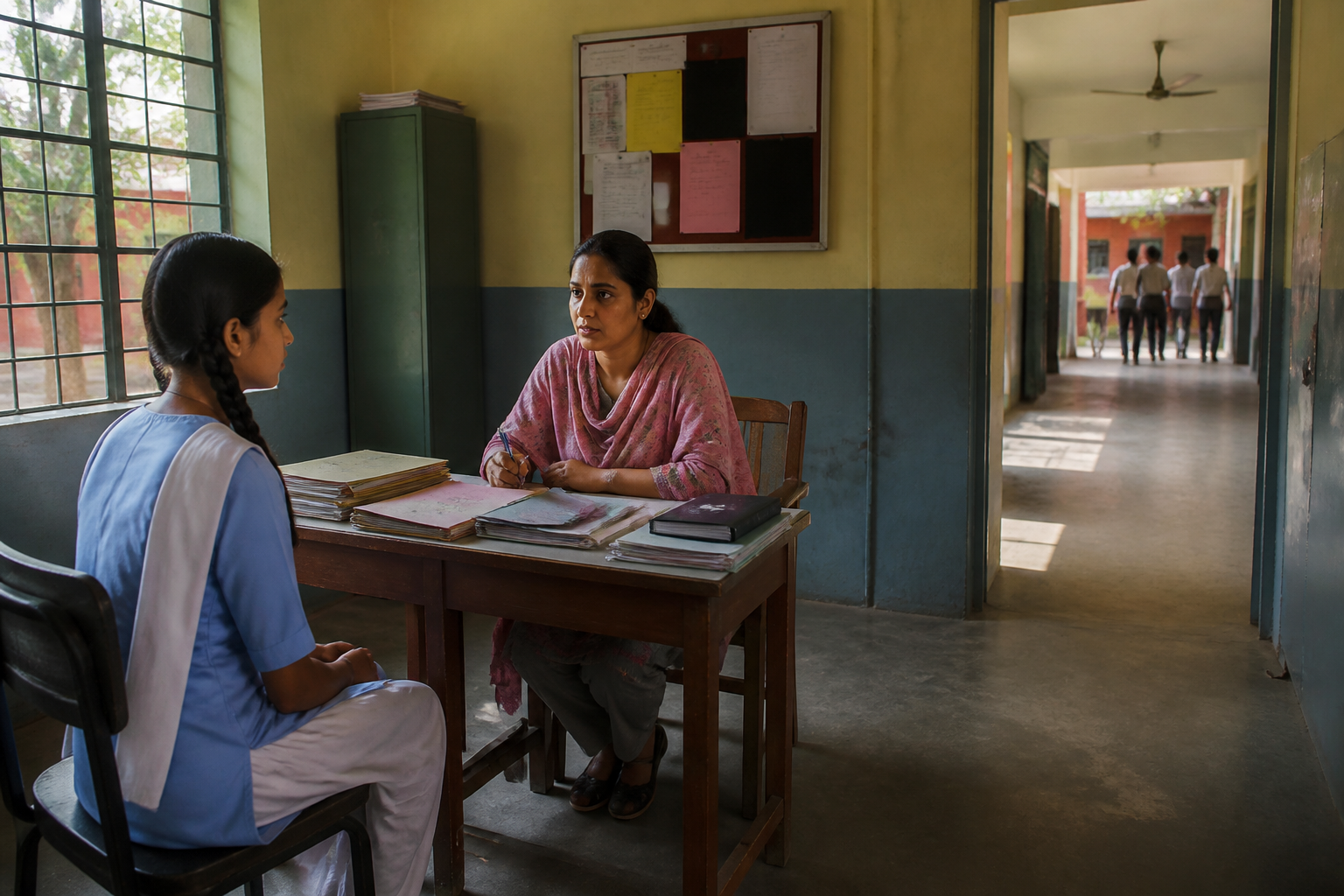
Around 90 outsourced counsellors working across Chandigarh’s 114 government schools are facing salary deductions during the upcoming autumn break. The immediate dispute is about whether counsellors should be paid when schools are closed. The larger issue is how a public education system can expand its reliance on counselling while leaving the workers delivering that service outside a stable employment framework.
The counsellors, engaged through an outsourcing agency, receive a gross monthly salary of about Rs 42,000 and a net amount of approximately Rs 40,000 after provident fund deductions. They say they face frequent payment delays and receive no wages during school vacation periods. The Chandigarh administration’s position, as reported by The Times of India, is that outsourced staff are not eligible for vacation pay because their services are not required when schools remain closed.
That explanation places the counsellors in an unusual position within the school system. Their work is treated as necessary during the academic year, but their employment conditions are structured around the assumption that the service can be paused whenever schools shut. The resulting gap is not merely a dispute over one break. It raises questions about whether counselling is being treated as a continuous institutional function or as an intermittent service attached to the school calendar.
## Chandigarh school counsellors and the public-school system
The numbers show both the scale and the limits of the current arrangement. About 90 counsellors are serving 114 government schools, meaning the system does not have one counsellor permanently assigned to every school. The reported staffing pattern also leaves counsellors serving across institutions whose needs may differ in size, student population and access to dedicated counselling facilities.
A counsellor quoted in the report said some schools have a proper room for counselling, but questioned what happens to employment conditions when counselling is simultaneously being recognised as an important part of the school system. That concern points to a basic administrative contradiction: the state may require or encourage counselling provision, yet the service can remain dependent on short-term outsourcing arrangements and rules that do not consistently recognise the work as essential.
The counsellors also report being redirected to duties outside their professional role, including substitution work for physical education, mathematics and physics. Such redeployment changes the practical meaning of the counselling post. A position created to support students’ emotional and mental wellbeing becomes part of the school’s general staffing pool when other teaching or operational gaps arise.
The issue is particularly significant because the counsellors’ own account describes work carried out during the Covid-19 pandemic. They said they completed 52 days of counselling work while also helping distribute ration and emergency relief. That experience shows how school-based staff can become part of a wider public-support network during a crisis. It also raises the question of whether the employment structure is designed to recognise such responsibilities or only the narrowest interpretation of a routine school assignment.
## From policy priority to employment practice
Student mental health has gained greater policy attention through CBSE affiliation norms, the Centre’s Manodarpan initiative and a Supreme Court-appointed National Task Force that has called for stronger school counselling mechanisms. These developments establish a policy direction in which counselling is no longer easily dismissed as an optional or peripheral school activity.
But policy recognition does not automatically create institutional capacity. A counselling programme requires people, space, time and continuity. It also requires clarity about who is responsible for hiring counsellors, paying them, supervising their work and ensuring that they are available when students need support. The reported Chandigarh arrangement shows what happens when the policy expectation and the employment model move at different speeds.
The administration’s stated position focuses on the operational fact that schools are closed during vacations. The counsellors’ demand for regularisation and consistent pay focuses on the nature of their engagement across the year. Both positions reflect different definitions of the service. One treats counselling as work activated by school operations. The other treats counsellors as part of the public-school workforce whose livelihoods cannot be repeatedly interrupted by the academic calendar.
The reported history of payments adds to that uncertainty. Counsellors received vacation pay in 2016 and during the autumn break in 2023, but are facing deductions again this year. The inconsistency matters because it makes household income dependent not only on the written terms of engagement but also on how those terms are interpreted and applied at different points in time.
## The cost of an intermittent workforce
The immediate financial impact of a salary deduction falls on workers earning about Rs 40,000 a month after provident fund deductions. The longer-term institutional cost is less visible. Repeated uncertainty can affect retention, morale and the ability of the system to build experience among counsellors. The supplied report does not establish the extent of attrition or quantify the financial loss caused by the deductions, but it does document repeated representations to senior education authorities and the UT administration without a change in service conditions.
That administrative pattern is important. When workers repeatedly seek regularisation and a consistent pay structure, the question is no longer limited to an individual payment dispute. It becomes a test of whether the department has a stable framework for a service that it has chosen to provide through outsourced personnel.
Outsourcing can allow an administration to add staff without creating permanent posts, but it can also separate responsibility for service delivery from responsibility for employment conditions. In this case, the counsellors work in government schools and serve government students, while their engagement is routed through an outsourcing agency. The available report does not specify the agency’s identity or the full contractual terms, so the precise division of responsibility cannot be established from the supplied material. What is clear is that the counsellors’ service conditions remain unsettled despite their continuing role in the public-school network.
Their reported redeployment to teaching-substitution duties adds another layer. If counsellors are regularly used to fill unrelated gaps, the school system may be compensating for shortages in one area by weakening capacity in another. Students may see a counsellor on the staff list, but that does not necessarily mean counselling time is protected, spaces are available or the professional role is being preserved.
## The institutional question behind vacation pay
The dispute also exposes the difficulty of applying conventional school calendars to support services. Teaching schedules naturally follow terms, examinations and holidays. Counselling needs may not follow the same pattern. Students and families can experience distress, conflict or mental-health concerns outside classroom hours and beyond the active teaching term. The supplied material does not provide data on counselling demand during vacations, so it cannot establish whether counsellors must work through every school closure. It does, however, show that the current rule is being applied without resolving the broader question of how counselling should be structured.
A consistent system would require clear answers on several administrative points: whether counsellors are school employees or agency personnel, whether their work is seasonal or continuous, what duties fall within their contracts, and how pay is handled during closures. The counsellors’ demand for regularisation indicates that these questions remain unresolved from their perspective.
The issue is also connected to the distribution of public services across schools. With around 90 counsellors for 114 government schools, counselling capacity is already spread across more institutions than the number of counsellors. If some counsellors are further diverted to physical education, mathematics or physics substitution, the effective availability of counselling may be lower than the headline staffing number suggests. The report does not provide school-wise deployment data, so the extent of this shortfall cannot be measured, but the staffing ratio makes the concern relevant.
## What the evidence confirms
The available evidence establishes four clear facts. First, Chandigarh’s government schools have about 90 outsourced counsellors serving 114 schools. Second, the counsellors face salary deductions during the autumn break because the administration says outsourced staff are not eligible for vacation pay when schools are closed. Third, counsellors report delayed payments, previous instances of vacation pay and continued demands for regularisation. Fourth, the workforce is being used for duties beyond counselling while national and judicial initiatives have elevated the importance of school mental-health support.
What remains unclear is equally important. The report does not set out the full outsourcing contract, the legal basis for the vacation-pay decision, the number of counsellors affected by the current deduction, or the administration’s detailed response to the regularisation demand. It also does not establish whether counselling rooms are available in all 114 schools or how students access counselling when a counsellor is serving more than one institution.
The next pressure point is the winter break, reported as running from December 25 to January 7. Unless the service conditions change, the counsellors expect another financial difficulty when schools close. That upcoming break provides a clear administrative milestone: the UT education authorities will have to decide whether the current interpretation of vacation pay continues and whether the broader questions around regularisation, deployment and counselling capacity are addressed.
Chandigarh’s case shows the distance between declaring student mental health a policy priority and building the institutional conditions needed to deliver it. The immediate dispute concerns salaries during school holidays. The deeper governance question is whether a public service can be treated as essential for students while the workforce providing it remains temporary, inconsistently paid and available for unrelated duties.
