


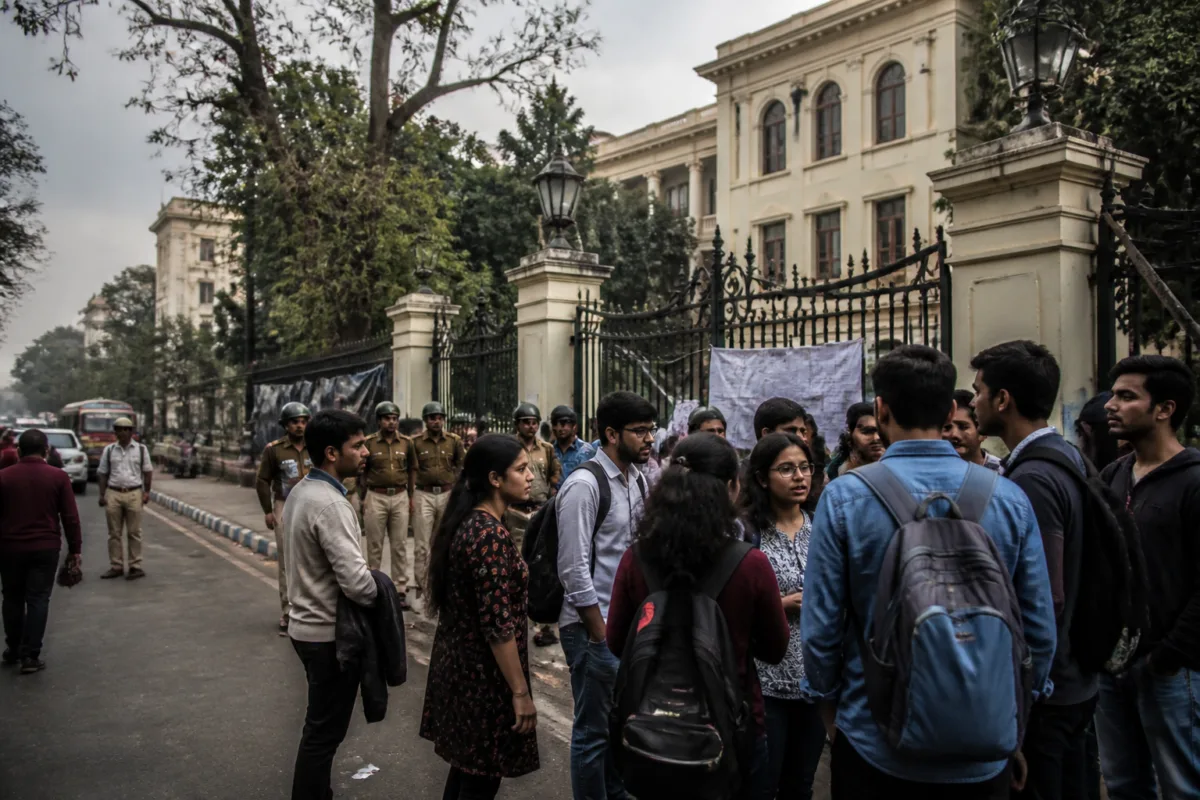
The latest confrontation at Presidency University is not only about two students expelled after an alleged defacement of an ABVP banner. It is part of a widening contest over who defines acceptable political expression on Bengal’s campuses, how university administrations respond to pressure from organised student groups, and where institutional discipline ends and political coercion begins.
Chief minister Suvendu Adhikari’s public praise for the ABVP’s campaign at Presidency and Jadavpur universities has brought that contest into sharper view. Speaking at the inauguration of a Kali Puja in Maniktala, Adhikari praised the organisation for what he described as a drive to remove “anti-national activities” from the two institutions and offered to supply “bleaching powder” and “phenyl” for what he called a continuing “clean-up” operation.
The remarks came a day after Presidency expelled two women students. According to the report, the university acted after a five-member committee examined a complaint from the ABVP alleging that students had written “rapist” and “throw garbage” on a banner carrying an image of Swami Vivekananda. The university had constituted the committee on October 14, and the expulsions followed its recommendations.
The ABVP welcomed the decision. Its media in-charge, Ananta Baruy, said college and university administrations had a responsibility to ensure that “anti-India sentiments and anti-national conspiracies” had no place in educational institutions or society. The Students’ Federation of India and Independents’ Consolidation, however, protested the expulsions and accused the ABVP of promoting intimidation and coercion on campuses.
The disagreement exposes the central institutional question: whether a university’s disciplinary process can remain credible when the underlying allegation is simultaneously framed as a matter of national loyalty and used in a wider political campaign. The supplied report establishes that an inquiry was conducted and that disciplinary action followed. It does not provide the committee’s findings, the students’ responses, the university’s detailed order or the evidence used to reach the decision. Those missing documents matter because expulsion is among the most severe penalties an academic institution can impose.
### Campus conflict and the language of institutional control
The language used by political and student organisations is significant because it changes the terms of campus administration. The alleged writing on the banner was treated by the ABVP as evidence of anti-national sentiment, while the protesting student groups described the organisation’s conduct as intimidation. These are not merely competing descriptions of one incident. They represent rival claims about whether campus disputes should be resolved primarily through university rules, through political mobilisation, or through pressure applied in public spaces.
Adhikari’s intervention places the state’s political leadership directly inside that dispute. His remarks did not announce a new university regulation or administrative order. They publicly endorsed the ABVP’s characterisation of the conflict and its campaign at two prominent institutions. The promise to provide cleaning materials was also framed as support for a continuing operation, turning a metaphor for ideological purification into a political statement about the campuses themselves.
That matters for university governance because disciplinary authority formally rests with institutional bodies, not with student organisations or political platforms. The report does not establish that the chief minister directed Presidency’s committee or disciplinary decision. It does show that the decision was followed by public political approval, while opposition groups challenged the broader climate in which such action occurred.
The result is a governance problem familiar across contentious institutions: the administration may follow a formal process, but the legitimacy of that process can be weakened if the surrounding political environment appears to reward one side before all relevant records and responses are publicly understood. Without the committee’s report and the expulsion order, outside observers cannot independently assess whether the punishment was proportionate to the alleged conduct.
### Jadavpur and the escalation from protest to confrontation
The Presidency episode also sits within a recent sequence involving Jadavpur University. The report says Adhikari had earlier urged the ABVP, speaking from a dais outside the university’s Gate No. 2, to teach Jadavpur the same “lesson” it had taught Jawaharlal Nehru University in Delhi. That statement followed an August 20 campus raid by ABVP supporters who allegedly vandalised property, issued sexual threats to women and hurled fireballs at students sheltering behind a locked grille gate.
The report attributes the description of the raid and the allegations to the account it cites; it does not provide an independent investigative finding on those allegations. It also records that an ABVP central committee member, Suvabrata Adhikari, described the organisation’s action as an operation to rid the campus of “dimagi naxals”. The rhetoric shows how campus disputes were framed not as isolated disagreements over student politics, but as a broader struggle between ideological camps.
That framing increases the risk that ordinary university spaces become treated as arenas of permanent political mobilisation. Gates, banners, student meetings and disciplinary committees then acquire significance beyond their immediate function. A banner can become a symbol of ideological ownership; a protest can be presented as an attack on the nation; and a disciplinary order can be read as a victory by one political network over another.
The supplied material does not establish the scale of ABVP activity at either university, nor does it provide figures on membership, campus incidents or disciplinary cases. It does, however, record that the organisation has been attempting to expand its presence on campuses since the BJP came to power in Bengal in May. The available evidence therefore points to an organised political effort, but not to a measurable assessment of its reach or support among students.
### What university administrations must make visible
The immediate institutional lesson is the importance of procedural transparency. When a university expels students over alleged political or symbolic misconduct, the administration’s credibility depends on more than announcing the outcome. It must be possible to understand the complaint, the evidence, the students’ opportunity to respond, the committee’s reasoning and the disciplinary rule applied.
The report confirms the existence of a five-member committee at Presidency but does not identify its members or reproduce its recommendations. It also does not state the duration of the expulsions, the specific rule invoked, whether the students have appealed or whether the university has released a reasoned order. These are not minor details. They determine whether the case represents a narrowly defined disciplinary action or a precedent for handling political speech and protest on campus.
The competing responses from the ABVP, SFI and Independents’ Consolidation underline another responsibility: administrations must distinguish damage to property, harassment, threats and physical violence from offensive or politically charged expression. The supplied report contains allegations relating to each type of conduct across different incidents, but it does not establish that they were investigated under a common framework. Treating every dispute as ideological misconduct can obscure serious safety concerns, while treating every provocative expression as protected dissent can also weaken campus order.
A credible system therefore requires both due process and physical safety. Students need protection from threats and violence, including sexual threats, while disciplinary action must be based on published rules and evidence rather than political endorsement. The report does not show whether Presidency or Jadavpur has adopted additional measures to address these overlapping concerns.
### The wider institutional pattern
The report also mentions recent action at the Satyajit Ray Film and Television Institute, where six students were rusticated over allegations of manhandling and heckling vice-chancellor Santosh Ajmera. Those students had been observing an academic boycott since September 27 to protest alleged attacks on them by organisations linked to the Rashtriya Swayamsevak Sangh. The report does not provide the institute’s inquiry findings or establish the relationship between that case and the Presidency or Jadavpur incidents.
Taken together, the cases indicate a wider pattern of disciplinary conflict involving student groups, administrators and organisations connected to competing political positions. But the evidence supplied is not sufficient to conclude that the institutions share a single coordinated policy or that all incidents have the same causes. What can be established is that disciplinary action and political mobilisation are repeatedly appearing in the same public debate.
That overlap makes institutional neutrality harder to demonstrate. A university may legally and administratively act against misconduct, yet its action can be interpreted through the political identities of the complainants, the students and the leaders commenting on the case. Once senior political figures publicly celebrate one side’s campaign, the administration faces a more difficult task in convincing students that future decisions will be based solely on evidence and rules.
The central urban-governance question is therefore not whether campuses should be free of politics. Universities are public institutions located within cities, and political debate is part of their social function. The question is whether campus politics can operate without turning administrative machinery, physical space and disciplinary power into instruments of partisan control.
The evidence presently confirms a sharp escalation in the language surrounding Presidency and Jadavpur, a formal expulsion at Presidency, support for that decision from the ABVP and the chief minister, and opposition from other student groups. It does not establish the full facts behind the alleged banner defacement, the proportionality of the expulsions, or the independent findings on the Jadavpur violence allegations. Those records, along with any appeals or further administrative decisions, will determine whether the latest episode remains a contested disciplinary case or becomes part of a deeper breakdown in trust between Bengal’s universities and their student communities.

