


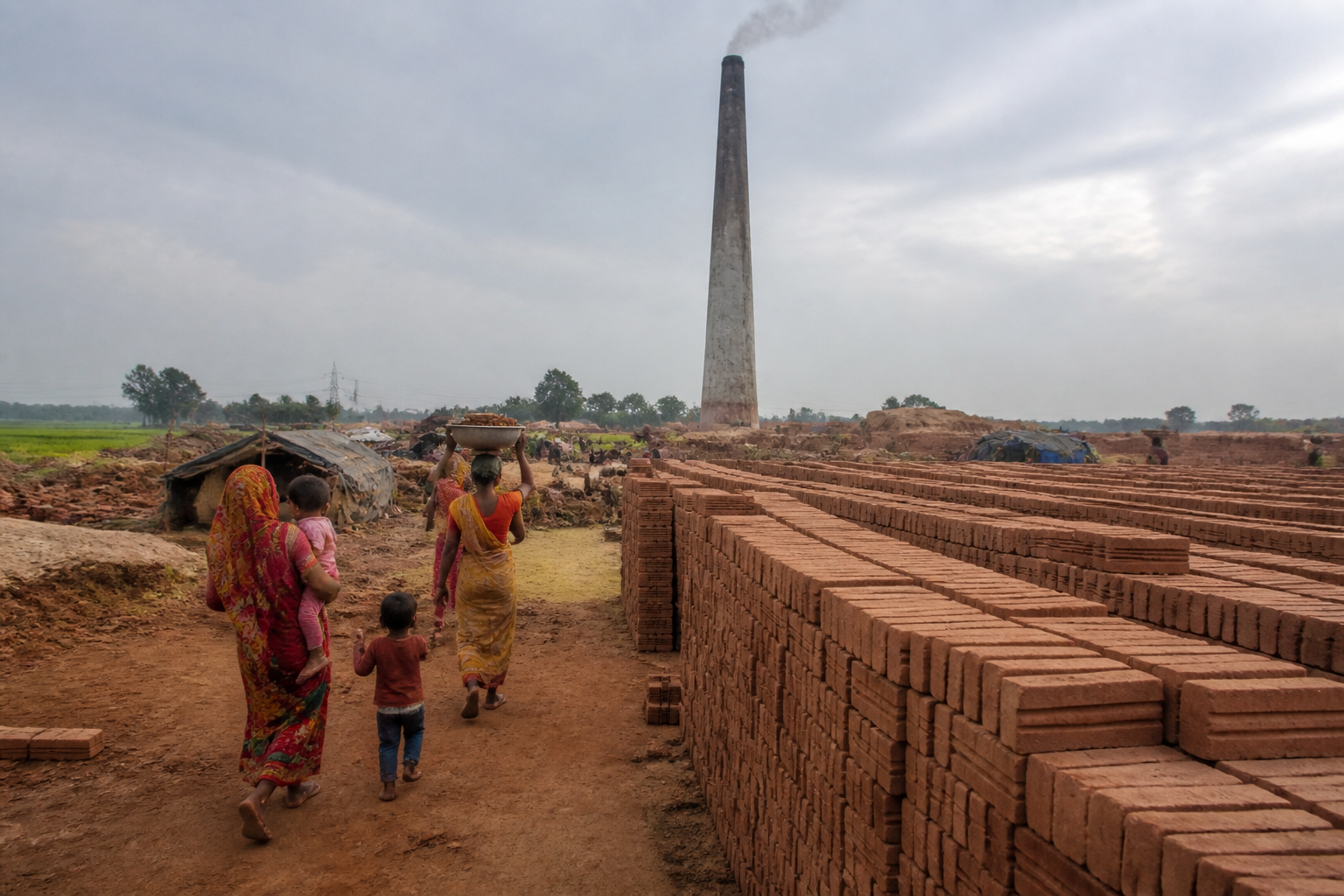
The investigation into an alleged interstate brick kiln labour-trafficking network in Chhattisgarh began with a 15-year-old girl arriving at a hospital four months pregnant. It has since widened into a case involving alleged bonded labour, child labour, sexual exploitation and the movement of thousands of workers from Chhattisgarh and Odisha to kilns in other states. The episode reveals how the construction-material economy can depend on a workforce that remains largely invisible once it leaves its village.
Police in Chhattisgarh arrested five suspected traffickers—three from Chhattisgarh and two from Odisha—after raids at 10 locations across the two states. Investigators seized Rs 1.4 crore in cash, labour-migration registers, diaries, mobile phones, bank passbooks, cheque books, ATM cards, mortgage documents and a currency-counting machine. The seized material is now being examined for evidence of recruitment, money flows, destination kilns and the number of workers who may have been subjected to trafficking or bonded labour.
The case was set in motion after a maternity home sent a memo to police on September 21 regarding the minor’s pregnancy. Mahasamund Superintendent of Police Prabhat Kumar told The Times of India that the inquiry led officers to the girl’s family, which had travelled to a brick kiln in Barabanki district of Uttar Pradesh for seasonal work. Police allege that the girl was sexually exploited there by a JCB driver.
What makes the case significant is the way a sexual-offence inquiry opened a wider line of investigation. Police began examining who had taken the family to Uttar Pradesh, how workers were recruited, who controlled their wages and why children accompanying migrant workers were being drawn into the labour process. According to the FIR account cited in the report, the family received an advance of Rs 40,000 from the main contractor. That advance allegedly became the basis for binding the family to the kiln.
The family was allegedly not free to leave the kiln, contact outsiders or return home. Workers were reportedly made to work from 11am to midnight, or about 16 hours a day. The minor was allegedly forced to work as a replacement for her brother, who had temporarily returned home after their grandfather fell ill. This detail shows how recruitment is organised around households rather than individual workers: when one member leaves, another family member can be pulled into production.
That household structure is central to understanding the vulnerability of migrant kiln workers. A labourer recruited for a kiln generally travels with a spouse and children. Once the family reaches the destination, the boundary between adult employment and family survival can disappear. Children may be made to work to meet production targets or to compensate for advances paid to the household. In the case under investigation, the presence of the family did not protect the child from the labour arrangement; it allegedly placed her inside it.
Police officials have described conditions in some cases as characteristic of bonded labour. The reported indicators include exceptionally long working hours, wages withheld or adjusted against advances, restrictions on leaving and dependence on contractors for transport home. The distance involved reinforces that dependence. Investigators said families were often taken 500 to 600 kilometres or farther from their villages, making it difficult to abandon the kiln midway through the season and arrange their own return.
Distance, in this system, is not only a geographical fact. It can become an administrative and economic barrier. A worker who is far from home may lack access to local institutions, legal assistance, transport or an independent source of income. If wages are controlled by a contractor and the family’s travel has been financed through an advance, leaving may carry an immediate financial cost. The investigation suggests that mobility itself can therefore be converted into control.
The records seized by police reportedly contain details of thousands of adult and minor workers moved to unregistered brick kilns without statutory permissions or valid documentation. Police are also examining information suggesting that teenage girls from labouring families return pregnant after seasonal work at kilns. Officials familiar with the inquiry have noticed numbers ranging between 10 and 50 girls, although the investigation is still determining how many were minors and whether cases were registered under the Protection of Children from Sexual Offences Act.
These allegations remain subject to investigation, but they point to a serious gap between the formal construction economy and the conditions under which some of its materials are produced. Bricks are basic inputs for housing and construction. Yet the chain connecting a kiln to a building site can be fragmented across contractors, labour intermediaries and destination-state operators. That fragmentation can make it difficult to establish who recruited workers, who paid them, who controlled their movement and who was responsible for the conditions at the kiln.
The reported scale of recruitment adds another layer to the case. Police officials said each of the five accused may have sent between 2,000 and 5,000 workers annually to brick kilns in different states for periods of up to six months. These figures are investigators’ estimates under examination, not a final determination of the network’s size. If substantiated, they would indicate a recruitment operation functioning across state borders and across repeated migration seasons rather than an isolated dispute involving one household.
The alleged annual movement of workers also shows why seasonal labour migration cannot be treated only as a private arrangement between a worker and a contractor. The system involves recruitment villages, transport, advances, destination kilns, wage settlement and return journeys. Each stage can create a point at which workers become dependent on intermediaries. Children and adolescent girls travelling with families are especially exposed because their presence may not be recorded as employment, even when they are made to work.
The institutional response in this case is being led by the police, but the evidence described in the report crosses several administrative responsibilities. Police are investigating trafficking, sexual offences and organised crime provisions. Labour authorities would be relevant to allegations involving bonded labour, wage control and working conditions. Child-protection agencies would be relevant where minors were allegedly made to work or were exposed to sexual exploitation. The movement of workers between states also requires coordination between origin and destination authorities.
The alleged use of unregistered kilns raises a further governance question. Registration and documentation are not merely procedural requirements if they determine whether authorities can identify a kiln, its operator, its workforce and the contractor supplying labour. Where kilns operate outside formal records, workers may become difficult to locate and the supply chain becomes harder to scrutinise. The documents seized in the raids could help establish whether the network relied on systematic gaps in registration and oversight.
The financial evidence may be equally important. Police seized cash, bank passbooks, cheque books, ATM cards, mortgage documents and a currency-counting machine. Investigators are examining call-detail records, bank accounts and the financial trail to identify what the SP described as the syndicate’s end-to-end links. This could clarify how advances were financed, how contractors were paid, whether wages were transferred or withheld and how recruitment profits were distributed.
The case also complicates the idea that labour trafficking is always organised through visible force. The reported arrangement appears to have combined poverty, advances, family recruitment, distance and control over return travel. A household may initially accept seasonal work as an income strategy, but the conditions at the destination can allegedly turn that arrangement into coercion. The distinction between migration for work and trafficking therefore depends on what happens after recruitment: whether workers can leave, whether wages are controlled and whether consent continues once the family reaches the kiln.
For cities and the built environment, the issue is not remote from urban development. Brick kilns supply a material used in construction, while migrant workers sustain a production system linked to housing and infrastructure demand. The people producing that material may live outside the cities where it is consumed, and their exploitation can remain absent from project approvals, material procurement discussions and construction schedules. The investigation brings that hidden connection into view without establishing that every kiln or contractor operates in the same way.
The available evidence does not yet establish the full number of workers involved, the identities of all destination kilns, the extent of child labour or the number of sexual-exploitation cases. It also does not establish how many employers, contractors or intermediaries may ultimately face action. Those questions depend on the examination of registers, digital records, bank accounts and statements from workers and families.
What the case confirms is narrower but significant: a police inquiry involving one minor has uncovered records pointing to a cross-border labour network, and investigators allege that advances, distance and contractor control may have trapped families in kiln work. The next stage will depend on the seized records, financial investigation and coordination between agencies in Chhattisgarh, Odisha and the destination states. The five arrested accused were being produced in court for judicial remand as the investigation continued.
