


Bosch AC expansion in India is being built around more than a new premium product line. Bosch Home Comfort Group is using a dual-brand strategy, local manufacturing and an existing Hitachi distribution network to enter a market it believes still has substantial room to grow. The plan shows how air conditioning is increasingly being treated as a manufacturing, engineering and urban-comfort opportunity rather than only a consumer-appliance category.
The company, part of German engineering major Bosch GmbH, plans to launch Bosch-branded air conditioners in India next year. Managing Director Sanjay Sudhakaran told PTI that the group is targeting a strong double-digit market share within two years and aims to become one of the country’s top five cooling and comfort brands in the medium term.
That ambition follows Bosch Home Comfort Group’s acquisition of Johnson Controls-Hitachi Air Conditioning’s global residential and light-commercial air-conditioning business in August 2025. In India, the acquisition has given Bosch control of Hitachi’s air-conditioning operations, including an established manufacturing base, product portfolio and distribution network.
The company’s immediate challenge is to expand without blurring the identities of the two brands. Sudhakaran said Hitachi would be positioned in the mainstream and mass-premium segments, while Bosch would target performance-premium and super-premium consumers. Bosch-branded air conditioners are expected to be priced at around ₹45,000 to ₹50,000 and above, placing them in a segment that includes brands such as O General and Mitsubishi Electric.
The strategy matters because it links market expansion to a differentiated industrial model. Rather than using one brand across the entire market, Bosch Home Comfort plans to use Hitachi’s specialist air-conditioning legacy to reach a broader consumer base while reserving Bosch’s German engineering association for higher-priced products. The company says the two brands will have separate product portfolios, features and value propositions, even when their backend operations overlap.
The evidence supplied by the company points to a business attempting to scale through shared infrastructure. Bosch Home Comfort India plans to use Hitachi’s existing retail and distribution network for both brands. It is also exploring the use of Bosch’s consumer-appliances retail footprint, including Bosch and BSH-branded stores, to sell Bosch air conditioners. Large-format retailers, regional retailers and online platforms will remain part of the distribution mix.
This arrangement reflects a practical constraint in the cooling market: a new brand does not only need a product. It needs dealer reach, installation capability, servicing capacity, spare-parts availability and customer confidence. The company says it expects synergies across sales and service networks, manufacturing, research and development, product development, supply chains and human resources. Sudhakaran described the approach as backend integration combined with differentiated front-end positioning.
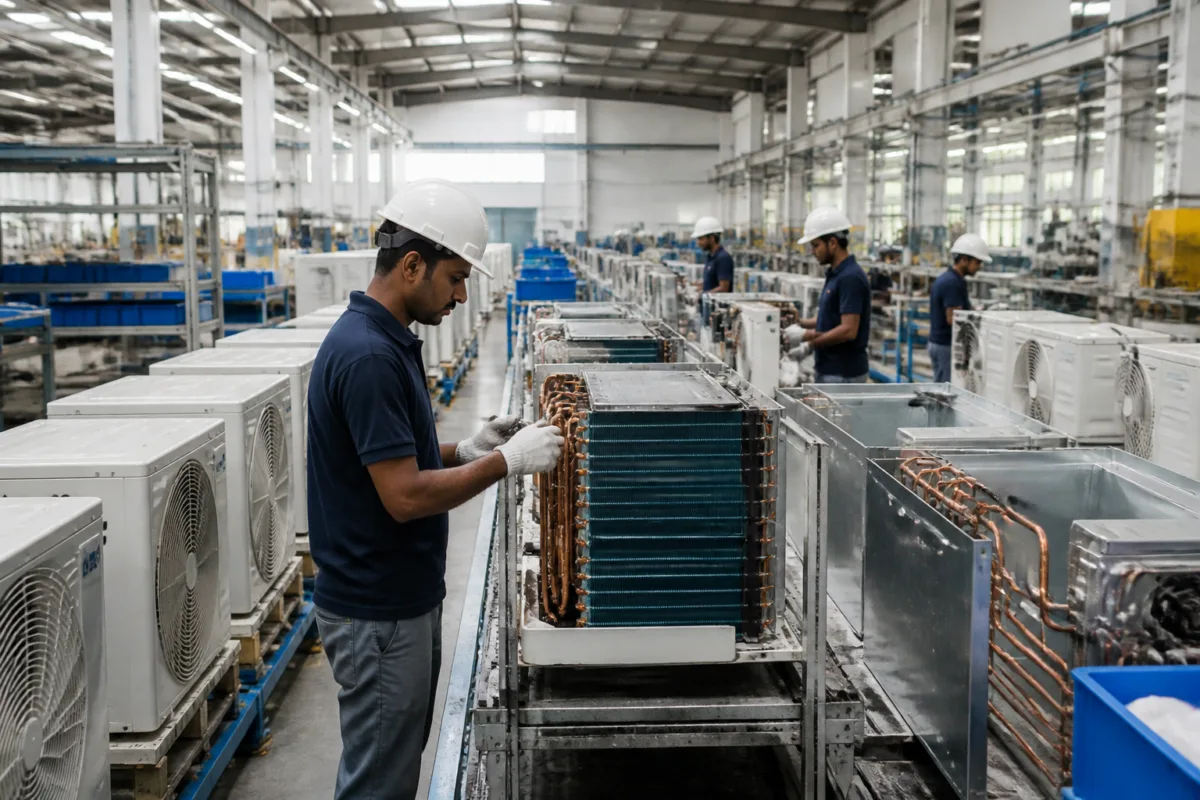
The industrial base for this expansion is the company’s Kadi facility in Gujarat. The plant currently has annual manufacturing capacity of more than 10 lakh air-conditioning units. It manufactures heat exchangers, indoor-unit moulds, condensing units, sheet-metal components, tubing and coils, and also carries out painting operations. The company is manufacturing its latest Hitachi variable refrigerant flow, or VRF, products at the facility.
The Kadi plant is therefore not limited to residential room air conditioners. Bosch Home Comfort also plans to expand in light-commercial air conditioning, with VRF systems forming part of that effort. VRF technology is used in buildings that require multiple indoor units connected to a common outdoor system, making it relevant to offices, retail spaces, hospitality properties and other commercial applications. The source does not provide sales or installation figures for this segment, but the manufacturing decision indicates that the company sees commercial cooling as part of its Indian growth plan.
The company has also expanded its global research and development centre in Ahmedabad to focus on light-commercial air-conditioning technologies. That creates a connection between local manufacturing and engineering capability. It suggests that India is being treated not only as a sales market but also as a location from which products and technologies can be developed for the cooling business.
The planned investment gives this strategy a measurable industrial scale. Bosch Home Comfort has announced an investment of €80 million, or around ₹900 crore, over the next few years. The funds are intended to expand manufacturing capacity, increase localisation and strengthen engineering and testing capabilities. The company has not provided a detailed project-wise allocation in the supplied material, so the precise split between capacity, research and development and testing infrastructure remains unspecified.
Localisation is central to the investment case. Sudhakaran said approximately 75 per cent of the company’s procurement is from domestic sources, while imports account for about 25 per cent. He described the company as one of the highly localised manufacturers in the air-conditioning industry and said it has prioritised domestic manufacturing instead of relying on imports when exchange-rate or wider macroeconomic conditions made imports more attractive.
The company’s current manufacturing model includes several forms of backward integration. Components such as heat exchangers, sheet-metal parts, tubing and coils are produced at Kadi, while compressor supplies are available through a joint venture with a major global compressor manufacturer operating a plant in Ahmedabad. This gives Bosch Home Comfort a supply-chain structure that is more integrated than a model based mainly on assembling imported components.
That structure is important for a company trying to compete across multiple price segments. Higher domestic sourcing can reduce exposure to import costs and currency movements, although the source does not establish the precise effect on consumer prices or margins. It can also make it easier to adapt products to local requirements, but the company has not disclosed the specific design or performance changes that will result from its expanded engineering programme.
Capacity expansion is being presented as a measured process rather than a single large-scale bet. Sudhakaran said the company would deploy capital in line with market growth. Bosch Home Comfort may also explore a new manufacturing facility in southern India, but he neither confirmed nor denied that such a project was under consideration. That distinction is important: the existing investment is confirmed, while a southern plant remains an undisclosed possibility rather than an announced project.
The company’s market argument rests on three factors identified by its managing director: low penetration of room air conditioners, rising disposable incomes and economic growth. These conditions, in Bosch Home Comfort’s view, create a substantial runway for expansion. The supplied report does not provide a national penetration rate, market-size estimate or year-by-year sales data, so the scale of that opportunity cannot be independently quantified from the available evidence.
For cities, the significance of the strategy lies in the changing infrastructure of indoor comfort. Air conditioning affects how homes, offices and commercial buildings are designed and operated. However, the source focuses on the company’s business and manufacturing plans and does not provide information on electricity demand, emissions, refrigerants, building codes or the affordability of cooling for lower-income households. Those questions remain outside what the current evidence establishes.
What the announcement does establish is a shift in the way Bosch Home Comfort is organising its India business. The company is combining an acquired brand with a new premium identity, using shared manufacturing and distribution while keeping product positioning separate. It is also linking residential cooling with light-commercial systems, local procurement and engineering capability.
The next stage will show whether this structure can translate into the stated double-digit market share and top-five position. The immediate milestones are the launch of Bosch-branded air conditioners next year, the expansion of the Kadi operation, continued development of the Ahmedabad research centre and the rollout of Hitachi VRF products. Until those steps produce disclosed sales, capacity or market-share outcomes, Bosch Home Comfort’s targets remain stated ambitions rather than demonstrated results.

