


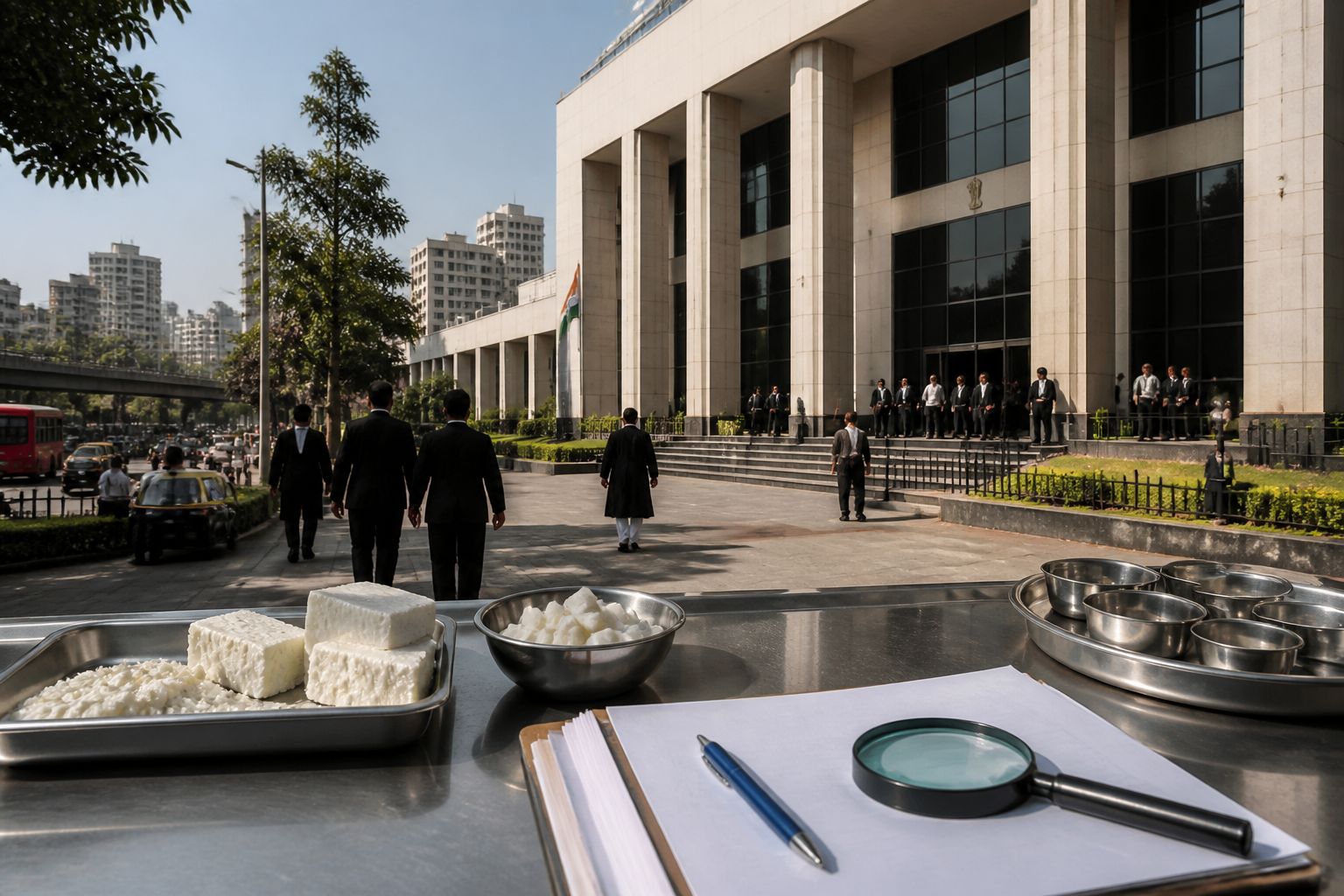
The Bombay High Court has refused interim relief to a Thane-based restaurant challenging the suspension of its food licence by the Food and Drug Administration (FDA) over the alleged serving of fake paneer, observing that consumers have the right to know what they are eating.
A bench comprising Chief Justice Mahesh Chandra Tripathi and Justice Advait Sethna directed the restaurant, Udupi Swad, to first pursue the legal remedies available under the Food Safety and Standards Act, 2006, before seeking relief from the High Court. The court’s observation was made during a hearing on Wednesday, according to a report by Loksatta – Mumbai.
The FDA suspended the restaurant’s licence through action dated August 11. The restaurant challenged the decision, arguing that its licence had been suspended without a corrective notice or a reasoned order. Its lawyers also told the court that no formal order was available to challenge, which, they argued, would prevent even the appellate authority from deciding whether a corrective notice should have been issued.
The restaurant had earlier approached the court after the FDA acted against it in connection with paneer described in the proceedings as “analogue paneer”. The restaurant’s lawyers questioned whether the FDA’s July 31 notification concerning analogue paneer could be applied retrospectively to a sample collected in June.
The legal dispute therefore involves both the food-safety regulator’s enforcement action and the procedure followed before the restaurant’s licence was suspended. The restaurant has maintained that the action was procedurally defective. The High Court, however, declined to provide relief and directed it towards the statutory mechanism under the 2006 law.
The court had also refused relief to the restaurant during an earlier hearing last month. At that time, it reportedly criticised the petitioners for seeking protection after action that allegedly harmed consumers and said they would themselves have to bear some loss and inconvenience for a period.
The restaurant cited the impact of the suspension on its workers while seeking relief. Its lawyers told the court that 18 employees depended on the establishment for their livelihoods.
The proceedings highlight the competing issues that arise when food-safety enforcement affects an operating urban business: consumers’ access to accurate information about food products, the regulator’s responsibility to act against potentially unsafe or misleading food, and the requirement that enforcement decisions follow legally valid procedures.
The High Court’s latest direction leaves the restaurant to pursue the remedies provided under the Food Safety and Standards Act, 2006. The court did not grant the restaurant relief against the FDA’s licence-suspension action in the hearing reported by Loksatta – Mumbai.
