


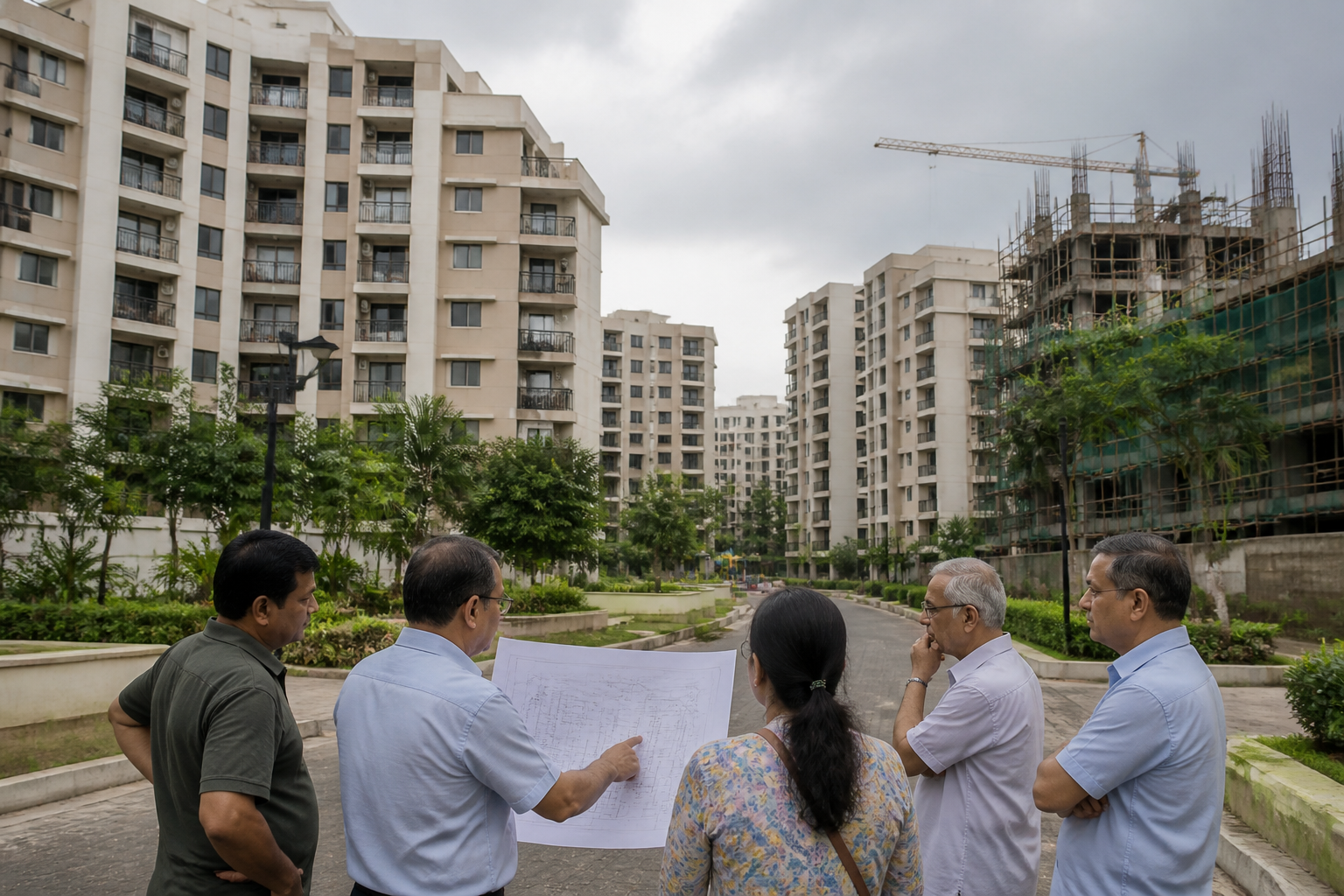
The Bombay High Court’s guidelines on land title in multi-building layouts address one of the most persistent problems in Maharashtra’s housing system: buyers may own flats in a registered society but remain uncertain about the land legally attached to that society. In a 170-page judgment, the court has set out how proportionate land entitlement should be determined, how later changes to development plans should be treated and what buyers must be told when transferable development rights, or TDR, are used.
The judgment is significant because land conveyance is not merely a formal transfer at the end of a housing project. It determines the legal relationship between a cooperative housing society, the developer and the land on which one or more buildings stand. In layouts containing several buildings, disputes over that relationship can affect redevelopment, future construction potential and the ability of societies to establish clear title.
The court said each society’s proportionate land entitlement would be “crystallised” at the end of four months from the formation of the cooperative housing society. That entitlement, it held, should not be reduced merely because development plans are revised later. The exception is where flat purchasers in earlier buildings give written consent to the revised plan.
This principle places an important limit on the ability to alter the land position of an existing society through subsequent planning decisions. It distinguishes between a society’s entitlement when it is formed and the additional development potential that a developer may seek to use later. The court’s reasoning, as reported, is that a later revision cannot automatically diminish rights that have already crystallised.
## Why multi-building layouts create a land-title problem
The difficulty arises when several buildings are developed within one larger layout, often over different stages and under changing development plans. Buildings may not all use the same development potential. Some may be constructed under originally sanctioned plans, while others may rely on revised plans, incentive floor space index or TDR.
The court identified these differences as a source of continuing disputes. It said the process of dividing land among societies in multi-building layouts remained a “hotbed of controversy”. The judgment also referred to situations in which developers attempted to retain future development potential by treating the land as their own, rather than conveying the relevant title and land rights to the housing societies.
The reported judgment records Justice Sandeep Marne’s observation that some builders assert that purchasers have bought only the structure and not rights in the land. That position conflicts with the statutory framework described in the ruling. The Maharashtra Ownership Flats Act requires builders to facilitate the formation of a society and convey the land and title within prescribed timelines.
Where a builder fails to complete that process, deemed conveyance allows a society to obtain the relevant rights without the builder’s cooperation. The mechanism was introduced to address situations in which conveyance is avoided or delayed. The court’s guidelines therefore operate within an existing legal framework rather than creating a new ownership model for housing societies.
## The Bombay HC land title ruling and TDR disclosure
A central part of the judgment concerns TDR. The court directed builders to give adequate notice to flat purchasers when TDR is being used. That notice must include the potential risk that a society may ultimately secure less land than a buyer might assume from the built-up area of the building.
This is an important distinction. The size or configuration of a building does not, by itself, establish the society’s proportionate share of the underlying land. Where development rights are transferred or additional development potential is used, the relationship between built-up area and land entitlement can become more complicated. The court’s direction seeks to ensure that buyers are not left to infer the land position from the visible scale of a building.
During the hearing, Advocate General Milind Sathe submitted that buyers in buildings constructed only through TDR should be informed of that fact. He also argued that such buyers could not claim parity with societies in earlier buildings constructed using the original development potential of the land.
The court addressed this issue by placing societies into two broad categories for determining proportionate land share: those constructed under originally sanctioned plans and those constructed under revised plans using TDR. It held that a developer’s revision of plans that “eats away” floor space index meant for earlier buildings could not be used to justify treating both categories as identical.
The categorisation does not remove the need to examine the facts of each layout. It does, however, recognise that different buildings may have been created under materially different planning conditions. That matters because a uniform formula could produce an unfair result if it ignored whether a building used the layout’s original development potential or additional rights introduced later.
## What the judgment changes for housing societies
For societies seeking deemed conveyance, the ruling provides a clearer legal basis for arguing that land entitlement must be identified at a defined stage rather than continually recalculated as a project evolves. The four-month point after formation of the cooperative housing society becomes the reference identified by the court for crystallising proportionate entitlement.
The ruling also places greater importance on the documents surrounding the formation of a society and the approvals applicable to each building. Originally sanctioned plans, revised plans, the use of TDR and the distribution of development potential are likely to be central to future conveyance applications and disputes.
For buyers, the significance is less about an immediate transfer of land and more about the information and legal records that accompany a purchase. The judgment indicates that the use of TDR and the possibility of a reduced land share should be disclosed rather than left hidden within the technical history of a development project.
The court’s observations also connect conveyance with the growing preference for gated communities and integrated residential complexes. Such projects can provide shared amenities and infrastructure across multiple buildings, but their legal structure can become difficult when individual societies have unclear or contested land rights. The larger and more integrated the layout, the more important the allocation of rights between societies becomes.
## The institutional question behind deemed conveyance
The dispute reflects a broader governance problem in urban housing: construction permissions, development potential and ownership rights are often managed through different stages and documents. A developer may obtain approval for a larger layout, construct buildings at different times and later revise the plan. Buyers, meanwhile, enter into transactions centred on individual flats and may not have a clear understanding of the land arrangements governing the entire project.
MOFA’s conveyance requirement attempts to close that gap by requiring the transfer of land and title to the society. Deemed conveyance is the enforcement route when the builder does not cooperate. The Bombay High Court’s guidelines clarify how that route should deal with the added complexity of multiple buildings and different forms of development potential.
The judgment therefore shifts attention from the completion of construction to the completion of legal ownership. A building may be occupied, maintained and integrated into a functioning residential complex while the society’s title to the land remains unresolved. That gap can become particularly consequential when societies later seek redevelopment or need to establish their rights in relation to other buildings in the same layout.
The three petitions before the court involved societies disputing the area of land conveyed to them. Their cases illustrate that deemed conveyance is not simply a procedural remedy for obtaining a missing document. It can involve determining how much land belongs proportionately to each society and whether later planning changes have altered the position of earlier purchasers.
The ruling confirms several principles but does not eliminate the need for project-specific examination. The supplied account does not set out a single numerical formula applicable to every layout, nor does it provide the full text of the court’s directions. What it establishes is the court’s approach: entitlement is to be crystallised at a defined stage, later revisions cannot automatically reduce it, TDR-related risks must be disclosed and societies built under different planning regimes should not be treated as identical without examining those differences.
For Maharashtra’s housing societies, the next practical stage will be applying these principles to conveyance and deemed-conveyance proceedings. The continuing legal question will be how authorities and societies implement the distinction between originally sanctioned plans and revised plans while determining each building’s proportionate land entitlement.
