


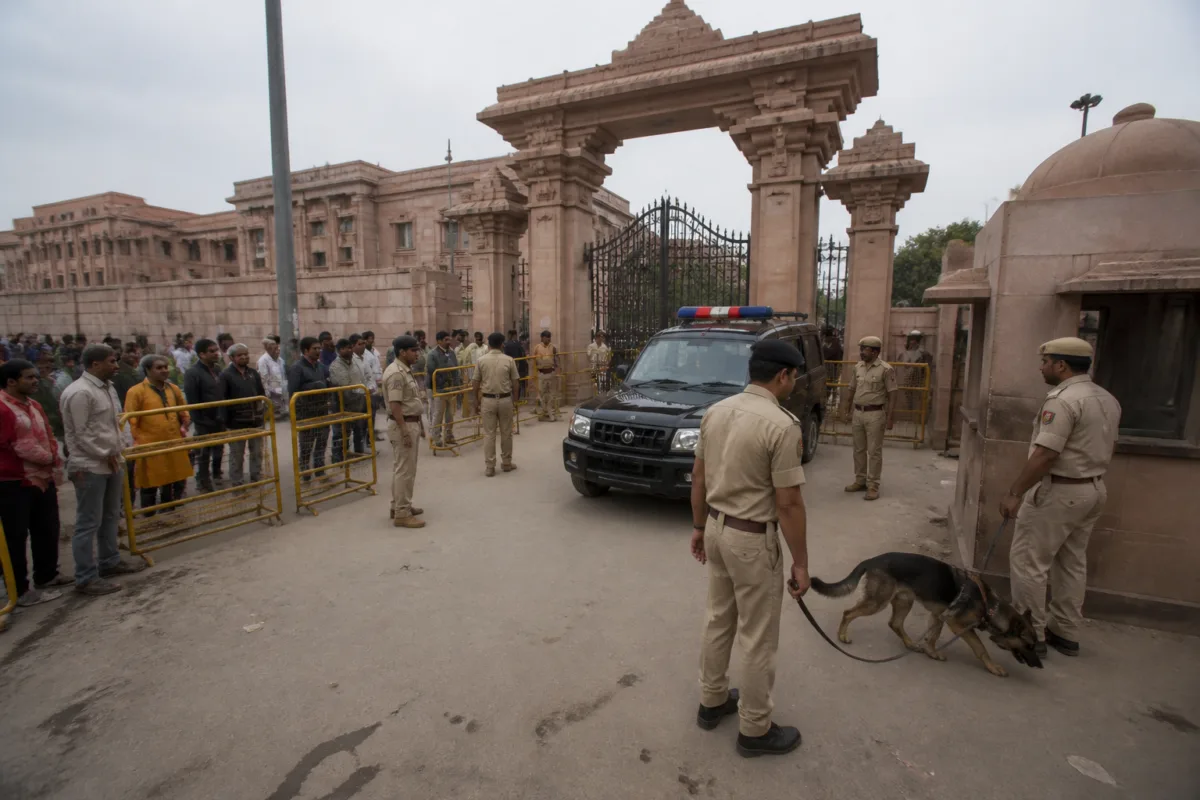
A bomb threat email received by the Ayodhya court has prompted heightened security across Ayodhya, Varanasi and Mathura, with police increasing surveillance at courts, religious sites, schools and other crowded locations during the period identified in the message.
The email, received on the official account of the Ayodhya court around 12.25 pm on Wednesday, warned of explosions at key religious sites and schools between November 8 and November 27. It also described November 8 as a “black Diwali” and allegedly contained pro-Khalistan references. Authorities have not established whether the threat is credible.
Police, intelligence units and cyber teams are examining the email’s contents, technical trail and digital footprint. In Mathura, the cyber cell has begun tracing the sender. Mathura SSP Shlok Kumar told the Times of India that the cyber team was examining the technical details to identify the source of the email.
The most detailed security response has been reported in Ayodhya, where Chief Judicial Magistrate Piyush Tripathi directed the police to strengthen security around the district court complex. In a communication to the Ayodhya SSP, the court sought increased deployment of police personnel and regular anti-sabotage checks by bomb-disposal teams and dog squads from November 8 to November 27.
Police teams from Ayodhya Kotwali and Cantt police stations carried out searches across the court premises. City Circle Officer Shriyash Tripathi said surveillance at the court complex would be strengthened further and that efforts were under way to identify the sender.
The warning has led authorities in all three cities to increase patrolling around locations identified as potentially vulnerable. These include temples and other religious establishments in Mathura, schools in Varanasi, and the court complex and religious sites in Ayodhya. The measures also cover crowded public locations where authorities could face difficulties in screening or evacuating people quickly.
The reported threat comes as the three cities prepare for a period of heightened public activity around religious and festive sites. Ayodhya, Varanasi and Mathura receive large numbers of visitors and pilgrims, while courts and schools remain important public institutions requiring separate security arrangements. The police response therefore involves both protection of specific sites named in the email and broader surveillance across busy urban areas.
Investigators are examining whether the message was sent to create panic or represents a genuine security risk. The technical investigation is expected to help establish the sender’s identity and determine the credibility of the warning. Police have not announced any confirmed explosive device or attack linked to the email.
For now, authorities have focused on preventive security, including additional personnel, searches, patrols and monitoring of sensitive sites. The enhanced security arrangements in Ayodhya are scheduled to continue from November 8 to November 27, while cyber teams continue their efforts to trace the email’s source.

