


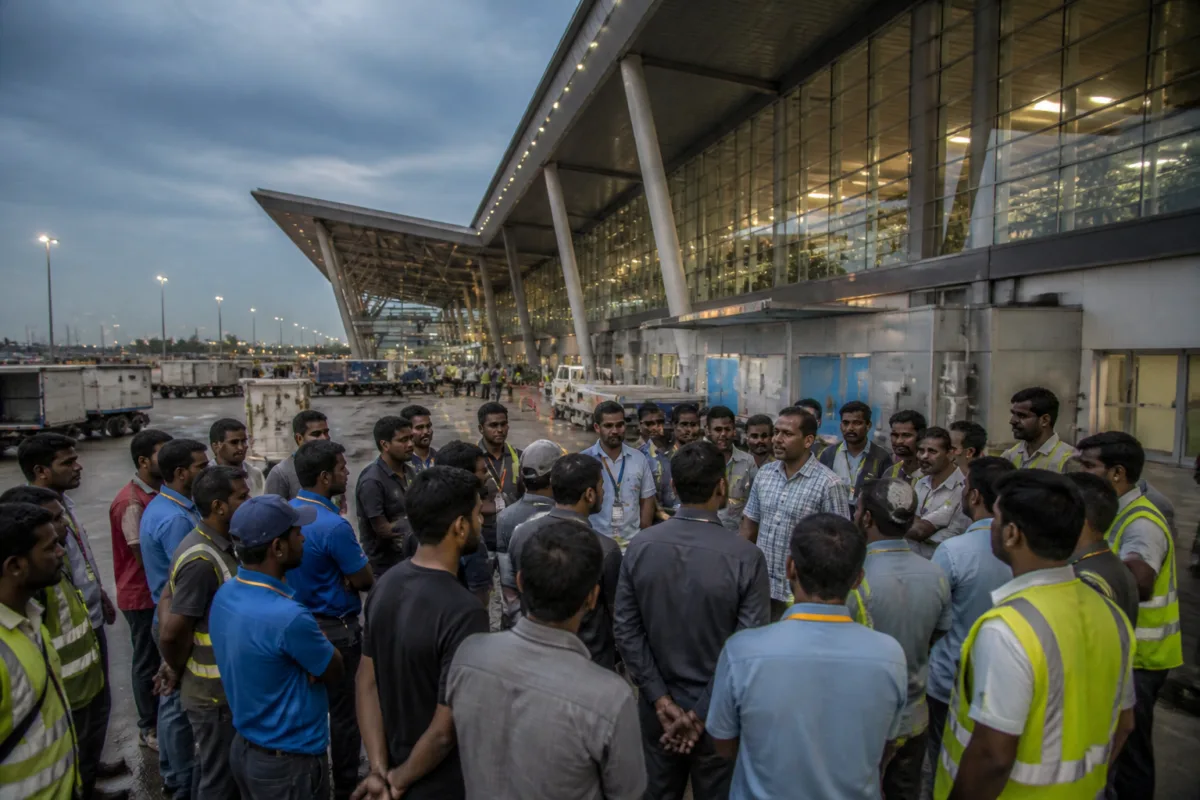
The BJP’s decision to form its first formally recognised workers’ organisation after 46 years is more than an internal party change. Beginning with contract workers at Netaji Subhas Chandra Bose International Airport in Kolkata, the move brings the party directly into a labour space it had historically approached through affiliated or regional bodies rather than an officially designated organisation of its own.
The new organisation, named the NSCBI Airport Contractors Workers Morcha, was launched at the Kolkata airport on Saturday. On the social media page of West Bengal BJP president Shamik Bhattacharya, it was described as the BJP Trade Union Cell. BJP national general secretary Sunil Bansal attended the launch and called it the party’s first official workers’ organisation. He said the initiative would be extended to other locations in the future.
The immediate focus is the urban contract workforce. Airport operations, construction activity and private-sector employment increasingly depend on workers hired through contractors rather than directly by public authorities or large employers. The organisation’s stated target group is therefore significant: it is intended to bring together workers whose employment relationships can involve multiple layers of contractors, supervisors and principal employers, even when their work is performed in highly visible public infrastructure.
The BJP’s own explanation for the policy shift provides the central institutional context. Bhattacharya said the party had previously believed that a political party with its own workers’ organisation could weaken workers’ ability to protest against the government when that party was in power. In his formulation, workers should be able to raise issues involving rights, deprivation and grievances independently of the ruling party. He said the new organisation would work on the principle that workers would work for the country and receive the money due to them.
That explanation points to the tension at the centre of the initiative. A workers’ organisation linked directly to a political party can provide an established channel through which workers’ concerns reach political leadership. At the same time, its formal relationship with the party raises questions about how it will maintain an independent position when the party controls the government or has influence over the institution where its members work. The source material records the BJP’s stated position but does not establish how the new bodies will operate in disputes involving government departments, public-sector institutions, airport authorities or private contractors.
The distinction between the new BJP organisation and the Rashtriya Swayamsevak Sangh’s Bharatiya Mazdoor Sangh is also important. The BMS already operates as the RSS’s labour wing and has been active in several sectors in West Bengal. The report says the BJP had previously relied on such affiliated structures, along with local workers’ groups and internal labour-relations arrangements, rather than maintaining an officially recognised workers’ organisation at the national party level.
This means the new structure is not simply entering an empty field. It is being created alongside an existing labour network associated with the wider Sangh Parivar. The report does not describe a division of responsibilities between the BJP’s new organisation and the BMS beyond the distinction announced by the party’s state-level leadership. That unresolved relationship will be one of the key factors in understanding whether the new initiative becomes a parallel organisation, a specialised platform for certain workers, or a broader political channel for labour mobilisation.
The BJP had attempted to engage workers through regional mechanisms before this launch. During the tenure of former state BJP president Dilip Ghosh, a body called the Bharatiya Janata Mazdoor Trade Union was created. However, the report says it did not have formal recognition from the state or central BJP leadership. West Bengal also already had a Trade Union Relations Cell, whose role was to maintain contact with workers and their organisations across sectors. The new initiative therefore gives a formal organisational structure to an activity that had previously been conducted through cells, local bodies and coordination arrangements.
The appointment of Aritra Chattopadhyay illustrates that continuity. Chattopadhyay, who was the West Bengal co-convener of the Trade Union Relations Cell, has been made president of the new airport contract workers’ organisation. He has also been given the same position in an organisation for Webel contract workers. The report thus describes a transition from informal or semi-formal liaison work to named, sector-specific organisations with office-bearers.
The choice of contract workers as the initial constituency is closely connected to the changing structure of urban employment. The airport is a major public-facing infrastructure asset, but many of the people who keep such facilities functioning may be employed through contractors. The source does not provide the number of workers covered, the contractors involved, their wage levels or the disputes that prompted the organisation’s formation. It does, however, establish that the new body is aimed at workers outside the traditional organised labour framework.
Chattopadhyay said the BJP’s labour wing would work mainly among workers in the unorganised sector. He identified contract workers, construction workers and employees in various private-sector workplaces as its intended constituency. He described the change as an effort to bring the existing Trade Union Relations Cell within a formal structure and said the organisation would work to establish workers’ legitimate rights.
The use of the term ‘unorganised sector’ is particularly relevant to the built environment. Construction workers and contract employees are central to the delivery of buildings, infrastructure and services, but their employment can be fragmented across projects and employers. That fragmentation can make representation difficult. Workers may move between sites, work under changing contractors or interact with public institutions through intermediaries. A formal workers’ organisation could give them a more identifiable platform, but the effectiveness of that platform would depend on its membership rules, dispute-resolution powers, access to employment records and ability to negotiate with employers.
None of those operational details has yet been announced in the supplied report. There is no information on membership fees, election procedures, collective bargaining arrangements, legal registration, grievance mechanisms or the division of authority between the new organisations and existing labour bodies. These omissions do not negate the significance of the launch, but they limit what can currently be concluded about its practical impact on workers.
The airport launch also places the announcement within a wider political and administrative setting in West Bengal. The BJP has been expanding its organisational presence in the state, while the BMS has already gained greater visibility in different sectors after the change in government in the state, according to the report. The creation of party-linked organisations for airport and Webel contract workers extends that organisational activity into workplaces and public infrastructure systems.
For urban governance, the important question is not only which party controls a workers’ organisation. It is also how labour representation is integrated into the management of outsourced urban services and facilities. Contract workers often stand at the intersection of public accountability and private employment. A facility may be publicly important, while the workers’ immediate employer is a private contractor. Responsibility for wages, working conditions and grievance handling can therefore become dispersed. The new organisation’s stated focus on rights places that institutional gap at the centre of its future work.
The launch also changes the BJP’s relationship with organised labour. For most of its existence since 1980, the party had no own workers’ or student organisation, according to the report. The absence of a formal labour wing was presented as a matter of political and ideological choice. The new decision reverses that position while retaining the claim that the organisation will not be used to prevent workers from raising grievances.
That claim will be tested through the organisation’s conduct rather than its launch statements. The evidence currently confirms a formal announcement, the first two reported workplace-level bodies, the appointment of their president and the party’s stated focus on unorganised workers. It does not yet show how the organisations will respond to wage disputes, contract termination, safety complaints or conflicts involving employers connected to governments led by the BJP.
The next phase will therefore be organisational rather than symbolic. Bansal has said that similar workers’ organisations will be formed elsewhere, while the state-level leadership has identified contract, construction and private-sector workers as the main constituency. The expansion of these bodies, their relationship with the BMS and their handling of workplace disputes will determine whether the Kolkata launch becomes a durable labour institution or remains primarily an organisational extension of the party.

