


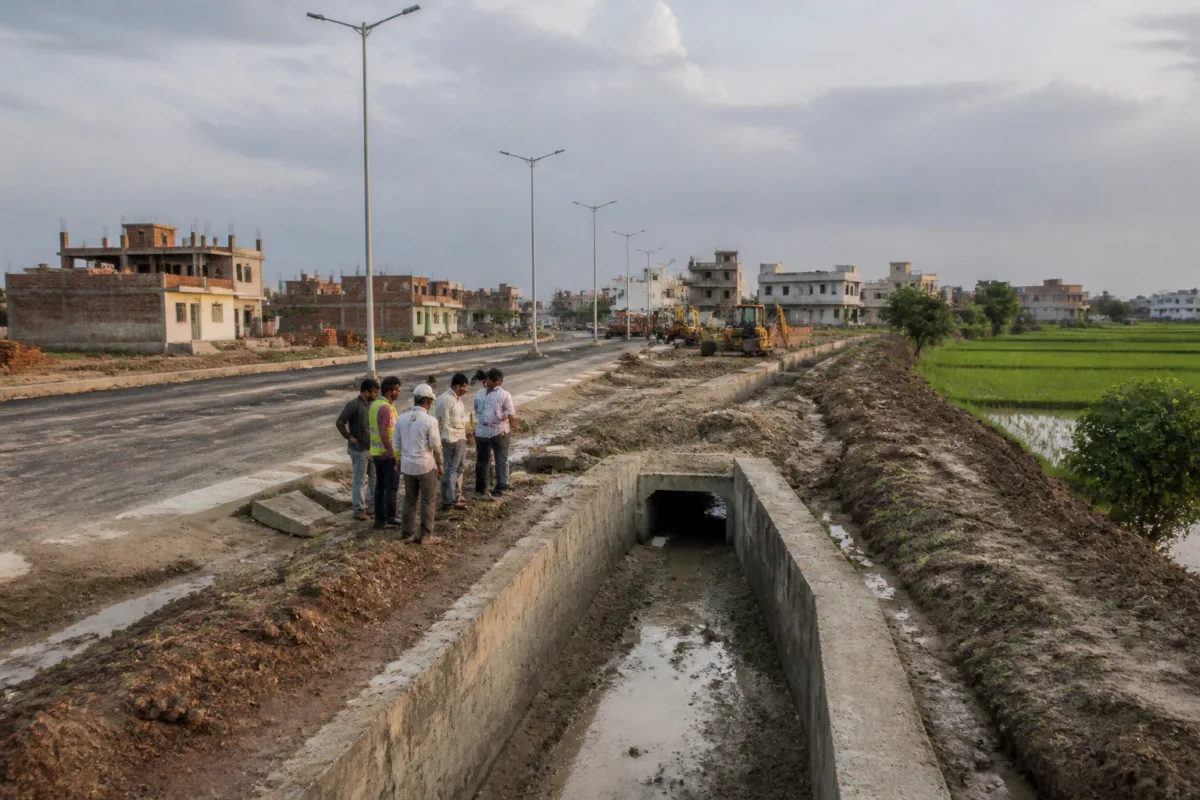
Bihar’s government has approved 12 greenfield satellite townships and secured a Rs140-crore loan to modernise drainage in Purnia, Bettiah and Jahanabad, according to a Times of India report reviewing the administration’s development and welfare measures.
The urban initiatives were listed alongside wider commitments covering electricity, water security, roads, healthcare, education, agriculture and tourism. The report said the state had also completed or upgraded 4,855km of rural roads and recommended Rs2,450 crore in loans through the National Bank for Agriculture and Rural Development’s Rural Infrastructure Development Fund for 326 projects.
The satellite-township decision is the most significant urban-planning measure identified in the report. However, the report does not provide the locations, land parcels, development agencies, proposed populations, planning standards or implementation schedules for the 12 projects. It also does not specify whether the townships are intended to absorb future growth, decongest existing cities or support industrial and transport corridors.
The drainage programme covers Purnia, Bettiah and Jahanabad, with a reported loan of Rs140 crore. The article does not detail the drains to be rebuilt, the implementing bodies, the project capacities or the expected completion dates. Those details will be important in assessing whether the funding addresses local flooding, wastewater management, storm-water conveyance or a combination of these needs.
Water security is another major component of the government’s reported programme. The minor water resources department sanctioned Rs178 crore for 70 projects, while the process for a World Bank loan for a Rs4,415-crore water security project was completed. The report does not identify the project’s specific districts, works or institutional arrangements.
The government also approved the Bihar Green Hydrogen Policy 2026, which the report said is intended to promote renewable energy and reduce dependence on natural gas imports. The policy’s potential relevance to the built environment will depend on the projects it enables, the infrastructure required for production and distribution, and how its implementation is coordinated with the state’s electricity and industrial plans. No capacity target or investment schedule was provided in the report.
Electricity support forms a large part of the state’s wider programme. Domestic consumers are to receive up to 125 units of free electricity a month from August 1, 2025, with a reported grant of Rs23,165 crore sanctioned for the scheme. The government also reported state-guaranteed loans of Rs22,849 crore for solar projects. The article does not clarify how the solar financing will be distributed, which agencies will administer it or how the programme will connect with the free-electricity support.
The report further said Adani Power had received approval for a 2,400MW thermal power project at Pirpainti in Bhagalpur district. The project, described as a 3x800MW facility, is estimated to cost around Rs28,000 crore. It was presented as the state’s largest private-sector investment. The report does not provide a construction timetable, land status, environmental-clearance position or transmission arrangements.
Healthcare infrastructure is also part of the development account. The government has launched plans for 16 brownfield medical and dental colleges under the public-private partnership model and a 2,500-bed facility at Patna Medical College and Hospital. A 400-bed orthopaedic superspecialty building was inaugurated at Loknayak Jayaprakash Narayan Hospital in Patna, while Rs29 crore was approved for the e-Sushrut system across 12 medical institutions.
The state has also sanctioned 50 acres in Vaishali for the National Institute of Food Technology Entrepreneurship and Management and approved Rs19 crore for Atal Kala Bhawan in Madhubani. For tourism infrastructure, the report cited a state guarantee for a Rs5,000-crore loan, Rs2,520 crore for the Vishnupad Corridor and Rs680 crore for the Baba Hariharnath Temple area.
The development measures were reported as part of the Bihar NDA government’s review of its first year in the current term. The report said Nitish Kumar took oath as chief minister on November 20, 2025, before Samrat Choudhary assumed office on April 15, 2026. However, the report’s reference to a Friday anniversary event does not align clearly with its November 19, 2026 publication date and the stated oath-taking date. The anniversary chronology and the individual project approvals require confirmation from official state records.

