


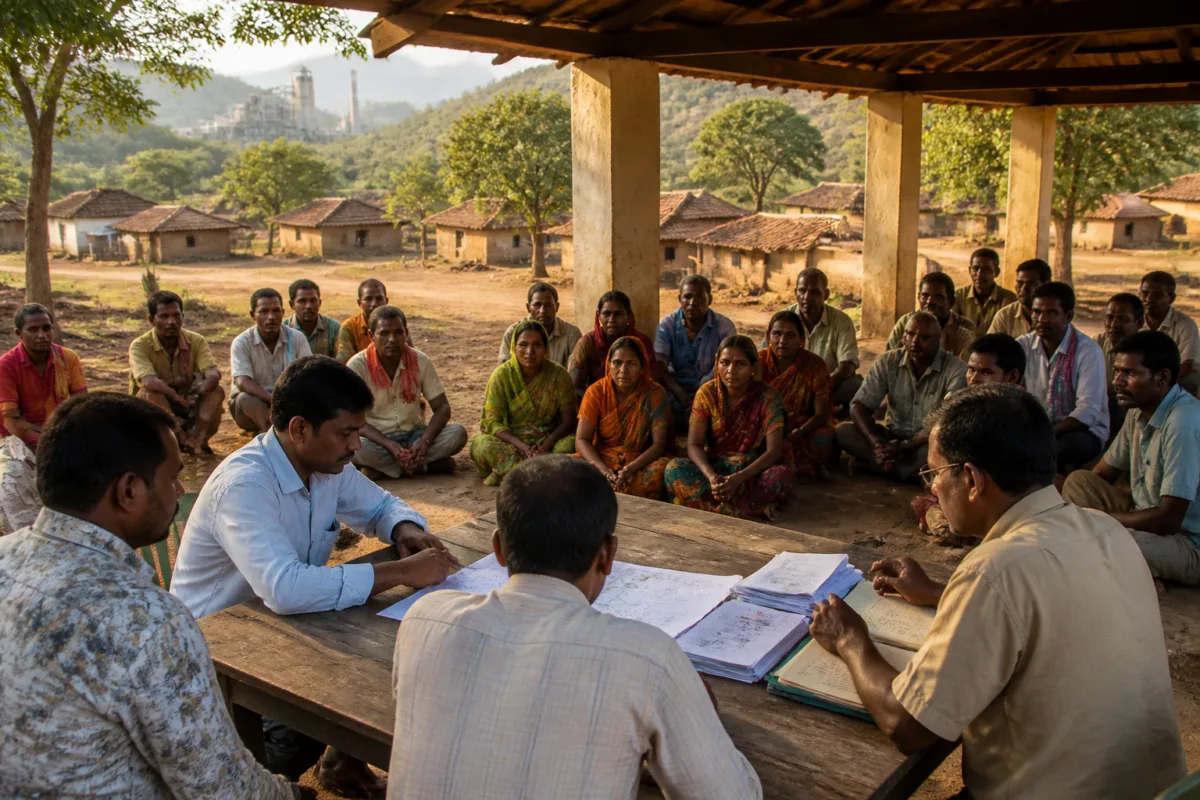
The Supreme Court has set aside land acquisition proceedings for Dalmia Cement’s proposed plant in Odisha’s Sundargarh district, ruling that prior gram sabha consent is mandatory when the government acquires land in Scheduled Areas under the Right to Fair Compensation and Transparency in Land Acquisition, Rehabilitation and Resettlement Act, 2013.
A bench of Justice Dipankar Datta and Justice Satish Chandra Sharma overturned an Orissa High Court judgment that had treated the consent requirement under Section 41(3) as directory rather than mandatory. The ruling followed an appeal by residents of Kukuda, Bihabandha and Lanjiberna villages, where the proposed acquisition was challenged.
The decision does not itself determine the future of the cement plant. It invalidates the acquisition proceedings because the required statutory process was not followed, meaning any fresh attempt would have to comply with the legal requirements identified by the court.
The Supreme Court said the consent provision could not be diluted once the government decided to proceed with acquisition in a Scheduled Area. The judgment rejected the submission made on behalf of Dalmia Cement that Section 41(3) was only directory and that a gram sabha could not override the consent of individual landowners.
The court held that the requirement was mandatory and criticised the authorities for proceeding without meaningful community approval. According to the report, the two gram sabhas concerned had rejected the acquisition proposal through resolutions passed on January 26, 2020. The proceedings nevertheless continued, despite the recorded opposition.
The case also involved acquisition for a private company. Under Section 2(2)(b) of the 2013 Act, the report states that consent from at least 80% of affected families was required before the government could consider the proposal. A Social Impact Assessment was also necessary.
The court found problems with the assessment process. No actual public hearing was conducted, and a company-linked adviser was included in the expert group, raising concerns about the group’s independence. These findings place the gram sabha decision within a wider procedural framework rather than treating it as an isolated consultation requirement.
The ruling is significant for industrial land acquisition because it links project approval in Scheduled Areas to documented local consent, public participation and an independent assessment of social consequences. For affected communities, the judgment reinforces the importance of gram sabha resolutions as part of the statutory process, rather than as a formality that can be recorded after administrative decisions have effectively been made.
The Supreme Court also criticised the earlier judgment for reducing a mandatory legal requirement to a paper formality. In the Sundargarh case, it said there was not even paper consent from the gram sabha, according to the report.
Residents who challenged the acquisition welcomed the decision. Manohar Toppo of Kukuda village said he had retained faith in the judiciary during the land dispute. Bibol Toppo, a petitioner and president of the Forum for Gram Sabha Committee in Rajgangpur, described the ruling as a challenge to the district administration’s control over the process and as a victory for affected residents.
For Odisha’s industrial development pipeline, the immediate consequence is that land acquisition in Scheduled Areas cannot proceed on the basis of administrative approval alone. Project authorities and the government will need to demonstrate compliance with the consent, affected-family approval, Social Impact Assessment and public-hearing requirements before any comparable acquisition can withstand legal scrutiny.

