


Bhubaneswar will host the 19th Urban Mobility India Conference and the second National Urban Conclave from 23 to 25 October, bringing mobility specialists, municipal leaders, researchers and policymakers together around a question that extends well beyond transport: can Indian cities move from building isolated assets to delivering coordinated urban systems? Organised by the Ministry of Housing and Urban Affairs (MoHUA) with the support of the Government of Odisha, the two events will place public transport, walking, housing, water, waste, planning regulation and municipal capacity within a single urban policy conversation.
The timing and structure of the gathering reflect a shift in the way India’s urban challenge is being framed. The 19th Urban Mobility India Conference, organised through the Institute of Urban Transport (India), will focus on “Urban Accessibility and Liveability in Digital Age”. The National Urban Conclave, which follows immediately, carries the theme “Urban Rising – Rethinking Urban Systems, Solutions and Delivery”. Together, the themes suggest that the immediate concern is no longer only whether cities have constructed metros, roads, buses or treatment facilities. It is whether these assets function as connected systems that residents can use reliably and affordably.
That distinction is important because urban infrastructure is often divided among agencies, budgets and administrative jurisdictions. A bus route may be operated separately from a metro system, footpaths may not connect to either, and land-use decisions may be taken without reference to transport capacity. The conference agenda acknowledges this fragmentation by placing integration, first- and last-mile connectivity, digital systems and institutional reform alongside physical infrastructure.
The mobility conference will bring roughly 1,500 delegates to Bhubaneswar, including national and international speakers, metro rail executives, transport undertaking chiefs, researchers and private-sector participants. Twenty-eight exhibitors from the Government of Odisha, metro rail companies and public and private entities are expected to participate in an exhibition of transport technologies and practices. The event will also include a research symposium in which 46 papers selected by a peer group will be presented through oral and poster sessions. Three papers will receive cash awards of ₹25,000 each and certificates.
The emphasis on Mobility as a Service platforms and real-time GPS-based solutions reflects an attempt to address a practical weakness in Indian public transport: the journey is often experienced as a chain of disconnected segments. A passenger may need to combine a bus, a metro, an intermediate shared mode and a walk, with limited information about timing, fares or transfers. The conference’s stated focus is on making those segments function more like a single journey through integrated information, ticketing and operational systems.
However, the supplied programme also makes clear that technology is not being presented as a substitute for institutional capacity. A GPS platform cannot resolve unclear responsibility for a footpath, a fragmented fare structure or a shortage of buses. Digital systems can make services more visible and responsive, but their effectiveness still depends on the agencies that collect data, operate services, maintain infrastructure and respond to failures.
This is where the National Urban Conclave broadens the discussion. Its seven thematic sessions cover the “Right to Walk”, water, waste and resource efficiency, affordable housing, integrated urban development and infrastructure delivery, new paradigms for urban service delivery, model building bye-laws and model municipal law. These subjects are usually handled through different departments and professional silos. Their placement within one programme highlights how closely everyday urban outcomes are connected.
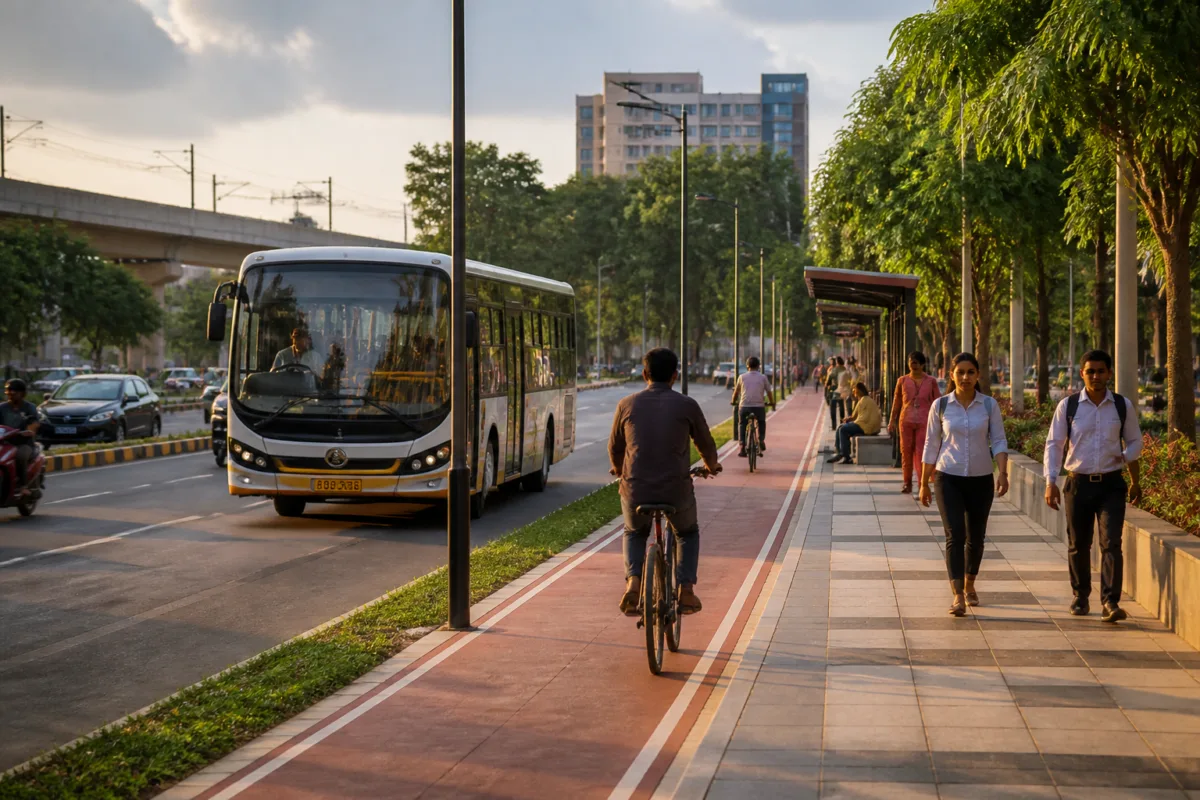
The “Right to Walk” session addresses a basic but unresolved condition of city life. Continuous footpaths, safer school zones, better crossings and usable last-mile connections determine whether residents can reach public transport without taking unnecessary risks. The issue is especially significant for children, older people and households that cannot depend on private vehicles. A transit system may have extensive network coverage, but its practical reach is limited if passengers cannot safely access stations and stops.
The sessions on water, waste and resource efficiency similarly focus on operational performance rather than only asset creation. Reducing non-revenue water, reusing treated water and recovering value from waste streams are presented as ways to improve the productivity of infrastructure that cities already possess. The agenda therefore moves the debate from how many facilities are built to how reliably they operate, how much capacity is lost and whether public systems can reduce their environmental burden.
Affordable housing introduces another dimension of the delivery problem. The Conclave is expected to examine the shortage of rental accommodation, regulatory approvals, access to land and finance, and the slow adoption of climate-resilient and lower-cost construction technologies. The focus on rental housing is significant because urban growth creates demand not only for ownership but also for flexible, accessible accommodation close to employment and transport. The supplied material does not specify new targets or funding commitments, but it identifies the regulatory and financial barriers that continue to constrain supply.
Integrated urban development and infrastructure delivery will examine coordination among agencies, GIS-based planning and integrated utility corridors. Better sequencing and shared data systems can reduce duplication when roads, water lines, power infrastructure and other services are planned together. Yet the institutional challenge remains substantial: coordination mechanisms must be backed by clear authority, shared information and budgets that allow agencies to act in sequence rather than independently.
The proposed discussion on new paradigms for urban service delivery directly addresses municipal capability. Clearer institutional roles, stronger own-source revenues, procurement reform, technical capacity and structured partnerships with private entities are all identified as necessary components. This is a recognition that a city’s service quality depends not only on capital investment but also on the administrative organisations responsible for operations and maintenance.
The model building bye-laws and model municipal law sessions move the debate further upstream. Building regulations influence approval timelines, safety, accessibility and the adoption of new construction technologies. Municipal law, meanwhile, concerns the distribution of powers between elected representatives and executive authorities, the autonomy of urban local bodies and the accountability of institutions. These are not technical details at the edge of urban policy. They shape who can make decisions, who controls resources and who is answerable when services fail.
The conferences also sit within a longer policy trajectory. The National Urban Transport Policy of 2006 established an early framework for shifting attention from private vehicles towards public and non-motorised transport, while emphasising capacity building and equitable mobility. Subsequent programmes expanded metro networks, bus fleets and smart-city infrastructure. The current agenda suggests that infrastructure expansion alone has not resolved uneven service quality, weak pedestrian environments or fragmented governance.
Odisha’s role as host gives the national discussion a local implementation setting. The state is scheduled to launch PM e-Bus Sewa in Odisha and release the ANKUR Handbook, Odisha Town Planning Handbooks and a policy on government and privately owned public spaces. A CRUT pavilion will present the state’s experience with the Ama Bus system, electric mobility, feeder services, women’s participation and passenger-facing technology. These initiatives will allow Odisha to position its transport and planning work within the broader national conversation, although the supplied material does not establish the scale, route coverage or delivery timeline of the proposed bus service.
Bhubaneswar’s preparations also show how a city is being presented as part of the policy argument. The Bhubaneswar Municipal Corporation is undertaking cleanliness, sanitation, beautification and public-space improvements. Exposure visits will cover waste processing and resource recovery facilities, shelters and rehabilitation centres, inclusive neighbourhood development, greenery and citizen services. The Bhubaneswar Development Authority will showcase planned development, housing schemes, town planning initiatives, public transport infrastructure, parks and rejuvenated public spaces. Delegates will also be offered walking and cycling experiences through Ekamra Walks and a cycle trail.
These displays can demonstrate how infrastructure and public space are experienced on the ground, but they cannot by themselves establish whether reforms are being implemented consistently across the city. The more consequential output will be the extent to which discussions produce specific recommendations that can be linked to budgets, institutional responsibilities, regulatory amendments and measurable follow-up.
The presence of a meeting of urban development ministers from states and Union Territories, along with participation expected from NITI Aayog leadership, creates a formal route for comparing priorities and reviewing earlier consultations. MoHUA has said the Conclave is supported by Odisha, with HUDCO and NBCC as principal sponsors and the National Institute of Urban Affairs as knowledge partner. That institutional arrangement gives the event a broad policy base, but the supplied report does not identify binding decisions or approved implementation commitments arising from it.
For Bhubaneswar, the conferences are therefore both a showcase and a test. The city will present bus modernisation, regional mobility planning, public spaces and urban services while hosting a national conversation about the weaknesses that affect cities across India. The juxtaposition is useful: a city cannot demonstrate liveability only through a conference venue or a curated visit. Its performance is also measured through the continuity of footpaths, the reliability of buses, the functioning of waste systems, the availability of housing and the clarity of responsibility among agencies.
The central evidence from the programme is that India’s urban policy debate is widening. Mobility is being connected to housing, municipal law, water, waste, public space and construction regulation. The unresolved question is whether that wider framing will produce equally integrated delivery. As the events open, the developments to monitor are the specificity of their recommendations, the responsibilities assigned to governments and agencies, and whether those recommendations are translated into funded programmes and regulatory changes after the three-day gathering ends.

