


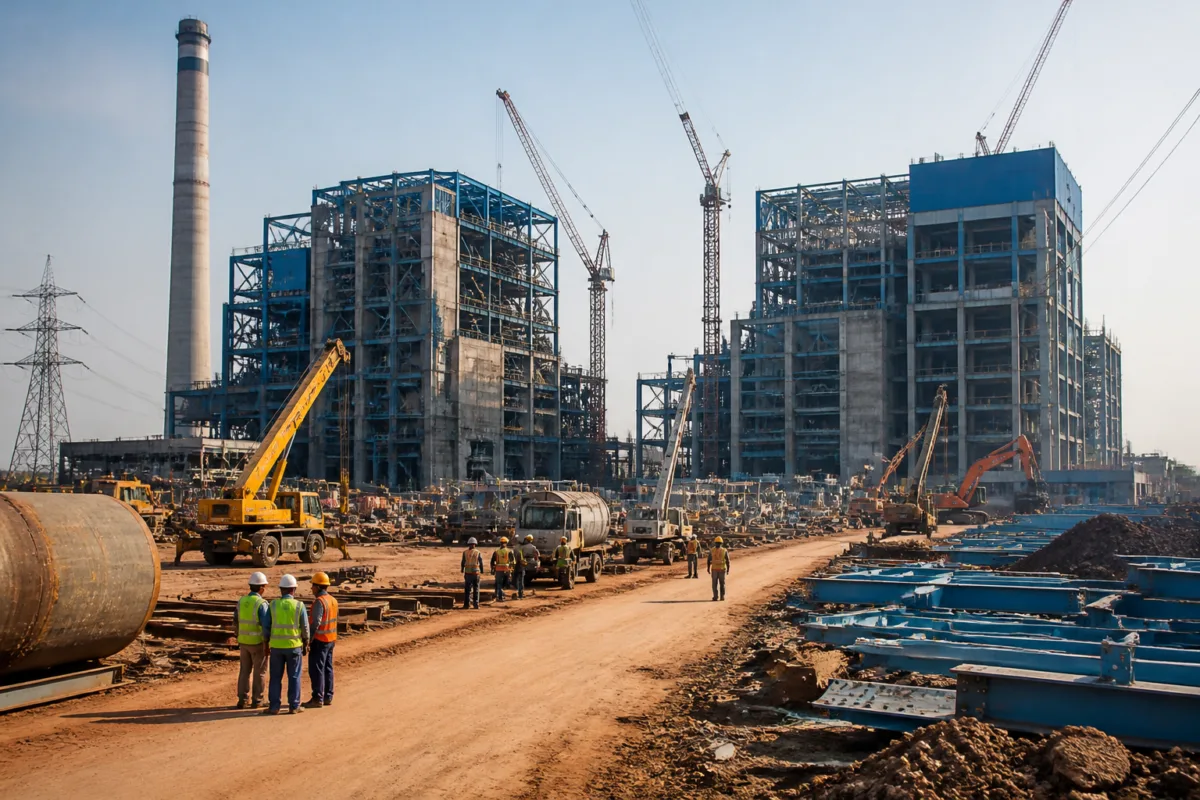
BHEL’s contracts worth up to ₹28,000 crore with Adani Power are more than a large order-book announcement. They offer a visible signal of how India’s infrastructure expansion is being distributed between public investment and private-sector capacity creation. The orders also place a state-owned engineering company at the centre of a private power developer’s expansion programme, linking government-backed industrial capability with private capital spending.
Bharat Heavy Electricals Ltd. said it had received orders from Adani Power Ltd. for four projects, each comprising two 800-megawatt units. Each contract is valued at between ₹5,000 crore and ₹7,000 crore, putting the combined value at as much as ₹28,000 crore. The contracts cover boilers, turbines and generators, as well as auxiliary equipment and related services.
The scale of the programme matters because power generation is not an isolated industrial activity. New generation capacity requires a chain of equipment procurement, engineering services, construction activity and supporting infrastructure. The information supplied by BHEL does not establish the locations, commissioning schedules or fuel arrangements for the four projects, but it does show that a major private-sector player has placed a substantial equipment order for new capacity.
That distinction is important. An equipment contract is an implementation milestone, not the same as an operating power plant. The orders indicate that the projects have moved far enough for major generating equipment to be procured, but the supplied material does not specify construction progress, completion dates or when electricity generation will begin. Those details will determine how quickly the investment translates into additional supply for the grid and industrial or household consumers.
The announcement comes against a policy backdrop in which the Union government continues to place infrastructure spending at the centre of economic growth. Finance Minister Nirmala Sitharaman said two days before the announcement that India would maintain spending on infrastructure, including roads, bridges and ports, while preserving fiscal discipline. She also said public investment would remain important until the private sector increased spending to expand existing operations or build new capacity.
The BHEL-Adani Power orders provide a concrete example of the transition described in that policy statement. The government remains a major infrastructure spender, while a private company is placing orders for large-scale generation projects. BHEL, meanwhile, supplies the equipment despite being state-owned. The arrangement shows that the public-private distinction in infrastructure is not always a simple division between government projects and private projects. Public-sector industrial capacity can remain embedded in privately financed expansion.
BHEL’s role is particularly relevant because the company is not merely supplying a single component. Its statement covers boilers, turbines, generators, auxiliary gear and related services. This indicates a broad equipment and service package, although the available report does not provide the full commercial or technical terms. For a large power project, such packages connect manufacturing capability with project execution, making the supplier’s delivery performance an important part of the eventual infrastructure outcome.
The order also demonstrates how infrastructure investment can be read through industrial procurement. A power plant becomes visible to the public when construction starts or generation begins, but the project’s economic footprint begins earlier. Equipment orders create demand for manufacturing and engineering work before a facility is operational. In this case, the announced value is large enough to make BHEL’s order book a proxy for a wider investment decision by a private power company.
However, the announcement should not be treated as proof that India’s infrastructure investment cycle has fully shifted to private spending. The source material provides evidence of one major set of orders, not a comprehensive measure of private-sector capital expenditure across the economy. It also does not provide the total number of projects under construction, aggregate private power investment or a comparison with previous procurement cycles. The strongest defensible conclusion is narrower: the contracts are a significant example of private-sector spending on new power capacity at a time when the government is publicly urging the private sector to invest more.
The timing adds to that signal. BHEL said the orders underscored an increase in private-sector spending on new capacity. The announcement followed the finance minister’s remarks on the continuing importance of public capital expenditure and the need for private investment to expand operations or build new capacity. Taken together, these developments point to an infrastructure model in which public spending continues to support the broader economic environment while private companies begin to commit capital to large, long-duration assets.
That model has an institutional dimension. Public capital expenditure is controlled through government budgetary decisions, while private generation projects depend on corporate investment and project execution. BHEL’s participation adds another layer because the supplier is a public-sector enterprise operating through commercial contracts. The arrangement therefore links three institutional functions: the state’s role as infrastructure spender and industrial actor, the private developer’s role as project investor, and the equipment manufacturer’s role as technology and engineering supplier.
The numbers attached to the announcement show the scale of the state’s continuing role. The government’s capital expenditure allocation has risen more than sixfold since fiscal 2015 to ₹12.2 trillion in the year ending March, according to the supplied report. That figure includes infrastructure spending across sectors and is not a measure of the power industry alone. It nevertheless establishes the size of the public investment push against which the private orders are being discussed.
Market reaction also indicates how investors interpreted the announcement. BHEL shares rose as much as 6.3 per cent, the company’s biggest increase in six months, after the announcement. The stock had gained 47 per cent during the year, while the benchmark Nifty 50 Index was down 9 per cent, according to the report. These figures describe the financial market response and relative stock performance; they do not by themselves establish whether the projects will be delivered on time, whether the contracts will produce the maximum stated value or how the assets will perform once commissioned.
For cities and the built environment, the relevance lies in the infrastructure chain behind electricity supply. Power capacity supports industrial operations, commercial activity and the functioning of urban systems, but generation projects also require land, construction logistics, transmission connections and regulatory clearances. None of those project-specific details is provided in the announcement. As a result, the urban impact cannot yet be assigned to particular locations or communities.
What the announcement does establish is a potentially important procurement relationship at a time of continued infrastructure expansion. Four projects with two 800-megawatt units each represent a planned equipment requirement of 6,400 megawatts across the announced units. That figure describes the nameplate capacity associated with the projects; the supplied material does not state their expected operating output, completion dates or contribution to the national grid.
The next stage will determine whether the order becomes visible as functioning infrastructure. The key milestones will include equipment delivery, project construction, installation, grid connectivity and eventual commissioning. The available report identifies no timeline for those steps. Until such information emerges, the BHEL contracts are best understood as a substantial commitment to power-generation equipment and as an early indicator of private-sector participation in new capacity—not as completed infrastructure.
The larger question is whether announcements of this kind become part of a sustained investment cycle. The evidence supplied confirms a major order involving a private power developer and a state-owned engineering company, alongside a government commitment to maintain infrastructure spending. It does not yet establish the pace or durability of a broader private-capex revival. Future project milestones and additional investment disclosures will show whether this order marks an isolated transaction or a wider shift in how India builds its next generation of infrastructure.

