


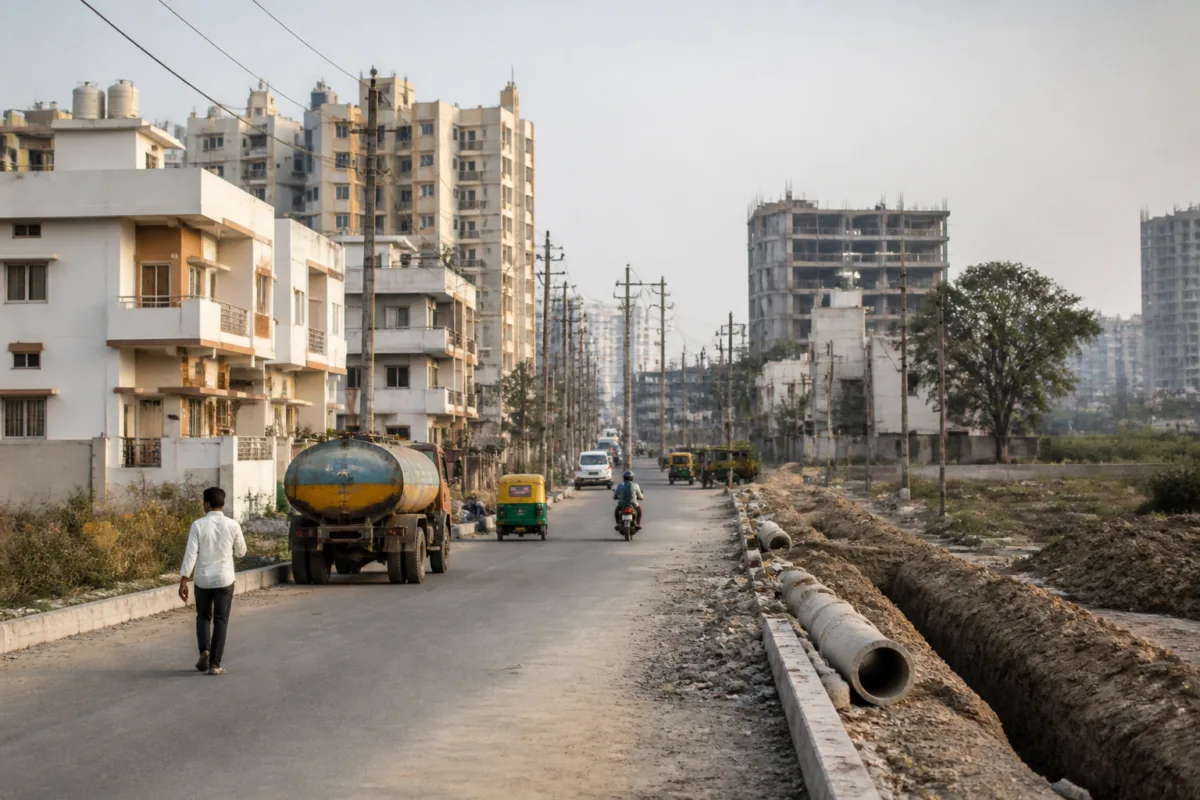
Bengaluru Urban district could have no gram panchayats if the Karnataka government proceeds with a plan to convert its existing panchayats and urban local bodies into multiple municipal corporations. The proposed restructuring would cover areas on the city’s rapidly urbanising periphery, but the boundaries and number of new corporations have not yet been decided.
The Urban Development Department (UDD) is considering the overhaul because much of the 2,196-sq-km district has acquired urban characteristics, according to Deccan Herald. The district currently contains 11 urban local bodies, including Hebbagodi, Madanayakanahalli, Anekal, Bommasandra, Chandapura and Jigani, along with 86 gram panchayats spread from the Yelahanka area in the north to Sarjapur in the south.
Tushar Giri Nath, Additional Chief Secretary of the UDD, told the newspaper that the government’s aim was to have no gram panchayats within Bengaluru Urban district. He said the proposed corporations would be determined on the basis of economics and population, and that the government would wait for Census 2027 data before beginning the restructuring. The Census is scheduled for February and March, according to the report.
The proposed corporations would remain outside the Greater Bengaluru Authority (GBA), which currently oversees five core city corporations across 712 sq km. Giri Nath said the number of corporations under the GBA would remain five, although minor changes to wards and corporation boundaries could be made.
For Bengaluru’s peripheral settlements, the institutional change could affect how roads, water supply, underground drainage, sanitation and property taxation are planned and delivered. The report says the government views municipal corporations as better positioned than panchayats to provide urban services. However, changing the administrative status of an area would not by itself provide the missing infrastructure.
The report also notes that municipalisation could push up real-estate prices even in locations without water connections, underground drainage or adequate road access. Property tax could rise as well. These effects are presented as concerns associated with the proposed upgrade, rather than as confirmed outcomes.
An urban planner quoted anonymously by Deccan Herald said municipalisation should be accompanied by an action plan with deadlines. The planner pointed to the rapid urbanisation of Bengaluru’s peripheral areas and warned that governance should not become more distant from residents. The report also cites the experience of the 110 villages added to the city limits in 2007, where water and sanitary connections were provided only recently.
That experience places implementation at the centre of the current proposal. The key question is not only whether gram panchayats should be replaced, but whether the transition will link new municipal jurisdictions to funded service plans, clear responsibilities and measurable delivery timelines. Since the government has not finalised the boundaries or the number of corporations, the eventual impact on residents and land markets will depend on the details of the restructuring that follows the Census data.

