


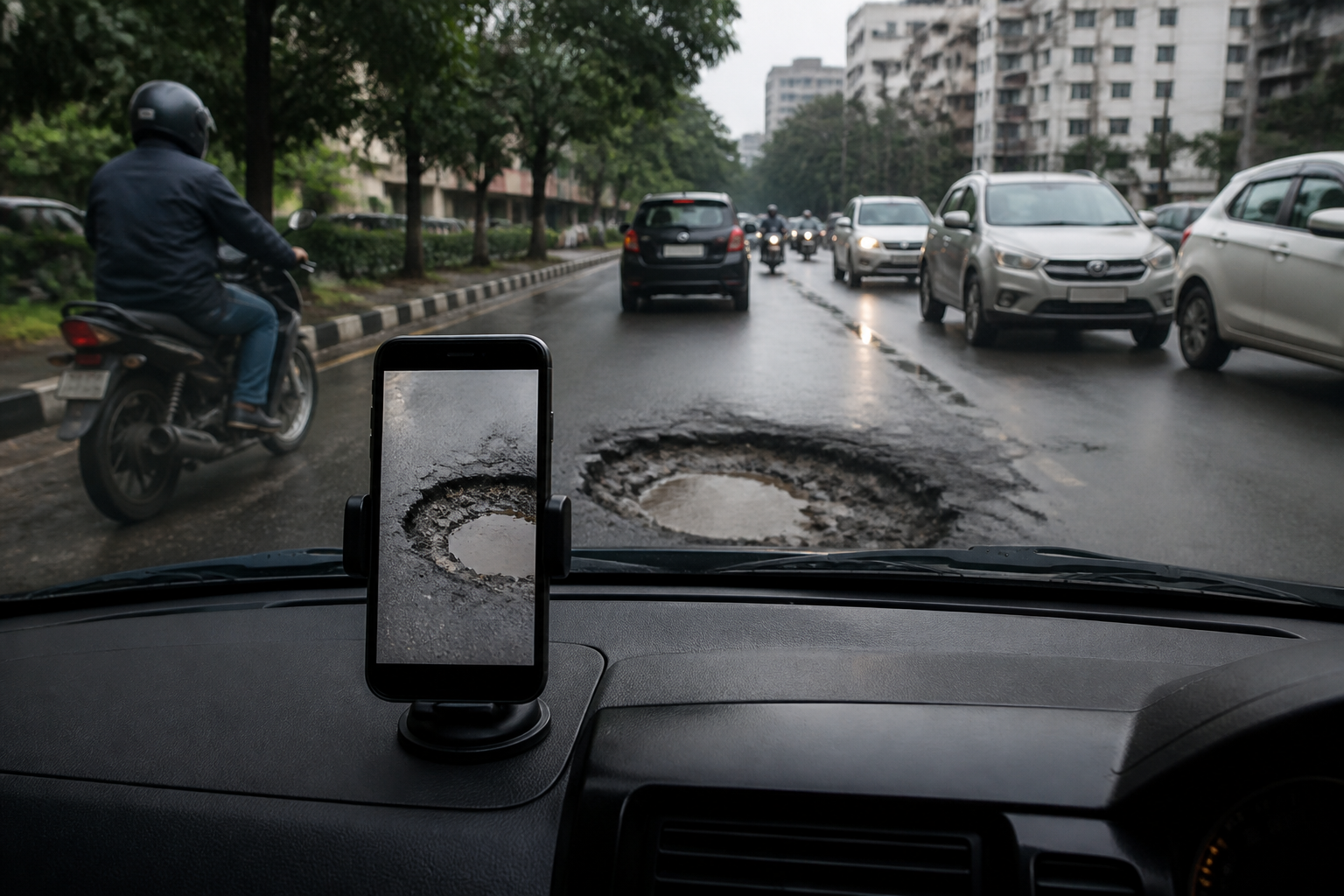
A new Bengaluru pothole reporting app can detect damaged road surfaces, locate them and identify the contractor responsible using public tender data. But its more important revelation is not the speed of the technology. It is the weakness of the civic system that such technology must navigate before a complaint can become a repair.
Pothole Reporter was built by Gaurav Sen, a 33-year-old entrepreneur who runs AI Engg and InterviewReady, after repeatedly encountering damaged stretches while travelling between his offices and home. On one routine drive from Cunningham Road to HSR Layout, he counted 12 potholes. Sen said his regular routes contained clusters of potholes, with one of two available routes particularly poor.
The app is designed to turn an ordinary drive into a structured complaint. A phone mounted on a dashboard, a dashcam or another video source records the road. When the system detects a pothole, it geolocates the damage, checks public road-tender data to identify the contractor responsible and prepares an email to the Greater Bengaluru Authority commissioner with images and related details. The user can send the complaint with a single click.
That workflow addresses several weaknesses in conventional civic reporting. A complaint is more useful when it records the exact location, includes visual evidence and identifies the institutional or contractual responsibility for the road. It also reduces the amount of information a resident must collect manually. Sen said the app is about 10 MB and that its initial version was set up in a few hours with the help of OpenAI’s Codex, followed by several days of manual review and adjustments to the generated code.
The app’s design, however, also reveals the limits of automation in municipal administration. Detection is only the first step. The complaint must reach the correct authority, enter an official workflow, be assigned to an accountable agency or contractor, and result in a repair that is checked on the ground. If those links are absent, a technically sophisticated reporting tool can simply produce more emails for a system that already struggles to close complaints.
Sen’s own experience illustrates that concern. He said an email sent in mid-August had still not been resolved when he spoke to The Indian Express. He also questioned whether reports sent by email would be read if the app could not obtain direct API access to the authorities’ systems. Without such integration, he said, the app could become another platform that generates complaints without creating action.
This is the central institutional question raised by Pothole Reporter: who owns the complaint after it is submitted? A pothole is visible to the road user, but responsibility for fixing it may depend on the road agency, the tender under which it was built or maintained, the contractor assigned to the work and the municipal system that records and verifies the response. The app attempts to make one part of that chain visible by connecting road damage to public tender data. It cannot, by itself, compel the chain to act.
Bengaluru’s road problem is also a safety issue rather than merely a maintenance inconvenience. The Indian Express report cited the recent death of a woman in Ananth Nagar near Hebbagoddi after the two-wheeler on which she was travelling as a pillion rider skidded and a mini goods vehicle ran over her. Residents who protested afterwards pointed to poor road conditions and the absence of safe alternatives. Sen also described an accident involving his mother-in-law, whose two-wheeler fell on an oil-slick road and caused a serious knee injury.
For two-wheeler users, the risk is shaped by the entire road environment. A pothole may become more dangerous when a rider has limited room to avoid it because of a truck on one side and a divider on the other. That makes road-surface defects part of a wider mobility problem involving traffic density, road design and the lack of safe alternatives. The app can document the defect, but the safety consequence is experienced in seconds by a person navigating a crowded corridor.
Sen’s account also places Bengaluru within a familiar urban pattern. He had previously lived in Mumbai and said that Bengaluru was comparable to Mumbai in the seriousness of its pothole problem, although he had encountered worse roads in some tier-two and tier-three cities. The comparison is not a statistical ranking; it is a user’s assessment shaped by daily travel. Its importance lies in showing how road quality becomes part of a city’s identity when residents repeatedly encounter the same failures across different routes.
The reporting problem is not new. Sen recalled that an app had been created during the Covid period to report potholes, but he did not know what happened to it. He said government reporting platforms exist, including the BBMP Sahaya app, but described the process as difficult because users must enter multiple details. A more user-friendly version is planned, he said, but it is not yet a reality.
This history matters because civic technology often fails through discontinuity rather than lack of ideas. A reporting app may be launched, attract early attention and then lose public trust if users do not receive a clear response. Residents are unlikely to repeatedly photograph and report road defects when complaints are closed without visible repairs. Sen said people become exhausted when they perform what they see as a civic duty and receive nothing in return.
That exhaustion is a governance problem. Public reporting systems depend on participation, but participation depends on credibility. A resident needs to believe that submitting a complaint will do more than create a record. The system must communicate what happened to the complaint, who is responsible, what action was taken and whether the road was actually repaired. The source material does not establish that Bengaluru’s existing systems provide all of those functions consistently. It does show that Sen is concerned complaints may be closed on platforms without the pothole being fixed.
Pothole Reporter’s use of public tender data points to another important issue: municipal accountability is often difficult for residents to see. People encounter roads as continuous public spaces, while administrative responsibility may be divided across contracts and agencies. A tool that links a pothole to the relevant contractor can reduce that opacity. It may also make complaints more precise by shifting them from general descriptions of bad roads to specific locations and contractual responsibilities.
But contractor identification is not equivalent to contractor accountability. The app can use available tender information to prepare a complaint, yet the authority must still determine whether the data is current, whether the contractor remains responsible, whether the defect falls within the contract and what remedy is required. Those administrative decisions remain outside the app’s control. The system’s effectiveness therefore depends on the quality and accessibility of government data as well as the response mechanism that receives it.
Sen said senior figures from several municipalities and some politicians had contacted him about the app. That interest suggests that the problem is recognisable beyond his own commute. Yet he also made a distinction that is crucial for civic technology: interest is not action. A municipality can express support for a tool without integrating it into the official complaint, inspection and repair process.
The app is currently available on GitHub, and Sen is working to get it approved for the Android app store. Its future reach will depend partly on whether residents can install and use it easily. But adoption alone will not solve the underlying problem. A more efficient intake channel could increase the volume of complaints without increasing the capacity to inspect and repair roads. In that situation, technology may improve visibility while making institutional failure more measurable.
The better test is not how accurately Pothole Reporter detects a pothole. It is whether a detected pothole can be tracked from evidence to responsibility, repair and verification. That requires a functioning connection with the Greater Bengaluru Authority and other relevant road agencies, along with a process that does not treat complaint closure as proof of physical work.
Bengaluru’s experience shows why urban technology should be judged by the administrative system around it. Artificial intelligence can identify a road defect, geolocation can place it on a map and public tender records can point towards responsibility. None of these steps replaces inspection, maintenance funding, contract enforcement or a reliable public response. The app makes the first part of the problem easier to see. The unresolved question is whether the city’s institutions can turn that visibility into safer roads.
For now, Pothole Reporter remains a citizen-built intervention responding to a gap between what residents experience and what official systems can process. Its Android approval, possible API access and the authorities’ response to submitted complaints are the next developments to watch. Those outcomes will determine whether the app becomes a useful civic layer or another reporting channel that citizens eventually stop using.
