


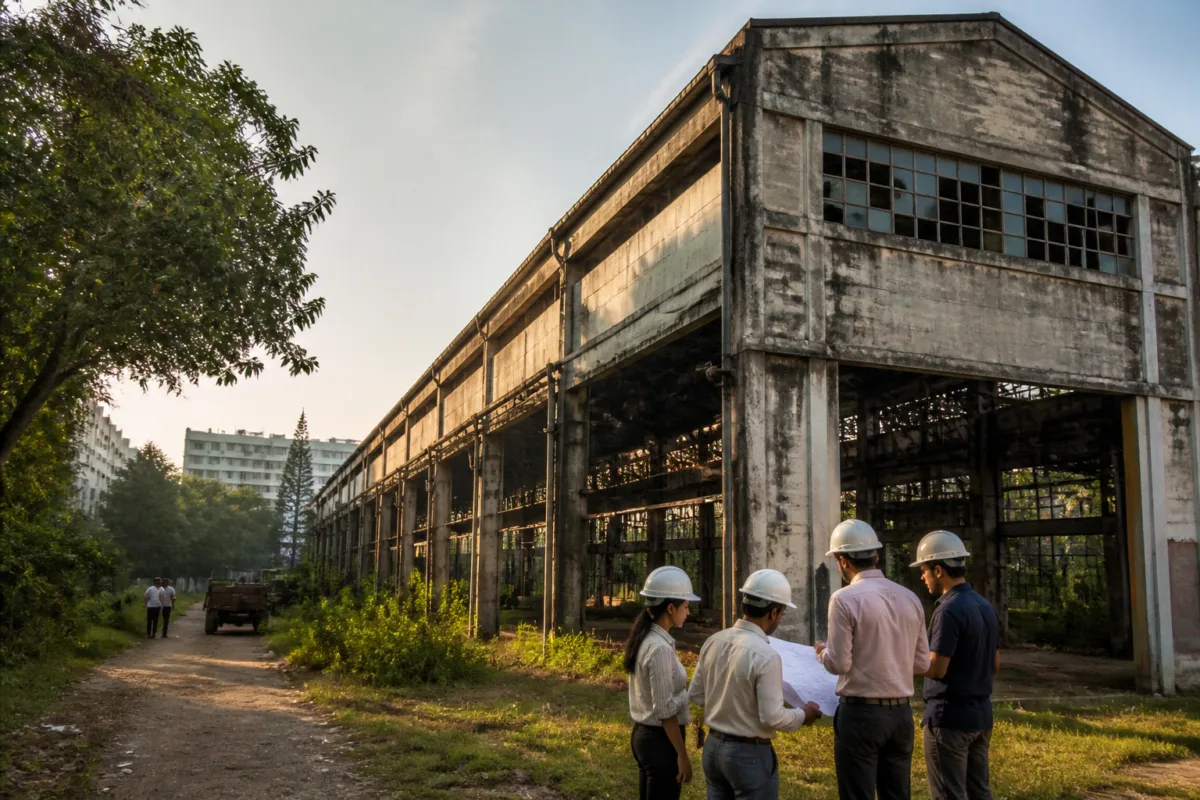
Bengaluru’s disused NGEF switchgear factory is set to be transformed into the Museum of Innovation, Startup and Technology (MIST), a public-private project intended to document India’s technological and entrepreneurial journey while reusing an industrial structure.
The architectural model for the museum was unveiled at the Bengaluru Tech Summit 2026. The first phase of the project at the NGEF premises in Baiyappanahalli is expected to become operational in 2028, according to the project announcement reported by the Times of India.
MIST is being developed through a public-private partnership between UnboxingBLR, which will hold a 51% stake, and the Karnataka government, which will hold 49% through the Karnataka Technology Innovation Museum Foundation (KTIMF).
The design was selected through a two-stage global competition launched in January 2026. The process attracted 13 consortiums comprising 30 Indian and international firms. The selected consortium is led by Heneghan Peng Architects, the firm behind Cairo’s Grand Egyptian Museum.
The museum will occupy a disused switchgear factory shed on the 105-acre NGEF campus. The structure, which project members said ceased operations in 2001, covers 10,061 square metres. The planned development will expand to nearly 24,000 square metres, with around 12,325 square metres allocated to the museum.
The proposal is centred on adaptive reuse rather than replacing the factory with a new building. Project members said the existing structure will be retained, while its facade and interiors will be reworked. They also said the architects were instructed not to cut any trees on the campus.
The NGEF site has 65 acres of green cover. According to Manjula N, secretary in Karnataka’s Department of Information Technology and Biotechnology, Science and Technology, the project is intended to combine the campus’s industrial heritage and urban forest with a new public institution.
The design is guided by the concepts of “forests and machines” and “expansion and disruption”. The first reflects the relationship between the campus’s greenery and its industrial past. The second refers to galleries that are intended to change periodically through dimmed exhibits and projection mapping, according to the project team.
The museum’s proposed content will cover Indian innovation since 1947, including aerospace, healthcare, consumer products, edtech, energy, telecommunications, artificial intelligence and other fields. Its themes will include digital public infrastructure, biotechnology, space, startups, AI and deep technology.
The project team said the museum would display prototypes and early designs associated with technologies such as electric vehicles and mobile phones. It is also intended to function as an educational and cultural space for students, researchers and the wider public, with interactive, experiential and gamified exhibits rather than a conventional press-a-button museum format.
Prashanth Prakash, chairperson of KTIMF and UnboxingBLR, said the project would turn the historic NGEF factory shed into a museum focused on modern innovation, technology and entrepreneurship. He also invited the wider innovation ecosystem to help shape the institution.
The proposal places Bengaluru’s industrial property and technology narratives within the same public project. Its stated approach also makes the treatment of the existing building and campus a central part of the museum’s identity, rather than treating the site only as land for a new cultural facility. The project’s delivery, public access and final exhibition programme remain to be established as work progresses.

