


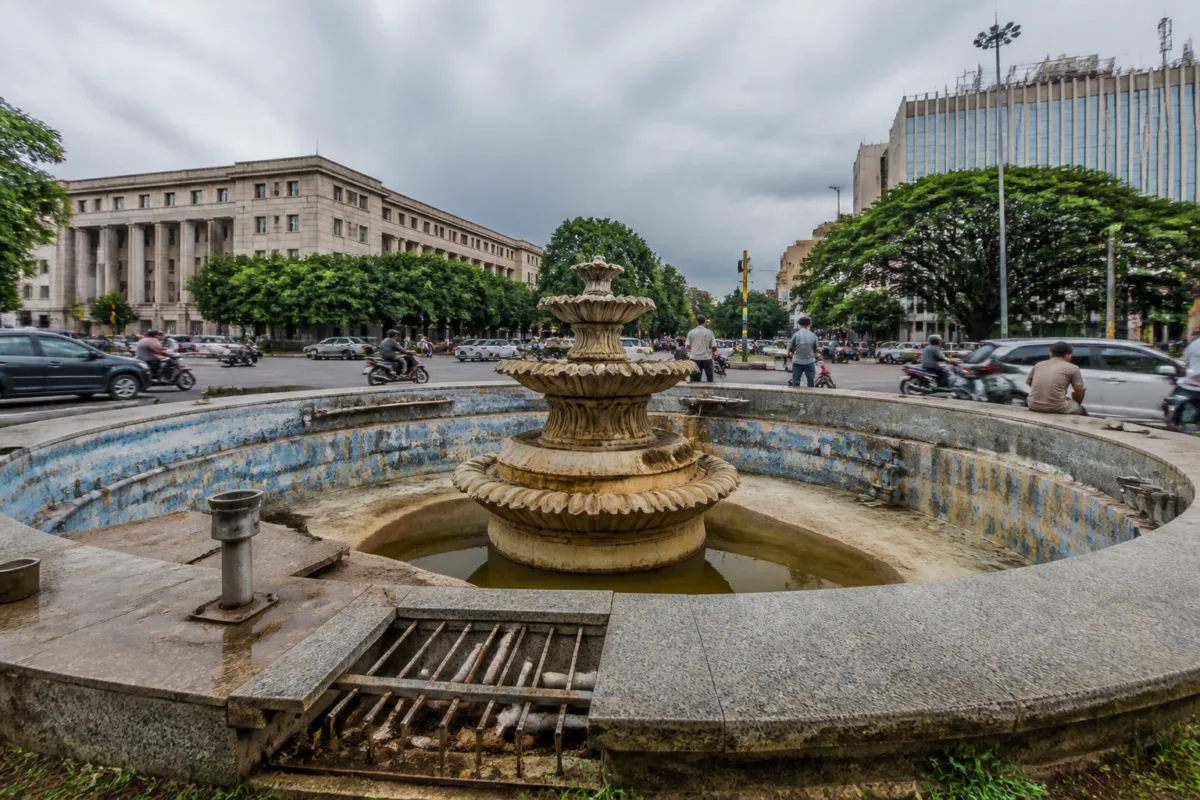
The decline of Bengaluru’s KR Circle fountain is not simply a story about a broken water feature. It is a record of what happens when a public-space project receives attention at the construction and inauguration stages but loses visibility during the years of routine maintenance that follow. Installed as part of the Rs 2.50-crore KR Junction development and inaugurated in November 2021, the fountain was reportedly dysfunctional within a year. More than three-and-a-half years later, it remains surrounded by broken or missing ornamental lights, a stagnant pool and unprotected drain gratings.
The condition, reported by Bangalore Mirror, raises a basic question about urban infrastructure in Bengaluru: who is responsible for ensuring that a publicly visible civic asset continues to function after the project is completed? The answer appears to involve more than one institution. The Bengaluru Central City Corporation’s executive engineer for Shivajinagar told the publication that the fountain is maintained by a private company and that he would speak to those responsible for its upkeep. That response points to an operational arrangement, but it does not by itself establish how performance is monitored, how often inspections take place or what happens when maintenance fails.
This distinction matters because the KR Circle project was not an isolated decorative object placed outside the city’s administrative system. It formed part of a larger junction development intended to improve the appearance and experience of a prominent public space. A project of that kind involves public money, physical equipment, electrical systems, water circulation, lighting, drainage and safety. Its success therefore cannot be measured only by whether the fountain was completed or inaugurated. It must also be measured by whether the asset remains usable, safe and visually coherent over time.
According to the report, the fountain became dysfunctional about a year after its inauguration. Since then, the feature has reportedly contained no functioning water display, apart from a dirty pool that has stagnated in one corner. Most light stands around it are described as missing or defunct. Drain gratings next to the fountain lack security, creating a separate concern about the protection of installed equipment and the safety of people moving through the area.
These are different kinds of failure, even if they are visible in the same location. The fountain’s inability to operate suggests a breakdown in equipment maintenance or in the systems required to keep it running. Missing and broken lights point to failures in repair, replacement or protection. Unsecured drain gratings raise questions about public safety and asset security. Treating all of these problems as a general issue of “beautification” risks hiding the separate contracts, responsibilities and inspection routines needed to address them.
A pedestrian quoted by Bangalore Mirror questioned why authorities were failing to maintain the space after spending a substantial amount on the KR Circle development. Another pedestrian said measures were needed to protect equipment installed in public places and called for police vigilance against people allegedly responsible for missing light stands and gratings. The comments reflect the ground-level experience of a public project: citizens do not encounter the original tender, design brief or maintenance agreement. They encounter the condition of the asset while walking through the space.
That experience also changes the meaning of the original investment. A capital project can improve a junction when it is new, but visible deterioration can reverse that benefit. Broken lights reduce the intended visual effect and may affect how secure the area feels after dark. A stagnant pool becomes a sign of neglect rather than an amenity. Unprotected gratings make the infrastructure itself a potential hazard. The physical decline is therefore also a decline in public confidence in the city’s ability to look after what it builds.
The KR Circle case illustrates the difference between creating public space and governing public space. Creation is usually concentrated in a defined project period, with a budget, contractor and inauguration date. Maintenance is continuous. It requires recurring expenditure, assigned personnel, inspection records, replacement schedules and a mechanism for responding to complaints. It also requires clarity over whether the municipal authority, a private operator, a contractor or another agency is responsible for each component.
The executive engineer’s statement that a private company maintains the fountain makes that clarity especially important. A private maintenance arrangement can assign day-to-day duties, but the public authority remains the visible institution when the asset deteriorates. The supplied report does not establish the terms of the arrangement, the duration of the contract, the service standards, the payment structure or whether penalties apply for non-performance. It also does not establish whether the ornamental lights and drain gratings fall under the same maintenance responsibility as the fountain.
Without those details, it is difficult for citizens to identify the precise point at which accountability failed. Was the fountain not repaired after the first breakdown? Were replacement parts unavailable? Did the contract cover only periodic cleaning rather than technical repairs? Were the lights stolen, vandalised or left unrepaired? Were inspections conducted and recorded? The report documents the visible outcome, but the administrative chain behind it remains unclear. That is precisely why routine maintenance needs to be treated as a governance function rather than as an afterthought.
Urban strategist Vinod Jacob, also quoted by Bangalore Mirror, said Bengaluru’s public spaces can improve the city’s liveability and charm, but that beautification cannot end with inauguration. He called for regular maintenance, accountability and protection, along with periodic inspections and CCTV cameras where necessary. His comments frame the issue as one of asset stewardship. Whether a public space is created with taxpayer money or through a corporate social responsibility initiative, the public-facing obligation does not end when construction is complete.
This is a particularly important distinction for projects that combine decorative infrastructure with essential urban systems. A fountain may be ornamental, but it still depends on water management, electrical supply, pumps, cleaning and technical servicing. Lighting may be decorative, but it affects the appearance and usability of the surrounding space. Drain gratings may be visually minor, but they form part of basic street safety. Once installed in a public area, these components become part of the city’s everyday operating environment.
The reported timeline is also significant. The fountain was inaugurated in November 2021, became dysfunctional roughly a year later and has remained in poor condition for more than three-and-a-half years. This is not a short-term interruption caused by a recently announced repair. It indicates that the gap between initial failure and corrective action has become the central story. A malfunction that persists for days may be a service problem. One that persists for years becomes an institutional problem.
The cost of the original KR Junction development adds another layer to the question. The Rs 2.50-crore investment represents the cost of creating the project, but the report does not provide the subsequent maintenance expenditure or the cost of restoring the fountain and lights. That missing information is important because low or irregular maintenance spending can make a project appear cheaper at the construction stage while allowing its value to erode later. Conversely, even a well-funded maintenance arrangement can fail if responsibilities are fragmented or inspections are weak.
The case also demonstrates why public-space audits should examine condition rather than merely completion. A project register may record that a fountain was installed, a junction was developed or lights were placed. It may not record whether the fountain operates, whether the lights work, whether the drainage covers are secure or whether citizens can safely use the space at night. Those are the indicators through which residents judge the project, and they are the indicators that determine whether a public investment continues to serve its purpose.
For Bengaluru’s civic administration, the immediate administrative task is straightforward in principle: identify the responsible maintenance company, assess the condition of the fountain and associated infrastructure, secure the drain gratings, restore or replace damaged lighting where required, and communicate the repair timeline. The supplied report records only the executive engineer’s commitment to speak to the private company. It does not record a repair deadline, a completed inspection or a confirmed restoration plan.
That absence leaves the most important questions unresolved. The city has not publicly established, within the material available for this report, who is accountable for the prolonged failure, what maintenance standards were agreed, whether the private company has been directed to act, or how similar public assets are being monitored. These questions are more consequential than the fountain’s appearance alone because they concern how the city protects public investments after the inauguration ceremony is over.
KR Circle therefore offers a small but clear example of a larger urban management challenge. Cities are often judged by the number of projects they announce and complete, but residents experience them through continuity: working lights, safe walkways, clean water features, maintained surfaces and functioning public equipment. The fountain’s deterioration confirms that construction is only the first stage of public infrastructure. What remains uncertain is whether Bengaluru’s authorities will treat its restoration as a one-off repair or use the episode to clarify the maintenance and accountability systems governing the city’s public spaces.

