


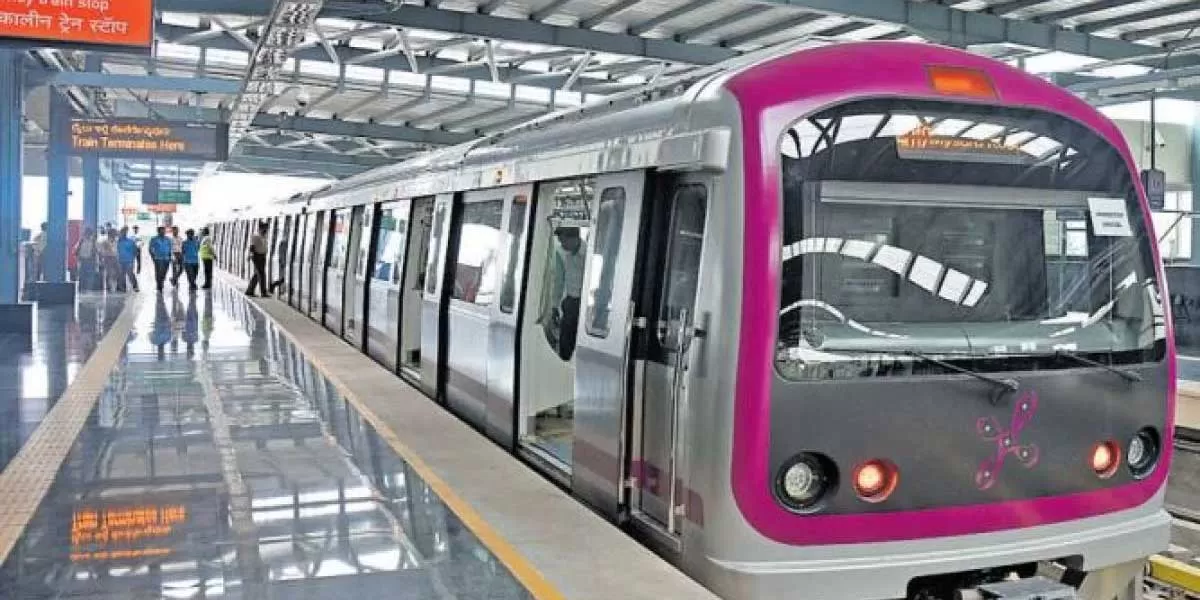
Bengaluru–Tumakuru Metro corridor awaits government approval, urban mobility experts are raising serious concerns about the viability and efficiency of extending a city-centric Metro system to a suburban-industrial belt over 70 kilometres away.
While the project has reached the Detailed Project Report (DPR) stage, experts argue that a high-cost Metro may not serve the mobility needs or commuting patterns of this corridor, and could end up as an underused, resource-draining infrastructure. The 56.6 km elevated Metro corridor, proposed by Bangalore Metro Rail Corporation Limited (BMRCL), intends to connect Madavara on the existing Green Line in Bengaluru to Shira Gate in Tumakuru. The DPR, which has been submitted to the State Government, outlines 25 stations along the stretch, passing through dense commuter zones like Makali, Nelamangala, and Dabaspet. Upon State approval, the plan will be sent to the Central Government for final clearance.
However, transport and urban planning experts argue that the Metro, designed for frequent-stopping urban travel within city limits, is fundamentally mismatched for long-haul, cross-regional transit like the Bengaluru–Tumakuru route. According to transport experts, a Metro’s average operational speed is around 30 km/h due to frequent stops, meaning a journey from Bengaluru to Tumakuru via Metro could take more than two hours. In contrast, the same route could be covered in 60–75 minutes using a suburban or semi-high-speed rail system with limited stops and faster coaches. With thousands of commuters—largely industrial workers and office-goers—making the trip daily, the demand is for a reliable, time-efficient, and seated transit mode, not the stop-and-go experience that Metro systems offer.
Industry insiders warn that the proposed Metro may end up being a “white elephant,” draining public funds without delivering proportional benefits. “The corridor’s travel demand pattern is more aligned with suburban rail services or rapid regional transport systems,” said one senior official familiar with the project analysis. “An extended Metro doesn’t match the comfort and speed commuters require on such long journeys.” Experts have pointed to successful alternatives in other parts of India. Delhi’s Regional Rapid Transit System (RRTS) and Mumbai’s fast and slow suburban rail services offer scalable and commuter-friendly models for intercity connectivity. These systems operate at higher speeds (100–160 km/h) and are designed to provide mostly seated travel with fewer stops—making them a better fit for working-class commuters over long distances.
From a sustainability standpoint, critics of the Metro plan stress that a long-haul Metro project carries significant energy, capital, and environmental costs. Elevated Metro lines not only require intensive construction but also disrupt landscapes, consume large amounts of concrete and steel, and are difficult to integrate with existing regional transport systems. A suburban rail-based solution would be less carbon-intensive, more cost-effective, and more aligned with sustainable urban transport goals. Officials from urban planning institutions believe that the rush to extend Metro lines beyond the city’s natural boundary reflects a flawed understanding of transit hierarchies. They caution against repeating past infrastructure planning mistakes where prestige projects overruled practicality and equity. “Every city wants a Metro, and now every neighbouring town wants to be connected to one. But that mindset overlooks the need for systemic transport planning based on user demand, land use, and socio-economic impact,” said a mobility systems researcher based in Bengaluru.
Moreover, experts point out that Bengaluru already has a suburban rail network under development, which could be expanded and modernised to serve the Tumakuru corridor at a fraction of the cost. “The financial resources for Metro expansion are enormous. If the goal is daily connectivity and climate resilience, investing in better rail integration, signalling upgrades, and more rakes will yield far greater returns for both commuters and the environment,” a senior transportation economist noted. The proposed Metro alignment also raises questions about last-mile connectivity and station integration in Tumakuru, where the urban form is spread out and lacks dense feeder infrastructure. Without robust planning for bus connections, bicycle access, or pedestrian pathways, the Metro may not achieve expected ridership levels, thereby undermining its return on investment.
The pressure to approve and implement big-ticket Metro projects is often politically driven, but city planners argue that infrastructure decisions must be grounded in data and long-term public interest. “This isn’t about opposing the Metro—it’s about finding the right solution for the right corridor,” explained a senior planner at a national-level urban transport institute. The project’s future now rests with the State Government, which must weigh both technical and socio-economic considerations before forwarding the plan to the Centre. Public transport expansion is critical for urban equity and sustainability, but stakeholders emphasise that mode choice is central to achieving those goals.
As Bengaluru’s metropolitan region continues to grow, striking a balance between ambition and appropriateness in transport infrastructure will be key. The conversation around the Tumakuru Metro is not just about one project—it reflects broader questions about how Indian cities can build efficient, inclusive, and climate-resilient mobility systems that truly serve their citizens.
Also Read : Delhi Metro to delay first Yellow Line train from Secretariat
