


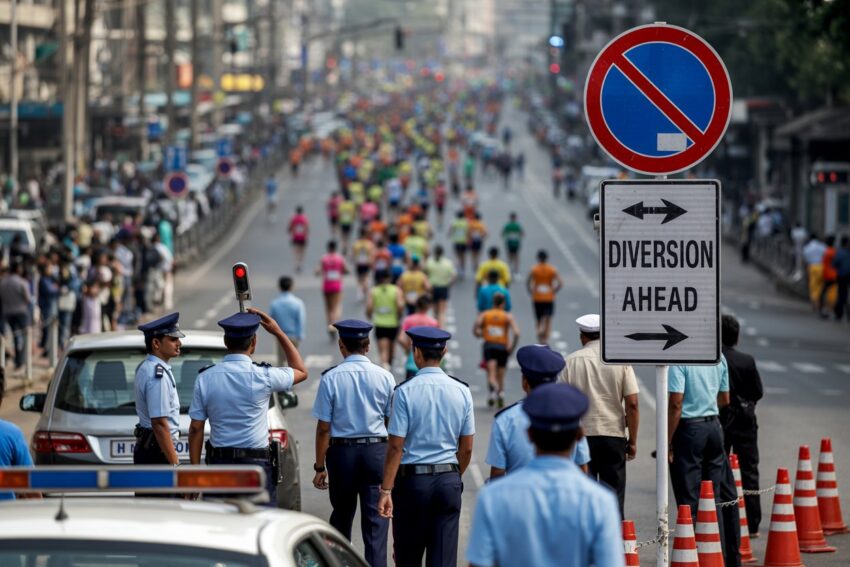
Widespread traffic diversions across Bengaluru for a major city run event are set to disrupt commuter movement, underscoring the challenges of balancing public events with everyday urban mobility in a rapidly expanding metropolis. The restrictions, covering key arterial roads, reflect both the city’s growing event culture and its infrastructure constraints.
The annual TCS World 10K Bengaluru has led authorities to implement temporary road closures and route diversions across central and high-density zones. These measures are intended to ensure participant safety and smooth event execution but have significantly altered regular traffic patterns, particularly during peak morning hours.Commuters navigating Bengaluru are expected to face longer travel times and rerouted journeys as traffic is redirected away from event corridors.The impact is especially pronounced in areas with limited alternative routes, where congestion can quickly build up.Public transport services are also likely to experience increased demand as residents seek more predictable travel options.Urban mobility experts note that such disruptions highlight structural limitations in the city’s transport network. Bengaluru’s road infrastructure, already operating under heavy load, often lacks the redundancy needed to absorb sudden diversions. This makes planning and communication critical to minimise inconvenience during large-scale events.
While city runs and similar events contribute to public engagement, health awareness, and urban branding, they also require careful integration with mobility planning. Experts suggest that staggered closures, improved signage, and real-time traffic updates can help reduce the impact on daily commuters.Encouraging the use of public transport and flexible work timings are also commonly recommended strategies.The environmental dimension of such events is another factor. Traffic diversions can lead to increased fuel consumption and emissions due to longer travel routes and idling vehicles.However, promoting non-motorised participation and minimising unnecessary vehicular movement can help offset some of these effects.From a governance perspective, the situation underscores the importance of coordinated urban management. Integrating event planning with traffic systems, emergency services, and digital navigation platforms can improve overall efficiency. Cities with advanced traffic management systems often use data-driven approaches to dynamically adjust signals and reroute vehicles in real time.As Bengaluru continues to host large-scale public events, the need for resilient and adaptable infrastructure becomes more evident.
Balancing civic activities with mobility efficiency will be key to maintaining liveability in a city experiencing rapid growth.Once the event concludes, normal traffic conditions are expected to resume. However, the experience offers valuable insights into how Bengaluru can better manage the intersection of public gatherings and urban transport demands in the future.
Also Read:Bengaluru Banashankari Dug Up Roads Disrupt Residents
